
Why Your Partnership Needs the Right W9 Form in 2025

A W9 form for partnership is an IRS document that partnerships use to provide their Taxpayer Identification Number (TIN) and certification to entities that need to report payments made to them. If you’re filling one out for your partnership, here’s what you need to know:
Quick Answer: Key Things to Check on Your Partnership W9
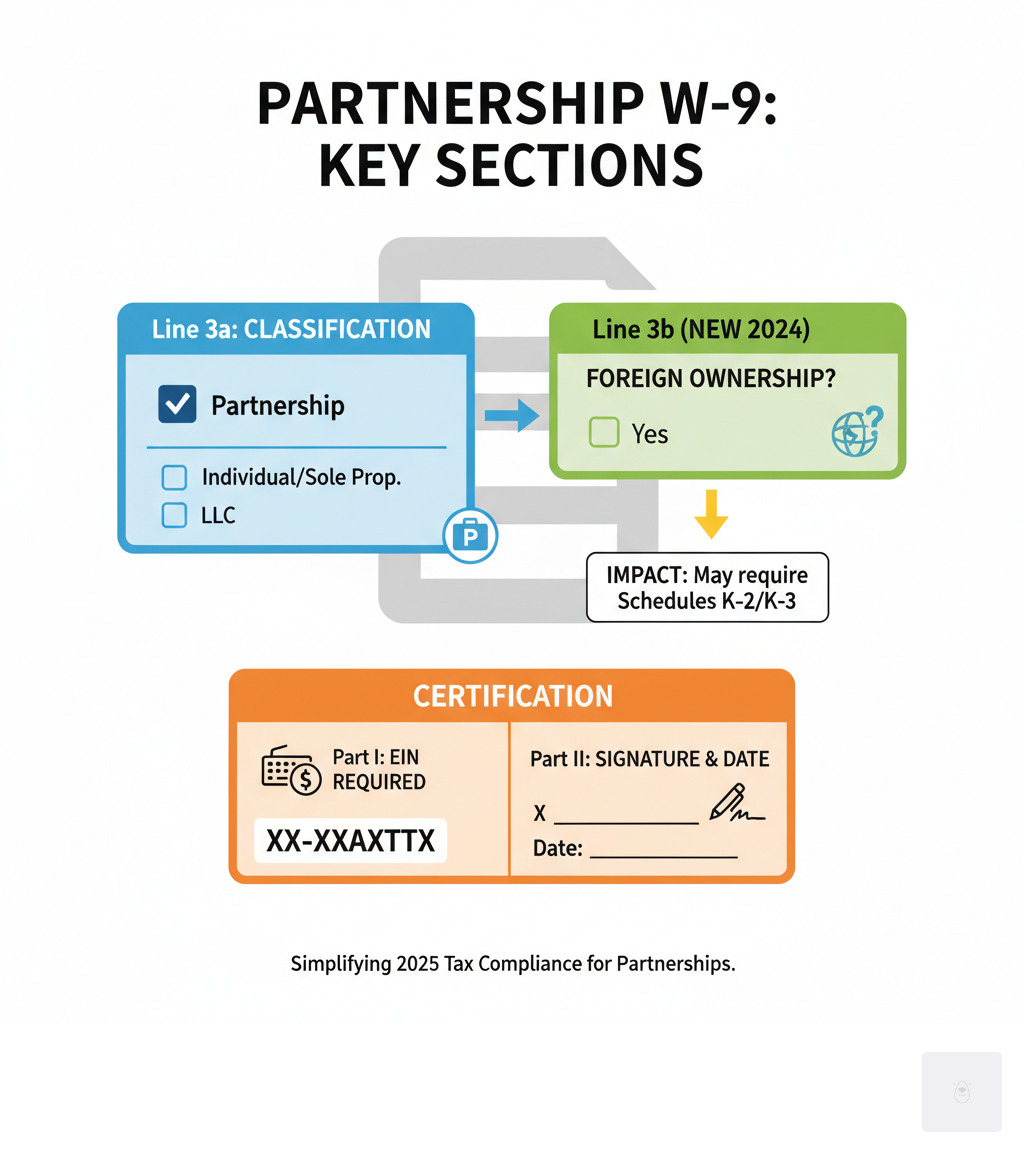
- Line 1: Enter your partnership’s full legal name as it appears on your tax return
- Line 3a: Check the “Partnership” box (or “LLC” box with “P” if you’re an LLC taxed as a partnership)
- Line 3b (NEW as of March 2024): Check this box if your partnership has any foreign partners, owners, or beneficiaries when providing the form to another partnership, trust, or estate you have an interest in
- Part I: Provide your partnership’s Employer Identification Number (EIN)
- Part II: Sign and date the certification under penalties of perjury
The IRS updated Form W-9 in March 2024, and the biggest change affects partnerships directly. The new Line 3b requires partnerships (including LLCs classified as partnerships) to indicate whether they have any foreign partners, owners, or beneficiaries. This seemingly small checkbox has major implications for tax reporting requirements, particularly for Schedules K-2 and K-3.
Why does this matter? Without the new Line 3b disclosure, lower-tier partnerships would have no way of determining whether their direct partners meet the domestic ownership requirements needed to qualify for certain filing exceptions. If you check Line 3b, your partnership will likely need to file Schedules K-2 and K-3, which report items of international tax relevance.
I’m Haiko de Poel, and throughout my career working with businesses on compliance and digital solutions, I’ve helped countless partnerships steer the complexities of the W9 form for partnership requirements. Getting this form right the first time saves headaches during tax season.
Understanding the W-9 and the Critical March 2024 Update for Partnerships
If you’ve ever wondered why that little W-9 form seems to show up everywhere in business, here’s the deal: Form W-9, officially titled “Request for Taxpayer Identification Number and Certification,” is one of the most important documents in the U.S. tax system. It’s the IRS’s way of making sure every dollar paid gets properly tracked and reported.
When your partnership receives payments from clients or other businesses, they need your Taxpayer Identification Number (TIN) to report those payments to the IRS. For partnerships, this is almost always your Employer Identification Number (EIN). The W-9 is how you officially provide that information, along with your certification that everything you’re telling them is accurate.
Here’s why getting this right matters: if you don’t provide a proper W-9, the company paying you might be required to implement something called backup withholding. That means they’ll automatically deduct 24% from every payment they make to you and send it directly to the IRS. Nobody wants to lose a quarter of their income to an avoidable withholding situation!
The Game-Changing March 2024 Revision
Tax forms don’t usually make headlines, but the March 2024 revision of Form W-9 introduced something that partnerships really need to pay attention to. The IRS added a new Line 3b that specifically targets flow-through entities like partnerships, trusts, estates, and LLCs classified as partnerships.
This new line asks a straightforward but crucial question: does your partnership have any foreign partners, owners, or beneficiaries? You only need to check this box when you’re providing the W-9 to another partnership, trust, or estate that you have an ownership interest in. It might seem like a small checkbox, but it has significant implications for your tax reporting obligations.
Why did the IRS add this? It’s all about improving transparency around international tax reporting. The agency needed a way for lower-tier partnerships to know whether their direct partners meet certain domestic ownership requirements. Without this information, it was nearly impossible to determine whether they qualified for certain filing exceptions related to Schedules K-2 and K-3—the forms used to report items of international tax relevance.
Think of Line 3b as an early warning system. When a partnership checks that box, it signals to any partnership they’re invested in that foreign reporting requirements will likely apply. This helps everyone in the ownership chain understand their filing obligations before tax season arrives.

The bottom line? If your partnership has any foreign ownership—even just one foreign partner—and you’re providing a W9 form for partnership to another flow-through entity, you’ll need to check Line 3b. This seemingly simple disclosure helps the entire partnership structure stay compliant with IRS requirements.
Getting your partnership’s W-9 right the first time saves you from headaches down the road. If you’re ready to complete your form with confidence, we’ve made the process simple and secure.
Start filling your W9 now at https://fillablew9.com/apply
How to Complete the W9 Form for Partnership: A Step-by-Step Guide
Getting your W9 form for partnership right doesn’t have to be complicated. Think of it as telling your story to the IRS—who you are, where you operate, and how you’re structured. The key is accuracy and attention to a few critical details that are unique to partnerships. Let’s walk through this together, line by line, so you can complete your form with confidence.
Filling Out Your Partnership’s Basic Information (Lines 1-6)
The top section of the W-9 is all about establishing your partnership’s identity. It’s like introducing yourself at a business meeting—you want to be clear, accurate, and consistent with how you present yourself everywhere else.
Line 1 is where you’ll enter your partnership’s full legal name, exactly as it appears on your federal tax return. This isn’t the time to get creative or use abbreviations. If your partnership is formally registered as “Smith & Johnson Investment Partners, LP,” that’s what goes here. For LLCs classified as partnerships, you’ll use your LLC’s official legal name.
Line 2 asks for your business name if it’s different from Line 1. Most partnerships will find that Lines 1 and 2 are identical, but if your partnership operates under a trade name or DBA (Doing Business As), this is where you’d note that. For example, if “Smith & Johnson Investment Partners, LP” does business as “SJ Capital,” you’d put the DBA here. If you’re not using a different business name, you can leave this line blank or simply repeat Line 1.
Line 3a is where things get important for partnerships. You need to check the box that reflects your federal tax classification. If you’re a traditional partnership, you’ll check the “Partnership” box—straightforward enough. If you’re an LLC that has elected to be taxed as a partnership (which is common), you’ll check the “Limited liability company” box and then write “P” in the space provided. That “P” is crucial—it tells the IRS and the requester that your LLC should be treated as a partnership for tax purposes.
Line 4 deals with exemption codes, and here’s the good news: most partnerships can skip right past this one. This section applies to certain entities that are exempt from backup withholding or FATCA reporting requirements. Unless your tax advisor has specifically told you that your partnership qualifies for an exemption code, leave this line blank.
Lines 5 and 6 are straightforward—just provide your partnership’s complete mailing address. Use your primary business address, the one where you’d want to receive any tax forms or correspondence. Make sure the city, state, and ZIP code are accurate, because this is where any 1099 forms or other important documents will be sent.

The New Line 3b: A Crucial Check for Your W9 Form for Partnership
Here’s where the March 2024 update really matters for partnerships. Line 3b is brand new, and it’s specifically designed to capture information about foreign ownership in your partnership.
The question Line 3b asks is very specific: if you checked “Partnership” or “Trust/estate” on Line 3a (or “LLC” with “P”), and you’re providing this W-9 to another partnership, trust, or estate in which you have an ownership interest, you need to check this box if you have any foreign partners, owners, or beneficiaries.
Let’s break down when you’d actually check this box, because all four of these conditions need to be true. First, you’ve indicated on Line 3a that you’re a partnership or LLC taxed as a partnership. Second, you’re giving this completed W-9 to another partnership, trust, or estate—not to a corporation or individual client. Third, your partnership actually owns a piece of that other entity. And fourth, your own partnership has at least one partner who is foreign.
This might seem like a narrow set of circumstances, but it’s incredibly important for what tax professionals call “lower-tier partnerships.” When a partnership receives your W-9 and sees that Line 3b is checked, they immediately know they can’t qualify for certain exceptions to filing Schedules K-2 and K-3. Without this disclosure, they’d have no way of knowing whether their partners have foreign ownership, which could lead to compliance issues down the road. It’s the IRS’s way of creating transparency in partnership structures that have international connections.
Certifying Your W9 Form for Partnership (Part I & Part II)
Once you’ve completed all the identifying information, you’re ready for the certification sections—where you confirm your partnership’s Taxpayer Identification Number and make a formal declaration about the accuracy of everything you’ve provided.
Part I is where you’ll enter your partnership’s Employer Identification Number (EIN). Nearly every partnership has an EIN, which is a nine-digit number the IRS assigns to identify your business entity. It typically looks something like 12-3456789. If you’ve applied for an EIN but haven’t received it yet, you can write “Applied For” in this space, but be aware that the requester may need to start backup withholding at 24% until you provide a valid number. That’s a strong incentive to get your EIN sorted out before submitting your W-9.
Part II is your certification, and this is where things get official. By signing this section, you’re making several important statements under penalties of perjury. You’re certifying that the TIN you provided is correct and that it matches the name on Line 1. You’re confirming that you’re not currently subject to backup withholding (unless you’ve been notified otherwise by the IRS, in which case you need to cross out item 2). You’re stating that you are a U.S. person, which for partnerships means you’re organized under U.S. law. And you’re verifying that any FATCA codes you’ve entered are accurate.
The signature must come from someone authorized to act on behalf of the partnership—typically a general partner or a member-manager if you’re an LLC. This isn’t just a formality; it’s a legal certification that carries real consequences if the information turns out to be false.
Don’t waste time with paper forms — complete your secure W9 online at https://fillablew9.com/apply
Why Line 3b Matters: Schedules K-2, K-3, and Foreign Reporting Explained
The introduction of Line 3b on the W9 form for partnership isn’t just bureaucratic box-ticking—it’s a strategic move by the IRS to bring clarity and enforcement to international tax reporting. This seemingly small checkbox has real consequences for partnerships when it comes to Schedules K-2 and K-3.
Think of Schedules K-2 and K-3 as the IRS’s way of tracking international tax items that flow through partnerships. Schedule K-2 (Form 1065) is where partnerships report items of international tax relevance from their operations—things like foreign tax credits, foreign-source income, and other cross-border activities. Then, Schedule K-3 (Form 1065) gets issued to each partner, showing their individual share of these international tax items. This allows partners to correctly complete their own U.S. tax returns with the right foreign tax information.
The IRS’s broader objective with these new foreign ownership reporting requirements is pretty straightforward: they want a clearer picture of foreign ownership within U.S. pass-through entities. Better visibility means better compliance with U.S. tax laws and international tax agreements. It’s all about closing information gaps.
Now, here’s the good news for many domestic partnerships: you might not need to file Schedules K-2 and K-3 at all. The IRS provides an exception for domestic partnerships that meet all four of these criteria:
- No Foreign Activity: The partnership has no foreign source income, hasn’t paid or accrued foreign taxes, and doesn’t own foreign assets that generate passive income.
- U.S. Person Partners Only: All of the partnership’s direct partners are U.S. persons with no foreign partners, owners, or beneficiaries lurking in their ownership structure.
- Partner Notification: The partnership notifies its partners that they won’t receive a Schedule K-3 unless they specifically request one.
- No Partner Request: The partnership doesn’t receive a request for a Schedule K-3 from any partner by one month before the tax return due date (without extension).
Here’s where Line 3b becomes absolutely critical. Let’s say you’re a “lower-tier” partnership—meaning you have other partnerships as partners. Without the disclosure from Line 3b, you’d have no way of knowing whether those partner partnerships meet that second criterion about being U.S. persons with no foreign ownership. You’d be flying blind when trying to determine if you qualify for the domestic partnership exception.
When your partner partnership checks Line 3b on their W9 form for partnership, they’re essentially giving you a heads-up: “We have foreign ownership in our structure, so you probably can’t use the domestic partnership exception.” It’s an early warning system that helps you understand your own reporting obligations before you file your return. If that box is checked, you’ll likely need to file Schedules K-2 and K-3, because you don’t meet the “all U.S. person partners” requirement anymore.
For lower-tier partnerships evaluating their compliance requirements, that little checkbox on Line 3b can be the difference between a straightforward filing and a much more complex one involving international reporting. It’s worth paying close attention to.
Frequently Asked Questions
Navigating tax forms can bring up a lot of questions, especially with new revisions. Let’s address some common concerns about the updated W9 form for partnership.
Do we need to get new W-9s from all our existing partners and vendors?
Here’s some welcome news: you generally don’t need to chase down everyone for a new form. I know the thought of collecting fresh W-9s from dozens (or hundreds) of partners and vendors can feel overwhelming, especially when you’re already juggling a million other things.
The IRS has clarified that previously collected W-9 forms remain valid and don’t expire simply because a new revision came out in March 2024. Your existing W-9s are perfectly fine to keep on file as long as the information on them hasn’t changed. Think of it this way: the form itself is just a vehicle for collecting information, and if that information is still accurate, you’re good to go.
That said, if any partner or vendor has experienced a change in their name, address, tax classification, or TIN, then yes, you’d want to request a new W-9 from them. It’s also smart practice to periodically refresh your W-9 collection as part of your regular compliance routine—perhaps every few years or when you notice something seems off.
When should our partnership start using the new March 2024 W-9 form?
The short answer? Start using the new version now for any new W-9 you’re filling out or requesting. Prospectively using the most current form is always the best practice for staying on the right side of IRS compliance.
If your partnership needs to provide a W-9 to another entity going forward, make sure you’re using the March 2024 revision. While some organizations might still accept older versions during a transitional period, why risk any confusion or delays? Download the latest version directly from the IRS website, or better yet, use a secure online solution that’s always up-to-date.
For W-9s you’re collecting from others, it’s perfectly fine to continue accepting the older versions if that’s what partners submit, but you might want to gently encourage them to use the newest form, especially if they’re partnerships themselves who need to address that new Line 3b.
What are the implications if our partnership checks the box on Line 3b?
Checking that little box on Line 3b comes with some significant reporting implications that you’ll want to plan for. When your partnership (or LLC classified as a partnership) checks Line 3b, you’re declaring that your entity has foreign partners, owners, or beneficiaries. This disclosure essentially disqualifies your partnership from the domestic partnership filing exception for Schedules K-2 and K-3.
Here’s what that means in practical terms: your partnership will need to file Schedules K-2 and K-3 with your Form 1065. These schedules require detailed reporting of items of international tax relevance, and they’re considerably more complex than the standard partnership return. You’ll be reporting information about foreign tax credits, foreign-source income, and other international tax items, then providing each partner with their share of this information via Schedule K-3.
The reporting obligations can be time-consuming and may require additional expertise, so if your partnership checks Line 3b, it’s a good idea to budget extra time (and possibly accounting fees) for tax preparation. You might also want to consult with a tax professional who has experience with international tax reporting to ensure you’re capturing everything correctly.
The silver lining? By checking this box honestly and filing the required schedules, you’re helping the entire chain of partnerships maintain IRS compliance, and you’re avoiding any potential penalties for underreporting or failing to disclose foreign ownership.
Securely Complete Your Partnership W-9 in Minutes
Getting your W9 form for partnership right matters—not just for compliance, but for protecting your business from unnecessary penalties and headaches. With the March 2024 update introducing Line 3b, there’s more to consider than ever before. But here’s the good news: it doesn’t have to be complicated or time-consuming.
That’s exactly why we built Fillable W9. We understand that as a partnership owner or manager, your time is valuable. You’re juggling partner relationships, client demands, and day-to-day operations. The last thing you need is to spend hours deciphering tax forms or worrying whether you’ve checked the right boxes.
Our platform takes the guesswork out of completing your W-9. When you use Fillable W9, you’re working with the latest IRS-approved March 2024 form—the one with the critical Line 3b that your partnership needs to get right. Our intuitive interface walks you through each section, explaining what information goes where and why it matters. No more staring at blank lines wondering if you’re about to make a costly mistake.
Form accuracy isn’t just about avoiding errors—it’s about maintaining your partnership’s professional reputation and staying on the right side of IRS compliance. When you complete your W-9 through our secure submission platform, you can trust that your sensitive partnership information is protected with bank-level encryption. We take data security seriously because we know you’re entrusting us with your EIN and other confidential details.
The digital forms era has arrived, and there’s simply no reason to wrestle with paper anymore. Our fillable W9 solution lets you complete, save, and submit your partnership’s W-9 from any device—whether you’re at your desk, working from home, or even reviewing documents on your phone between meetings. You’ll have a professional, accurate form ready to send to requesters in just minutes, not hours.
Think about it: instead of printing, filling out by hand, scanning, and emailing (or worse, faxing), you can handle everything in one smooth digital process. Plus, you’ll have a secure copy stored for your records, ready whenever you need it.
✅ Ready to complete your W9 in minutes? Apply here now