Missing or misfilled W-9s delay payments and can trigger 24% backup withholding. If you’re a freelancer, contractor, or a small business that hires them, getting this one-page form right saves time, stress, and money. Most people can finish it in under 5 minutes once they know what each line means.
Form W-9 isn’t filed with the IRS—it’s given to the requester so they can report your income correctly. You’ll use it to share your legal name, tax classification, and your SSN or EIN. For 2025, the current W-9 version is still the March 2024 revision, and it’s what payers use for 1099 reporting. See the official overview on About Form W‑9. (irs.gov)
Get this done now: Print, type, or e-sign your W‑9, then save a secure PDF you can reuse with future clients.
Before You Start: What a W-9 Is (and Isn’t) in 2025
A W‑9 verifies your identity and tax status—nothing more. It’s how a client collects your Taxpayer Identification Number for 1099 reporting and to determine if backup withholding applies.
You don’t send a W‑9 to the IRS, and it’s not a billing form or a contract. It simply supports accurate 1099‑NEC reporting and helps prevent backup withholding by confirming your TIN.
For the current, fillable form, use the official PDF of Form W‑9 (Rev. March 2024). (irs.gov)
Who Needs a W-9: Freelancers, Independent Contractors, and LLCs
If you get paid as a non-employee, you’ll be asked for a W‑9. Designers, writers, rideshare drivers, consultants, and other independent workers typically provide it before the first payment.
Small businesses request W‑9s from U.S. vendors so they can issue 1099‑NECs at year‑end. Keeping accurate W‑9s on file reduces penalties and TIN‑mismatch notices.
For the IRS’ contractor onboarding basics, see Forms and taxes for independent contractors.
SSN vs EIN on a W-9: Which Should You Use in 2025?
Use an SSN if you’re a sole proprietor without an EIN; use an EIN if you have or want a business identifier. Many independents choose an EIN to avoid sharing their SSN widely.
An EIN is free and instant online. If you formed an LLC or hire contractors, an EIN is a smart move for banking and forms. Just keep your records consistent across invoices and the W‑9.
Apply directly with the IRS—no fees—via Get an employer identification number (EIN).
W-9 for LLCs: Single-Member vs Multi-Member and How to Choose the Right Box
Single‑member LLCs usually list the owner’s name on Line 1 and check the owner’s tax classification, not “LLC.” If the LLC is disregarded, enter the owner’s name on Line 1 and the LLC name on Line 2.
Multi‑member LLCs typically check “LLC” and enter the tax classification (C, S, or P). If you’re a flow‑through entity providing a W‑9 to another flow‑through entity, new Line 3b indicates whether indirect foreign owners exist.
The IRS clarified these points in 2024; see the official Instructions for the Requester of Form W‑9. (irs.gov)
Line-by-Line W-9 Form 2025 Instructions: Name, Business Name, and Federal Tax Classification
Match Line 1 to the TIN you’ll enter. If you enter an SSN, Line 1 should be your personal legal name. If you enter an EIN, Line 1 should show the entity’s legal name. Put trade names on Line 2.
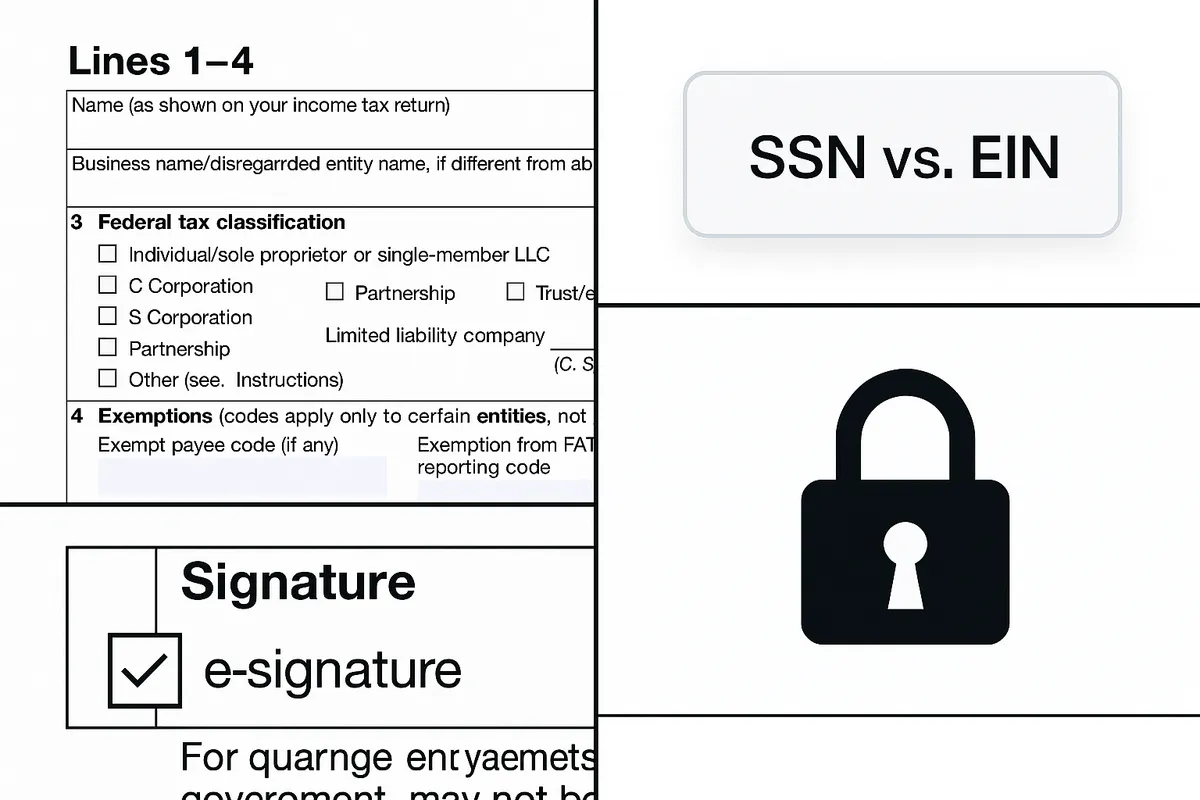
Line 3a is your federal tax classification (individual/sole proprietor, C corp, S corp, partnership, trust/estate, or LLC with C/S/P code). Line 3b is for flow‑through entities reporting indirect foreign owners. Line 4 covers “Exempt payee” and “FATCA” codes—most freelancers leave these blank.
Line 5–6 is your mailing address. Part I is your SSN or EIN. Part II is your signature certifying your TIN and that you’re not subject to backup withholding (unless notified otherwise).
For exact field labels and the latest revision used in 2025, open the official Form W‑9 PDF. (irs.gov)
Quick example that prevents mismatches
If “Alex Rivera” runs “Rivera Design LLC (disregarded),” Line 1 = Alex Rivera, Line 2 = Rivera Design LLC, Line 3a = “Individual/sole proprietor,” and Part I uses Alex’s SSN (unless Alex uses a personal EIN). The client’s 1099‑NEC will list Alex Rivera.
TIN Entry: How to Correctly Enter Your SSN or EIN Without Mistakes
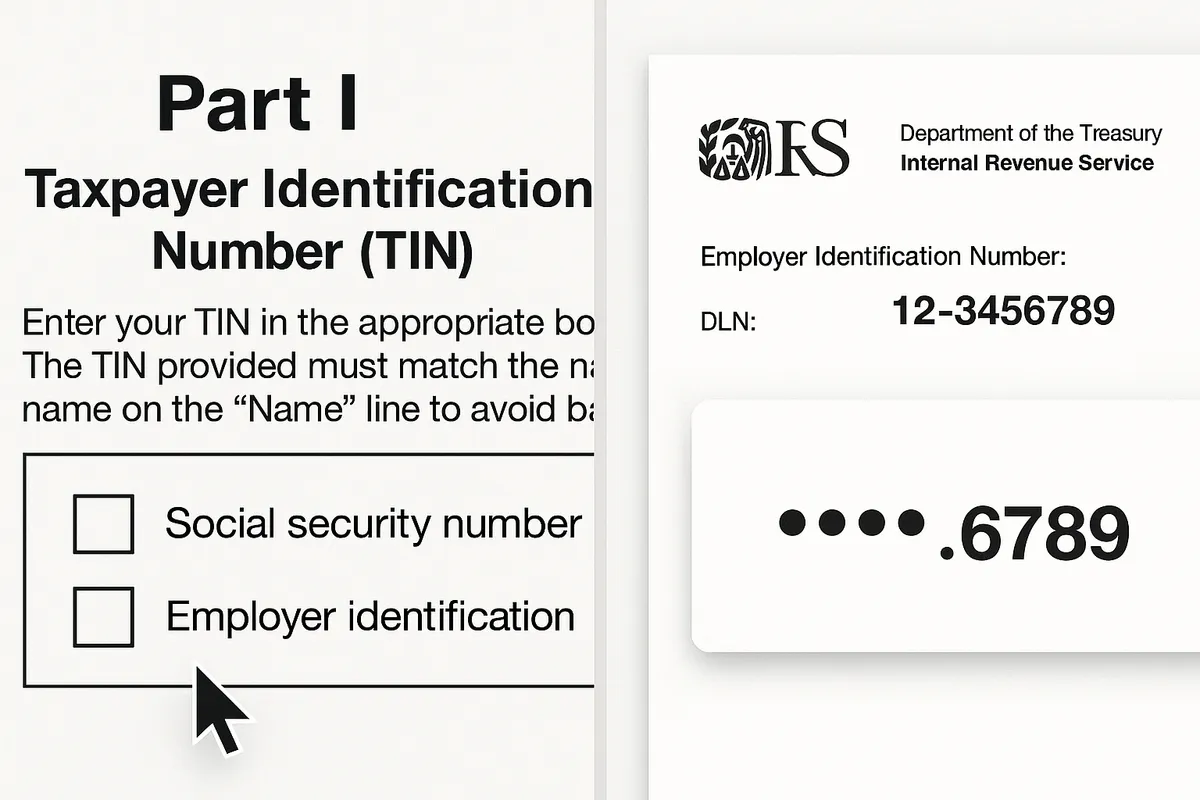
Enter only one TIN—SSN or EIN—formatted with dashes (XXX‑XX‑XXXX or XX‑XXXXXXX). The name on Line 1 must match the IRS records for that TIN.
If you changed your name or entity type, update the IRS first, then submit an updated W‑9 so your payer’s TIN‑match won’t fail. Keep a secure copy of the W‑9 you sent.
Backup Withholding on a W-9: What It Is, When It Applies, and How to Avoid It
Backup withholding is a flat 24% taken from your payments if you don’t provide a correct TIN or the IRS flags underreported interest/dividends. It applies until you fix the issue or the IRS lifts it.
To avoid it, send a complete W‑9 before getting paid, and ensure your Line 1 name matches IRS records for your SSN/EIN. If you get a “B‑notice,” follow the instructions quickly.
Learn when the 24% applies on the IRS page for Backup withholding. (irs.gov)
Real‑world example
A videographer typed the LLC’s name on Line 1 but used a personal SSN. The 1099 TIN‑match failed and payments were withheld at 24% until a corrected W‑9 was submitted.
Address, Exemptions, and FATCA: What to Fill and What to Leave Blank
Use your mailing address where you receive tax forms. If you move, send an updated W‑9 to requesters.
Most U.S. freelancers leave Exemptions blank. FATCA codes generally don’t apply to typical domestic vendor payments; that line is for certain accounts maintained outside the U.S.
For code definitions and when they apply, see the Instructions for the Requester of Form W‑9.
How to Electronically Sign and Submit a W-9: Fillable Online W-9 and e-Sign Tips
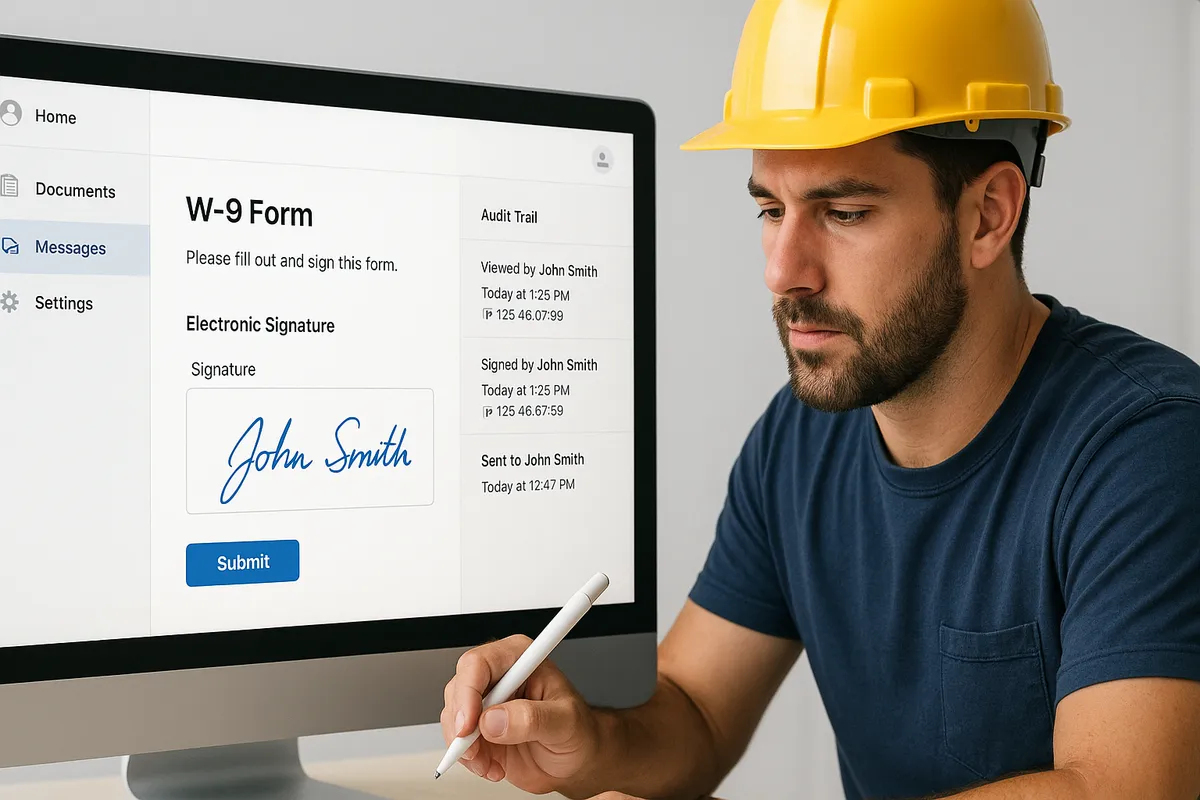
Electronic W‑9s are allowed if the system verifies identity and captures an e‑signature under penalties of perjury. Your requester may provide a secure portal to complete and sign.
If you email a W‑9, send a password‑protected PDF and share the password via a different channel. Prefer secure portals whenever possible to reduce risk.
Requesters must follow the IRS rules for electronic W‑9 collection—review the “Electronic Submission of Forms W‑9” in the W‑9 Requester Instructions. (irs.gov)
What counts as an e‑signature?
A typed name, checkbox, or drawn signature can qualify when the system authenticates the signer and logs access, and the certification text matches the paper form.
Security Best Practices: Safely Sharing Your W-9 with Clients and Platforms
Treat your SSN/EIN like cash—share only through secure channels. Use password‑protected PDFs, encrypted cloud links, or client portals. Avoid sending TINs in plain‑text email or chat.
Limit who can access stored W‑9s, enable MFA on storage apps, and purge old copies. A simple data‑handling policy prevents accidental leaks and keeps client trust high.
For practical, plain‑English data safeguards, follow the FTC’s guide: Protecting Personal Information: A Guide for Business.
Common W-9 Mistakes (and Quick Fixes) for 1099 Filings
Most errors come from name/TIN mismatches or the wrong tax classification. Match Line 1 to the TIN format, and don’t list your DBA as Line 1 if you’re using an SSN.
If a payer gets a CP2100 “B‑notice,” they must solicit a new W‑9. Fix quickly to avoid backup withholding on future payments.
Payers and bookkeepers can spot and prevent errors using the IRS’ 2025 General Instructions for Certain Information Returns. (irs.gov)
W-9 for New LLC Owners and Side Hustlers: First-Time Setup Checklist
If you formed an LLC, decide how it’s taxed before filling your W‑9. Disregarded single‑member LLCs usually put the owner’s name on Line 1 and check the owner’s tax status.
Get an EIN if you want to keep your SSN private or if your bank or platform requires it. Keep your W‑9, EIN letter, and operating agreement in a secure folder.
IRS overview: Single‑member limited liability companies. (irs.gov)

W-9 for Small Business Owners and Hiring Managers: Collecting, Storing, and Staying Compliant
Collect a W‑9 before the first payment and verify details in your vendor record. Standardize naming (exact Line 1), and mask TINs in internal views.
E‑file 1099s if you meet electronic filing requirements, and lock down access to stored W‑9s with role‑based permissions and MFA. Keep W‑9s for at least four years.
To file 1099s for free and stay organized, use the IRS’ IRIS portal: E‑file Forms 1099 with IRIS. Note the 10‑return e‑file threshold in effect for 2025. (irs.gov)
Tight on time? Block one hour to collect W‑9s, verify names/TIN formats, and set calendar reminders for January 31 1099‑NEC filings.
What Happens After You Submit a W-9: 1099-NEC, Payments, and Year-End Steps
Your W‑9 info flows to a 1099‑NEC if payments meet the reporting threshold. Most payers issue 1099‑NECs by January 31 for the prior year’s nonemployee compensation.
Review your 1099‑NEC for name/TIN accuracy and keep it with your records. If something’s off, ask for a corrected form.
See official timing and basics on About Form 1099‑NEC. (irs.gov)

Wrap-Up and Next Steps: Get Your Completed W-9 in Minutes (Download, Fill, e-Sign)
You can finish a W‑9 fast when you match Line 1 to your TIN and select the correct tax classification. Save a secure PDF and reuse it with new clients to speed onboarding.
Confirm whether you’ll use an SSN or EIN, choose the right LLC treatment if applicable, and sign under penalties of perjury. Share only through secure channels.
Download the official form here: Form W‑9 (Rev. March 2024) PDF. Then send a clean, locked copy to the requester and keep your own secure version for records.
FAQs
Do I file a W‑9 with the IRS? No—you give it to the requester. A W‑9 is a request-for-information form used so your payer can report correctly on a 1099. Keep your own copy and send updates if your information changes.
Should I use an SSN or get an EIN for my W‑9? Use an SSN if you don’t have an EIN; get a free EIN if you prefer a business identifier or need one for banking, platforms, or privacy. Keep your records consistent with the number you choose.
What if my name and TIN don’t match? You’ll likely face backup withholding until the mismatch is corrected. Submit a corrected W‑9, and if you receive a “B‑notice,” follow its instructions promptly to stop withholding on future payments.
What does “Exemption from FATCA” mean on Line 4? Most U.S. contractors leave this blank. FATCA codes are for certain entities and accounts maintained outside the U.S., not typical domestic vendor payments.
Can I e‑sign a W‑9? Yes, if the system verifies your identity and captures the perjury statement. Many client portals support compliant e‑sign W‑9s with audit trails; otherwise, use a password‑protected PDF and share the password by a different channel.