
IRS W-9 Rules and How to Survive Them
What the IRS W-9 Rules Actually Mean for You

IRS W-9 rules determine how U.S. taxpayers collect and certify their Taxpayer Identification Number (TIN) for anyone required to file an information return on their behalf — think clients, banks, and brokers.
Here’s a quick-reference summary of the core rules:
| Rule | What It Means |
|---|---|
| Who fills it out | U.S. persons: citizens, resident aliens, LLCs, partnerships, corporations |
| When it’s required | Before your first payment from a client or vendor paying you $600+ |
| What it collects | Your legal name, business name, entity type, address, and TIN (SSN or EIN) |
| Backup withholding | 24% withheld if you don’t provide a correct TIN |
| Foreign persons | Use Form W-8, not W-9 |
| Penalties | $50 per incorrect TIN filing; $500 civil penalty for false information |
| How long to keep it | Requesters must retain W-9 records for at least 4 years |
The W-9 is one of the most requested tax forms in the U.S. — and one of the most misunderstood. A simple mistake like a mismatched name, wrong TIN, or outdated form version can trigger backup withholding, IRS notices, or penalties. Whether you’re a freelancer filling one out for a new client or a small business collecting them from contractors, getting the rules right matters.
I’m Haiko de Poel, a fractional CMO and digital strategist who has navigated complex compliance and business processes across industries — including the kind of high-volume contractor and vendor workflows where IRS W-9 rules become a daily operational reality. In the sections below, I’ll break down everything you need to know to stay compliant and avoid costly mistakes.
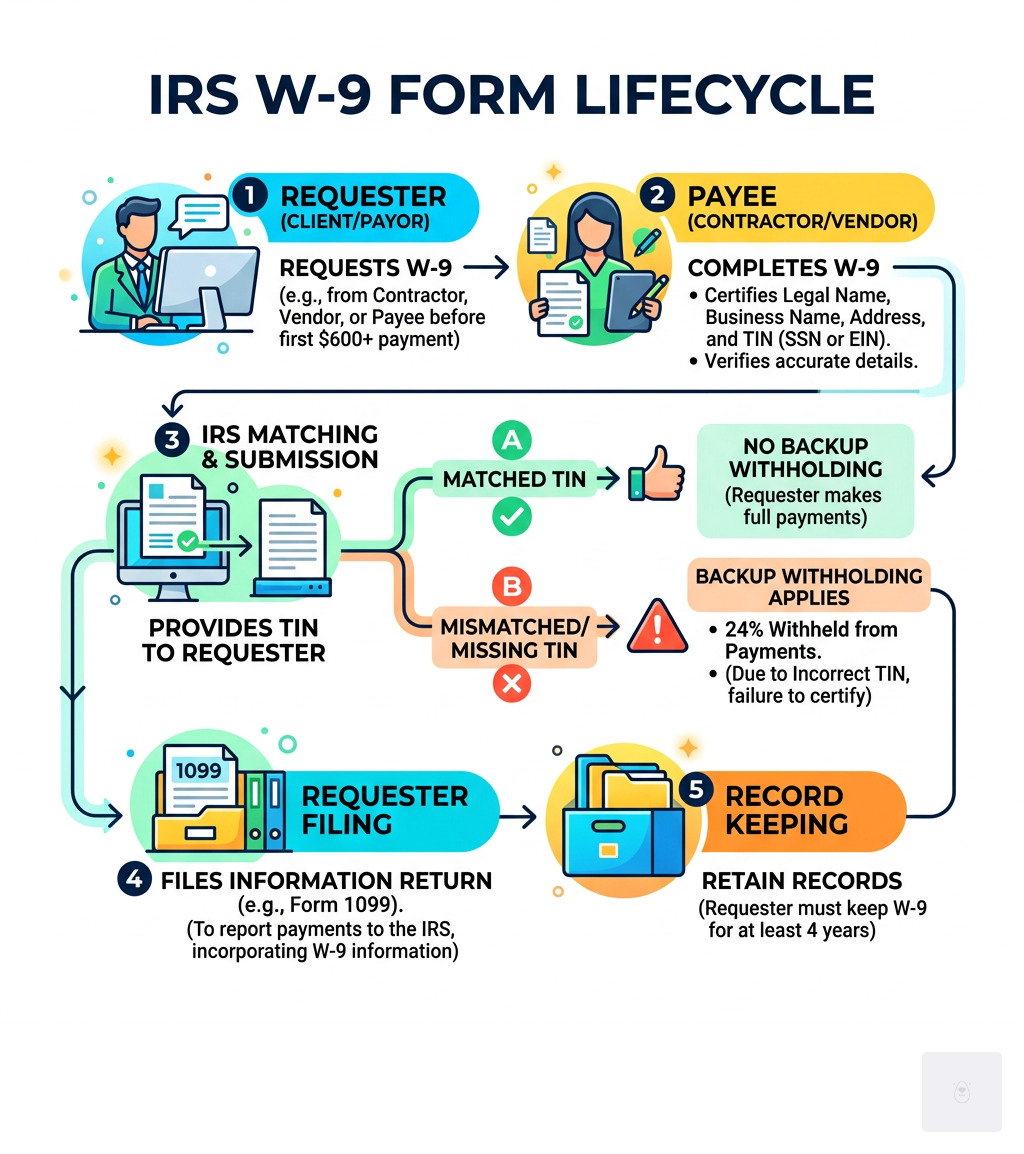
Key terms for irs w 9 rules:
Understanding the Core IRS W-9 Rules for 2025

At its heart, Form W-9 is a “Request for Taxpayer Identification Number and Certification.” While it might seem like just another piece of administrative homework, it serves as a legal bridge between you and the IRS. When a business pays you for services, they need to tell the IRS how much they paid. To do that accurately, they need your verified TIN.
The irs w 9 rules apply specifically to “U.S. persons.” This definition is broader than just citizens; it includes resident aliens, domestic partnerships, corporations, and estates or trusts. If you are a freelancer or contractor, providing this form is usually the prerequisite for getting paid. For businesses, collecting a W-9 is the first step in preparing Form 1099-NEC (for nonemployee compensation) or 1099-MISC (for other income).
A critical threshold to remember is $600. If a business pays an individual or unincorporated entity $600 or more during a tax year, they are generally required to issue a 1099. However, many savvy businesses request a W-9 for any amount to ensure their records are complete from day one.
Who is Required to Submit a W-9?
If you fall into any of the following categories and are performing work or receiving reportable income in the U.S., you’ll likely need to submit a W-9:
- Independent Contractors and Freelancers: The most common users of the form.
- Vendors: Businesses providing goods or services to other companies.
- Domestic Entities: Corporations, Partnerships, and LLCs registered in the U.S.
- Estate Beneficiaries: Individuals receiving distributions that require tax reporting.
- Resident Aliens: Those who meet the “substantial presence test” for tax purposes.
When to Request a New Form
A W-9 doesn’t necessarily expire every year, but the irs w 9 rules state it must be updated if there is a “change in circumstances” that makes the previous form incorrect. You should submit a new W-9 if:
- Your legal name changes (e.g., through marriage or legal filing).
- Your business entity type changes (e.g., you move from a Sole Proprietorship to an S-Corp).
- Your TIN changes (e.g., you finally got an EIN for your business).
Interestingly, the IRS notes that a simple change of address does not strictly require a new W-9, though it is often best practice to provide one to ensure your 1099s reach the right mailbox.
Start filling your W-9 now at https://fillablew9.com/apply.
Line-by-Line Guide to Filling Out the Form
Filling out the form incorrectly is the fastest way to delay your payments. Let’s break down the most important lines according to the latest irs w 9 rules (including the March 2024 revisions).
- Line 1 (Name): This must be the name shown on your income tax return. If you are an individual, this is your legal name. If you are a single-member LLC, this is the owner’s name.
- Line 2 (Business Name): Enter your “Doing Business As” (DBA) name or disregarded entity name here if it differs from Line 1.
- Line 3a (Federal Tax Classification): Check the box that applies to the name on Line 1. If you are an LLC, you must also provide the appropriate tax code (P for Partnership, C for C-Corp, or S for S-Corp).
- Line 3b (Foreign Partners): This is a newer requirement. Flow-through entities (like partnerships) must check this box if they have foreign partners, owners, or beneficiaries when providing the form to another flow-through entity.
- Line 4 (Exemptions): Most individuals leave this blank. It is used by specific entities (like corporations or government agencies) that are exempt from backup withholding.
- Lines 5 & 6 (Address): Provide the address where you want your tax reporting forms (like the 1099) to be mailed.
Navigating IRS W-9 Rules for LLCs and Disregarded Entities
The most common point of confusion involves Limited Liability Companies (LLCs). Under irs w 9 rules, a single-member LLC is typically treated as a “disregarded entity” for tax purposes.
If you are a single-member LLC:
- Line 1: Your personal name (not the business name).
- Line 2: The business name.
- Line 3a: Check the “Individual/sole proprietor or single-member LLC” box.
- Part I (TIN): You can generally use either your Social Security Number (SSN) or your Employer Identification Number (EIN), though the IRS often prefers the SSN for individuals to ensure a perfect match with Line 1.
For multi-member LLCs, you must check the “Limited liability company” box and enter the letter for your tax classification (P, C, or S).
Common Mistakes Regarding IRS W-9 Rules
We see the same errors over and over again. To keep your tax season stress-free, avoid these pitfalls:
- Mismatched Name and TIN: If the name on Line 1 doesn’t match the TIN in Part I according to IRS records, the requester will receive a “B-Notice,” which can lead to immediate backup withholding.
- Using the Wrong Form Version: The IRS updated the W-9 in March 2024. Always use the most current version to ensure compliance with the new Line 3b requirements.
- Missing Signatures: A W-9 is not valid unless it is signed and dated in Part II.
- Illegible Handwriting: If a clerk can’t read your SSN, they might enter it wrong, triggering a mismatch.
Don’t waste time with paper forms — complete your secure W-9 online at https://fillablew9.com/apply.
Backup Withholding and Penalty Risks
If you fail to follow the irs w 9 rules, the financial consequences are immediate. The most significant risk is backup withholding.
Currently, the backup withholding rate is 24%. This means if you don’t provide a correct TIN, the person paying you is legally required to take 24% off the top of your payment and send it directly to the IRS. For a $10,000 project, that’s $2,400 you won’t see until you sort out your tax return the following year.
Beyond withholding, the IRS can impose several penalties:
- Failure to Furnish TIN: A $50 penalty for each failure to provide a TIN when required.
- Civil Penalty for False Information: If you make a false statement with no reasonable basis that results in no backup withholding, you may face a $500 penalty.
- Criminal Penalties: Willfully falsifying certifications can lead to fines or even imprisonment.
Exemptions from Backup Withholding and FATCA
Not everyone is subject to backup withholding. Certain “exempt payees” can enter a code on Line 4 to signal their status.
- Exempt Payee Codes (1-14): Generally apply to corporations, government agencies, and financial institutions. For example, code 1 is for tax-exempt organizations under section 501(a).
- FATCA Exemption Codes (A-M): These relate to the Foreign Account Tax Compliance Act. If you are an individual or a standard U.S. business, you typically won’t need these. However, entities like banks or insurance companies use them to certify they are exempt from reporting foreign-held accounts.
Signature and Certification Requirements
When you sign Part II of the W-9, you are certifying four things under penalties of perjury:
- The TIN you provided is correct.
- You are not subject to backup withholding.
- You are a U.S. person.
- The FATCA code (if any) is correct.
Electronic Signatures: The IRS does allow electronic signatures on W-9 forms, provided the system used identifies the person signing and ensures the form cannot be altered after signing. Using a dedicated platform like Fillable W9 ensures your electronic signature meets these rigorous standards.
Minors: If a W-9 is required for a minor (for example, for a savings account or acting work), a parent or legal guardian may sign on their behalf.
Best Practices for Secure W-9 Submission and Personal Recordkeeping
Because a W-9 contains your Name, Address, and Social Security Number, it is a goldmine for identity thieves. You should never send a completed W-9 as an unencrypted email attachment.
Secure Electronic Submission: We recommend using secure portals that use SSL encryption. This protects your data while it’s in transit to the client.
Recordkeeping: As a rule of thumb, the IRS requires payers to keep W-9 records for at least four years after the date the return was filed. As a payee, you should also keep a copy of every W-9 you submit. This helps you track which entity type and TIN you provided to which client, making it easier to reconcile your 1099s at the end of the year.
Substitute Forms: Many large organizations use “substitute” W-9 forms. These are legal as long as they contain the same certifications and fields as the official IRS form. If you are a business owner, using a professional service to generate these can save hours of manual data entry.
Ensure secure submission with Fillable W9.
Frequently Asked Questions about IRS W-9 Rules
What is the difference between an SSN and an EIN on a W-9?
An SSN (Social Security Number) is issued to individuals. An EIN (Employer Identification Number) is issued to businesses. If you are a sole proprietor, the irs w 9 rules allow you to use either, but the IRS generally prefers the SSN. If your business is incorporated or has employees, you must use an EIN.
Do I need to provide a W-9 if I am a foreign person?
No. If you are a nonresident alien or a foreign entity, you should not use Form W-9. Instead, you will likely use a version of Form W-8 (such as W-8BEN for individuals). Providing a W-9 as a foreign person is a common mistake that can lead to incorrect tax treatment and potential 30% withholding.
What happens if I refuse to provide a W-9 to a requester?
If you refuse to provide a TIN, the requester is required by law to begin backup withholding at a rate of 24%. Additionally, you may be subject to a $50 penalty from the IRS. Most businesses will also refuse to work with vendors who won’t provide a W-9 because it creates a massive compliance headache for their accounting departments.
Conclusion
Navigating irs w 9 rules doesn’t have to be a nightmare. By understanding who needs to file, how to correctly identify your entity type, and the importance of matching your name to your TIN, you can ensure your payments are processed smoothly and without the “surprise” of backup withholding.
As we move into the 2025 tax season, staying updated on form revisions—like the recent additions for foreign partners and digital asset brokers—is essential for every freelancer and business owner. At Fillable W9, we’ve built a platform specifically designed to handle these complexities for you, ensuring your forms are accurate, current, and securely delivered.
✅ Ready to complete your W-9 in minutes? Apply here now.