
Why Your Next Payment Depends on This One Simple Form

A W9 form for payment is required when a business pays you $600 or more in a calendar year for services or other reportable income. Here’s what you need to know:
- Purpose: The W-9 collects your name, address, and Taxpayer Identification Number (TIN) so the payer can report payments to the IRS.
- Who fills it out: Independent contractors, freelancers, vendors, and most U.S. persons receiving payments.
- When it’s needed: Before your first payment or when your tax information changes.
- What happens next: The payer uses your W-9 to prepare a Form 1099 at year-end, which reports your earnings to the IRS.
When you work as a contractor or receive non-employee payments, the W9 form simplifies the tax process. It’s the paperwork handshake that connects your work to your payment and keeps everyone compliant with the IRS. Without a completed W-9, payments can be delayed or subject to 24% backup withholding, where the payer sends a quarter of your payment directly to the IRS.
Fortunately, completing a W-9 takes just a few minutes. The form asks for your name, business name, tax classification, address, and either your Social Security Number or Employer Identification Number. You submit it to the payer, who keeps it on file; you never send it to the IRS yourself.
I’m Haiko de Poel, and I’ve processed countless W9 forms throughout my career. I understand how critical accurate tax documentation is for smooth business transactions. Understanding the W9 form is essential for getting paid on time and staying compliant.
Start filling your W9 now at https://fillablew9.com/apply.
What is a W-9 Form and Why is it Essential for Payment?
Officially titled “Request for Taxpayer Identification Number and Certification,” the W-9 form for payment is a simple document that connects your tax identity to the money you earn. When a business pays you for work, they must report that payment to the IRS. The W-9 provides them with your Taxpayer Identification Number (TIN) to do so accurately. You fill out the form and give it to the payer, who uses it to prepare a Form 1099 at year-end. As the IRS explains, the form’s purpose is to provide your correct TIN for tax reporting.
Crucially, you never send the W-9 to the IRS yourself; it stays between you and your client. Its main purpose is to enable accurate tax reporting and prevent issues like backup withholding, where the payer must withhold 24% of your payment and send it to the IRS. Providing a correct W9 form for payment ensures payments flow smoothly and keeps everyone compliant.
Understanding Your Taxpayer Identification Number (TIN)
Your TIN is the nine-digit number the IRS uses to track your tax obligations. Getting it right on the W-9 is critical to avoid backup withholding. The type of TIN you use depends on your situation:
- Social Security Number (SSN): Used by most individuals and sole proprietors.
- Employer Identification Number (EIN): Used by businesses, partnerships, and LLCs. Sole proprietors can also get an EIN to separate business and personal finances or if they have employees. Applying for an EIN is free on the IRS website.
- Individual Taxpayer Identification Number (ITIN): Issued by the IRS to certain foreign individuals who have U.S. tax obligations but cannot get an SSN.
- Adoption Taxpayer Identification Number (ATIN): A temporary number for a child in the adoption process who doesn’t yet have an SSN.
Always double-check your TIN before submitting your W-9. An incorrect number can trigger backup withholding and require extra paperwork to fix.
Who Needs to Fill Out a W-9 and When?
As a U.S. person (citizen, resident alien, corporation, etc.), you’ll need to complete a W-9 if you receive $600 or more from a business in a calendar year for services or other reportable income. This applies to a wide range of individuals and entities, including:
- Independent contractors and freelancers
- Vendors supplying goods or services
- Sole proprietors, LLCs, corporations, and partnerships
- Landlords receiving rent through property managers
- Individuals receiving interest, dividends, or certain legal settlements
Proper documentation is essential for compliance, as outlined in the IRS guidance on Reporting payments to independent contractors.
Common Scenarios Requiring a W9 form for payment
You’ll encounter a W9 form for payment in many situations beyond freelance work. These include real estate transactions (reported on Form 1099-S), investment gains from a bank (interest and dividends), rental income (Form 1099-MISC), canceled debt (Form 1099-C), and legal settlements. In each case, the payer needs your W-9 to report the income correctly to the IRS.
Special Cases: Rules for Minors and Exempt Payees
Some situations have specific rules. For a minor receiving payments, the W-9 should list the minor’s name and TIN, but a legal guardian can sign it. This ensures income is attributed correctly.
Exempt payees are entities that are not subject to backup withholding, such as government agencies, tax-exempt organizations, and most corporations. If your entity qualifies, you must enter the correct exemption code on Line 4 of the W-9. However, be aware that even exempt entities may have reporting requirements in certain cases, such as corporations receiving payments for legal services. Understanding these nuances is key to providing the correct information.
A Step-by-Step Guide to Filling Out the W-9 Form
Filling out a W9 form for payment is simpler than it seems. Accuracy is key to avoiding payment delays and backup withholding. Let’s walk through the form line by line.
Where to Get Your W-9 Form
The official W-9 is available on the IRS website’s Forms, instructions and publications page. Always use the most current version.
However, downloading, printing, and scanning is outdated. There’s a better way.
Complete your secure fillable W9 online at https://fillablew9.com/apply.
Our platform guides you through each field, ensuring your information is correct and secure.
Line-by-Line Instructions for Individuals and Sole Proprietors
For most freelancers and contractors, the process is straightforward:
- Line 1 (Name): Enter your full legal name as it appears on your tax return.
- Line 2 (Business Name): Enter your business, trade, or DBA name if you have one. Otherwise, leave it blank.
- Line 3 (Tax Classification): Check the “Individual/sole proprietor” box. This also applies to single-member LLCs treated as disregarded entities.
- Line 4 (Exemptions): Most individuals and sole proprietors leave this blank.
- Lines 5 & 6 (Address): Provide your complete mailing address.
- Part I (TIN): Enter your Social Security Number (SSN) or Employer Identification Number (EIN).
- Part II (Certification): You must sign and date this section to certify that your information is correct and that you are a U.S. person. This makes the W9 form for payment valid.
How Different Business Entities Fill Out a W-9
Your business structure determines how you complete the form:
- LLCs: A single-member LLC is often treated as a sole proprietorship (see above). A multi-member LLC taxed as a partnership or an LLC taxed as a corporation should check the “Limited liability company” box and enter “P,” “C,” or “S” for its tax classification. Use the LLC’s EIN.
- Corporations (C or S): Check the appropriate box (“C Corporation” or “S Corporation”) and use the corporation’s EIN.
- Partnerships, Trusts, or Estates: Check the corresponding box and use the entity’s EIN.
The March 2024 revision added Line 3b for flow-through entities to declare if they have foreign partners, which is important for international tax reporting.
Signing and Submitting Your W-9: Wet vs. Digital Signatures
The final step is your signature. A traditional wet signature (signing a printed copy) is still valid but slow. Digital signatures are now widely accepted by the IRS, provided they are properly authenticated. Simply typing your name in a script font is not a valid e-signature.
Digital signatures dramatically speed up the process, allowing you to securely complete and submit your W9 form for payment in minutes.
Don’t waste time with paper forms — complete your secure W9 online at https://fillablew9.com/apply.
Our platform ensures your digital signature meets all IRS standards, so your form is accepted without delay.
The W9 Form for Payment: Compliance, Consequences, and Best Practices
Understanding the W9 form for payment is about more than just filling it out; it’s about recognizing its role in tax compliance and avoiding common pitfalls.

What is Backup Withholding?
Backup withholding is the IRS’s safety net for collecting taxes on non-employee income. If you provide an incorrect TIN or fail to submit a W-9, the payer is required to withhold a flat 24% of your payment and send it directly to the IRS. This is a significant loss of immediate income for any freelancer or contractor.
The fix is simple: complete your W9 form for payment accurately, double-check your TIN, and sign the certification. For more details, see the IRS Backup Withholding page.
Implications of Not Providing a W9 Form for Payment
Refusing or delaying a W-9 request has serious consequences for both you and the payer.
- For You (the Payee): Your payments may be put on hold indefinitely. If you are paid, the payer must apply 24% backup withholding. It can also damage your professional reputation, as it signals a lack of understanding of basic business practices.
- For the Payer: The IRS can levy penalties for failing to collect a W-9. The business also faces an administrative burden, as they must calculate and remit the withheld funds to the IRS using Form 945. They may also lose the ability to deduct your payments as a business expense.
Simply put, not providing a W-9 creates unnecessary problems for everyone involved.
How Often to Update Your W-9
A W9 form for payment does not expire, but you must submit a new one if your information changes. Update your W-9 when:
- Your legal name changes (due to marriage, divorce, etc.).
- Your business structure changes (e.g., from a sole proprietorship to an LLC).
- Your Taxpayer Identification Number changes.
An address change does not require a new W-9, but it’s good practice to inform your payers to ensure you receive your year-end 1099s. Some businesses may request a new W-9 periodically to keep their records current; it’s best to comply to maintain a good relationship.
W-9 vs. Other Tax Forms: W-4 and 1099 Explained
The W9 form for payment is often confused with other tax forms like the W-4 and 1099. Understanding their distinct roles is key to proper tax compliance. The W-9 is the information-gathering step, the W-4 is for employees, and the 1099 is the year-end report.
| Form | Purpose | Who Fills It Out | Who Receives It | Key Trigger |
|---|---|---|---|---|
| W-9 | Collects TIN and certification for reporting payments made to non-employees. | Independent contractors, freelancers, vendors, individuals receiving reportable income. | The payer (business or individual making the payment). | Receiving $600+ in payments as a non-employee, interest, dividends, etc. |
| W-4 | Informs employer how much federal income tax to withhold from an employee’s paycheck. | Employees | The employer | Starting a new job as an employee or needing to adjust withholding. |
| 1099-NEC | Reports non-employee compensation (e.g., payments to independent contractors). | The payer (business) | The independent contractor (copy) and the IRS (original). | Paying $600+ to a non-employee for services in a calendar year. |
| 1099-MISC | Reports miscellaneous income (e.g., rents, royalties, prizes, medical/health care payments). | The payer (business) | The recipient (copy) and the IRS (original). | Paying $600+ for certain miscellaneous income. |
W-9 vs. W-4: Contractor vs. Employee
The main difference between a W9 form for payment and a W-4 is your employment status.
- W-9 is for independent contractors and freelancers. You are considered self-employed, so no taxes are withheld from your payments. You provide a W-9 so the payer can report your total earnings to the IRS.
- W-4 is for employees. You fill out a Form W-4 so your employer knows how much federal income tax to withhold from each paycheck. At year-end, you receive a W-2, not a 1099.
Correctly classifying workers as either contractors or employees is crucial for businesses to avoid IRS penalties.
How the W-9 Feeds into the 1099 Form
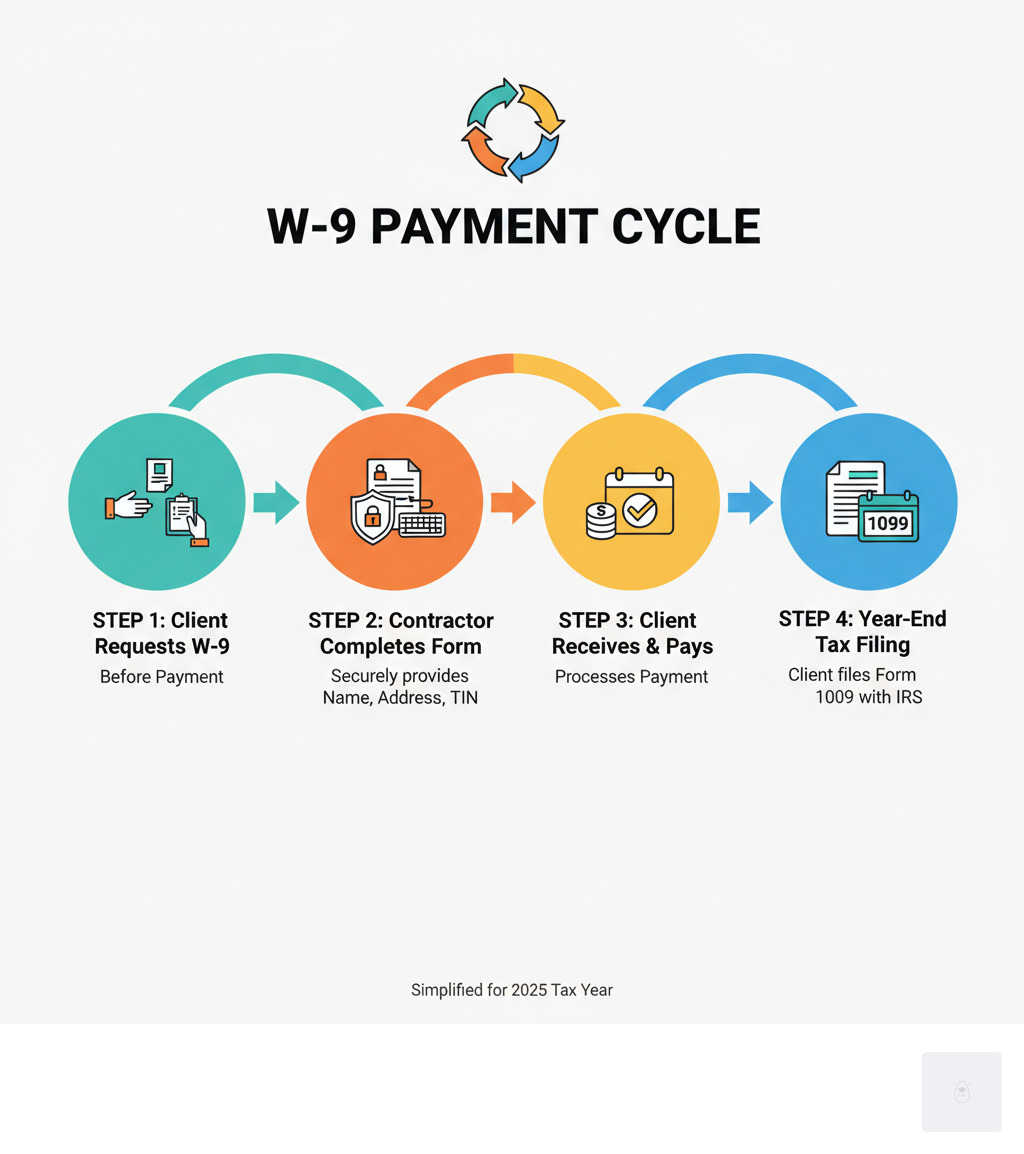
The W-9 is the first step in a process that ends with a 1099 form. Here’s the flow:
- You provide a completed W-9 to your client.
- The client keeps it on file and tracks payments made to you throughout the year.
- If payments total $600 or more, the client uses your W-9 information to prepare a 1099 form.
- The client sends a copy of the 1099 to you and the IRS by January 31 of the following year.
For most contractors, this will be a Form 1099-NEC (Non-Employee Compensation). For other income like rent or royalties, it might be a Form 1099-MISC. The IRS provides guidance on Reporting payments to independent contractors. An accurate W9 form for payment is essential for this process to work correctly and prevent reporting issues.
Frequently Asked Questions about the W-9 Form
Here are answers to common questions about the W9 form for payment.
Can I refuse to fill out a W-9?
While you can refuse, it’s not recommended. A payer is legally required to initiate 24% backup withholding on your payments if you don’t provide a W-9. Furthermore, most businesses will delay or refuse payment altogether and may decline to work with you in the future. It’s simpler to complete the form promptly.
Is it safe to email a W-9 form?
No, standard email is not a secure method for sending a W-9 because it contains sensitive information like your SSN or EIN. Unencrypted email exposes you to the risk of identity theft. Instead, use secure methods like:
- A secure online portal (like Fillable W9)
- Encrypted email services
- Fax or traditional mail
Our platform uses robust encryption to protect your data when you complete and submit your W-9.
Does filling out a W-9 mean I have to pay more taxes?
No. Filling out a W-9 does not increase your tax liability. It simply ensures that the income paid to you is reported to the IRS, which you are already required to do. As a contractor, you are responsible for paying your own income and self-employment taxes. The W-9 is a tool for reporting and transparency; it doesn’t create new taxes.
Conclusion
The W9 form for payment is a crucial but manageable part of being an independent contractor or small business owner. At its core, it’s a simple document that ensures you get paid correctly while keeping you compliant with IRS tax law. Understanding how to fill it out, when to update it, and how it relates to other tax forms protects your income and professional relationships.
In today’s gig economy, mastering the W-9 is essential for avoiding payment delays and costly backup withholding. We built Fillable W9 to eliminate the stress of paper forms and security concerns. Our platform offers a simple, secure, and guided experience to help you complete your W9 form for payment accurately in minutes.
With your tax documentation handled correctly, you can focus on what you do best: running your business. The peace of mind that comes with compliance is invaluable.
✅ Ready to complete your W9 in minutes? Apply here now