
Understanding the Essential Forms for Contractor Payments

The 1099 vs w9 definition is simple: A W-9 is a form contractors fill out to provide their tax information to businesses, while a 1099 is a form businesses file to report payments made to contractors. Here’s the key difference:
- Form W-9: Filled out by the contractor at the start of the relationship, provides their name, address, and Taxpayer Identification Number (TIN)
- Form 1099: Filled out by the business at year-end, reports total payments of $600 or more made to the contractor
The W-9 comes first, the 1099 comes later.
If you’re one of the 31.9 million independent contractors in the U.S. (as of 2022), or if you’re a business that hires them, understanding these two forms is crucial. Get them wrong and you could face IRS penalties ranging from $60 to $660 per form. Get them right and tax season becomes straightforward.
The confusion is understandable. Both forms have numbers in their names, both deal with contractor payments, and both go to the IRS eventually. But they serve completely different purposes at different times in the contractor-business relationship.
Start filling your W9 now at https://fillablew9.com/apply.
I’m Haiko de Poel, and throughout my career leading marketing and digital change for companies like Palmetto Surety Corporation and Mass Impact, I’ve helped countless businesses steer the 1099 vs w9 definition and streamline their contractor onboarding processes. In this guide, I’ll break down exactly what each form does, when you need them, and how they work together to keep you compliant with IRS requirements.
Know your 1099 vs w9 definition terms:
The Foundation: Are You a Contractor or an Employee?
Before diving into the specifics of W-9 and 1099 forms, understand the fundamental difference between an independent contractor and an employee. The IRS has clear guidelines on worker classifications, and this distinction dictates which tax forms are used.


1. What is the difference between an independent contractor and an employee in the context of these forms?
The IRS defines an independent contractor as someone who is in an independent trade, business, or profession, offering services to the public. The key here is control: the person for whom the services are performed has the right to control or direct only the result of the work, not what will be done or how it will be done. For example, doctors, lawyers, accountants, and contractors offering services to the public are generally independent contractors.
An employee, on the other hand, performs services that can be controlled by an employer regarding what will be done and how it will be done, even if they have some freedom of action. The employer’s legal right to control the details of service performance is the defining factor. Employees typically receive a Form W-2 for their wages, while independent contractors receive a Form 1099.
To determine worker classification, the IRS uses a “control test” with three main categories:
- Behavioral Control: Does the company control or have the right to control how the worker does their job? This includes instructions, training, and evaluation methods.
- Financial Control: Does the company control the business aspects of the worker’s job? This includes how the worker is paid, whether expenses are reimbursed, and who provides tools/supplies.
- Relationship of the Parties: How do the worker and the company perceive their relationship? This includes written contracts, employee benefits (like insurance or 401(k) plans), and the permanency of the relationship.
The tax implications differ significantly. Employees have income tax and FICA (Social Security and Medicare) taxes withheld from their paychecks by the employer. Independent contractors, however, are responsible for their own taxes, including Self-Employment Tax (which covers Social Security and Medicare contributions for self-employed individuals) and income tax, often paid through quarterly estimated payments. This is why understanding your classification is the first step toward tax compliance.
Form W-9 Explained: The “Request for Taxpayer Information”
The W-9 tax form, officially titled “Request for Taxpayer Identification Number and Certification,” is a crucial piece of the puzzle. It’s a single-page document that businesses use to collect essential tax information from non-employees.

1. What is the primary purpose of Form W-9?
The primary purpose of Form W-9 is for a U.S. person (whether an individual, sole proprietor, corporation, or partnership) to provide their correct Taxpayer Identification Number (TIN) to an entity that is required to file an information return with the IRS. Think of it as the contractor’s way of saying, “Here’s my tax ID, so you can properly report the money you pay me.”
3. Who is responsible for filling out Form W-9, and who receives it?
The independent contractor or payee is responsible for filling out Form W-9. They then provide it to the business or payer who requested it. The business keeps the W-9 on file for their records and uses the information to prepare year-end 1099 forms. The W-9 is not sent to the IRS by the contractor; it stays with the business.
5. What key information is collected on a W-9 form?
A W-9 form collects several vital pieces of information:
- Name: The individual’s legal name or business name, as it appears on their income tax return.
- Business name/Disregarded entity name: If applicable, for businesses operating under a different name.
- Federal Tax Classification: The type of business entity (e.g., individual/sole proprietor, C corporation, S corporation, partnership, LLC).
- Address: The full mailing address, including street, city, state, and zip code.
- Taxpayer Identification Number (TIN): This is either a Social Security Number (SSN) for individuals/sole proprietors or an Employer Identification Number (EIN) for businesses.
- Certifications: The contractor certifies that the TIN provided is correct, that they are not subject to backup withholding, and that they are a U.S. person.
You can download a copy of Form W-9 directly from the IRS website.
What is the 1099 vs W9 definition for a contractor?
From a contractor’s perspective, the 1099 vs w9 definition clarifies responsibilities. The W-9 is your form to provide information, while the 1099 is their (the business’s) form to report what they paid you.
7. When should a business request a W-9 from an independent contractor?
A business should request a W-9 from an independent contractor as early as possible, ideally when they are first onboarded and definitely before the first payment is made. This ensures the business has all the necessary tax information to accurately report payments at year-end and to comply with backup withholding rules if the W-9 isn’t provided.
14. What happens if a contractor does not provide a TIN for a W-9 form?
If a contractor fails to provide a correct TIN on their W-9, the business is generally required to implement “backup withholding.” This means the business must withhold 24% of the contractor’s earnings for taxes and send it directly to the IRS. This isn’t fun for anyone, as it significantly reduces the contractor’s take-home pay. The business must document at least three attempts to obtain the TIN before applying backup withholding.
9. What are the penalties for not submitting or incorrectly submitting a W-9 form?
For contractors, failing to provide a correct TIN can result in a $50 penalty per occurrence, unless there’s reasonable cause. If a contractor submits false information submitted for the W-9, they could face a $500 penalty. Purposely falsifying certifications or affirmations can lead to additional fines or even imprisonment. It’s always best to be truthful and timely!
How to fill out a W9 for freelancers and small businesses
Filling out a W-9 is usually straightforward. Here’s a quick guide:
- Name: Enter your legal name exactly as it appears on your tax return.
- Business Name: If you have a business name (e.g., “DBA” or LLC name), enter it here.
- Federal Tax Classification: Check the box that best describes your tax entity (e.g., “Individual/sole proprietor” if you’re a freelancer without a registered business, or the appropriate corporate/partnership type).
- Exemptions: Most contractors leave these blank.
- Address: Provide your current mailing address.
- City, State, Zip: Complete your address.
- Requester’s Name/Address: This section is for the business requesting the W-9; you can usually leave it blank.
- Taxpayer Identification Number (TIN): Enter your SSN if you’re an individual/sole proprietor. If you have an EIN for your business, use that instead.
- Certification: Sign and date the form, certifying that the information is correct.
When sending your W-9, security is paramount. Since it contains sensitive information like your SSN, always send it securely. This could mean using an encrypted file attachment if sending electronically, or mailing a hard copy.
Don’t waste time with paper forms — complete your secure W9 online at https://fillablew9.com/apply.
Form 1099 Explained: The “Report of Payments”
If the W-9 is the contractor’s statement of who they are, the 1099 is the business’s statement of what they paid. These forms are crucial for the IRS to track non-employment income and ensure everyone pays their fair share.
2. What is the primary purpose of Form 1099 (specifically 1099-NEC and 1099-MISC)?
The primary purpose of Form 1099 is for businesses to report various types of income paid to non-employees to the IRS. This helps the IRS verify that independent contractors are reporting all their income. For contractors, receiving a 1099 serves as a reminder of their earnings from a particular client.
13. Are there different types of 1099 forms, and which are most relevant for independent contractors?
Yes, there are many types of 1099 forms, each designed to report different kinds of income. The most relevant for independent contractors are:
- Form 1099-NEC (Nonemployee Compensation): This is the big one for most freelancers and contractors. It reports payments of $600 or more for services performed for a trade or business by a person not treated as an employee. This form specifically replaced Box 7 of the 1099-MISC for nonemployee compensation.
- Form 1099-MISC (Miscellaneous Information): While it used to cover nonemployee compensation, it’s now used for other types of miscellaneous income totaling $600 or more, such as rents, royalties, prizes and awards, or payments to attorneys.
- Form 1099-K (Payment Card and Third Party Network Transactions): If you receive payments through third-party payment networks (like PayPal, Stripe, etc.) or payment cards, you might receive a 1099-K. However, for 2023, the reporting threshold for 1099-K was $20,000 in payments and over 200 transactions. For 2024, there was transition relief to a $5,000 threshold, aiming for $600 in future years.
4. Who is responsible for filling out Form 1099, and who receives it?
The business or payer is responsible for filling out Form 1099. They send a copy to the independent contractor (the payee) and another copy to the IRS. This ensures both parties and the tax authority have a record of the reported income.
6. What key information is reported on a 1099 form?
A 1099 form typically reports:
- The payer’s name, address, and TIN.
- The payee’s name, address, and TIN.
- The total amount of income paid to the payee during the tax year (e.g., $600 or more).
- Specific boxes indicate the type of income (e.g., Box 1 for nonemployee compensation on Form 1099-NEC).
8. When should a business issue a 1099 form to an independent contractor?
A business should issue a 1099 form to an independent contractor if they paid them $600 or more for services in a single tax year. The deadline for providing Form 1099-NEC to your contractor is January 31, and it’s also the deadline to file it with the IRS. For Form 1099-MISC, the recipient copy is due January 31, while the IRS copy is due by February 28 (paper filing) or March 31 (electronic filing).
10. What are the penalties for not submitting or incorrectly submitting a 1099 form?
The IRS takes 1099 reporting seriously. Penalties for not submitting or incorrectly submitting a 1099 form can be steep:
- Late Filing: Penalties range from $60 to $330 per form, depending on how late the form is filed. The earlier you correct it, the lower the penalty.
- Intentional Disregard: If a business intentionally does not provide a correct statement (Form 1099), they are fined a minimum penalty of $580 per form or 10% of the income reported on the form, with no maximum. This is serious stuff and can hurt your business significantly.
What is the 1099 vs W9 definition for a business?
For businesses, the 1099 vs w9 definition clarifies distinct roles in the reporting process. The W-9 is your collection tool, and the 1099 is your reporting tool.
| Feature | Form 1099-NEC (Nonemployee Compensation) | Form 1099-MISC (Miscellaneous Information) |
|---|---|---|
| Primary Purpose | Reports payments of $600+ for services rendered by non-employees. | Reports various other types of income of $600+ (e.g., rents, royalties). |
| Who Fills Out | The business (payer). | The business (payer). |
| Who Receives | Independent contractor (payee) and the IRS. | Payee and the IRS. |
| Key Information | Payer/payee info, total nonemployee compensation (Box 1). | Payer/payee info, various income types (rents, royalties, etc., in specific boxes). |
| Deadline | To recipient: January 31. To IRS: January 31. | To recipient: January 31. To IRS: Feb 28 (paper) / March 31 (e-file). |
| Context | Payments for services (e.g., freelance work, consulting). | Payments for things like property rental, medical payments, awards. |
W9 form is for collecting contractor info; 1099 form is for reporting payments.
The W9 & 1099 Workflow: From Onboarding to Tax Season
The W-9 and 1099 forms are not isolated documents; they work in tandem to ensure proper tax reporting for independent contractors.
11. How do W-9 and 1099 forms work together in the tax reporting process?
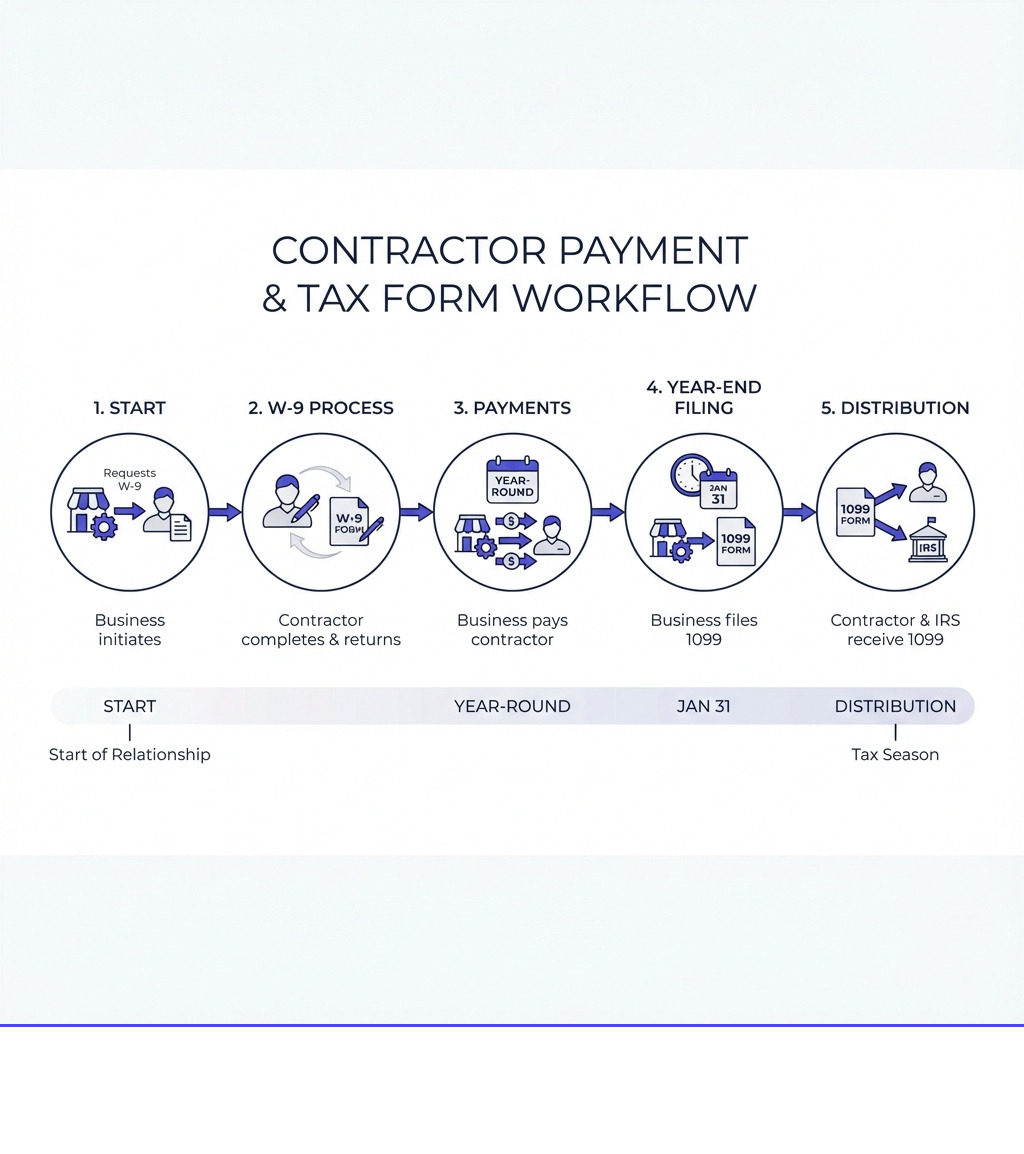
The W-9 form is the foundational document. When a business hires an independent contractor, they request a W-9 to collect the contractor’s correct name and TIN. This information is then stored by the business. At the end of the year, if the total payments to that contractor reach $600 or more, the business uses the information from the W-9 to accurately complete and issue the relevant 1099 form (usually a 1099-NEC). The 1099 form is then sent to both the contractor and the IRS, linking the payment to the contractor’s TIN. It’s a seamless cycle designed for transparency and compliance.
Checklist: W9 and 1099 Workflow
- Step 1: Request W9: As soon as you engage an independent contractor, request a completed Form W-9. This is crucial for collecting their tax information and avoiding issues later.
- Step 2: Verify TIN: Though not explicitly required to verify every TIN, using tools like TIN Matching can help ensure the information on the W-9 is correct, preventing potential backup withholding or penalties.
- Step 3: Pay contractor: Throughout the year, pay your contractor for their services, keeping accurate records of all payments.
- Step 4: Track payments: Carefully track all payments made to each independent contractor. If the total reaches $600 or more, you’ll need to issue a 1099.
- Step 5: Issue 1099: By January 31st of the following year, use the W-9 information to prepare and issue the appropriate 1099 form to the contractor and the IRS.
15. What are the deadlines for submitting W-9 and 1099 forms?
- W-9 Deadline: There is no specific IRS deadline for submitting a W-9 form to the IRS, as the contractor provides it directly to the payer. However, as a business, you should obtain a completed W-9 from your contractor before making any payments to ensure you have the correct information for year-end 1099 reporting and to avoid backup withholding.
- 1099 Deadline: The deadline for providing it to your contractor and filing with the IRS for Form 1099-NEC (Nonemployee Compensation) is January 31st of the year following the payments. For Form 1099-MISC (Miscellaneous Information), copies to recipients are due January 31st, while paper filing with the IRS is due February 28th, and electronic filing is due March 31st.
It’s important to note a recent change: the IRS has lowered the threshold requiring electronic filing of information returns like 1099 forms to 10 or more forms (down from 250), effective January 1, 2024. This means many more businesses will need to e-file. You can find more details on information return deadlines from the IRS.
Frequently Asked Questions about the 1099 vs W9 Definition
We know tax forms can be tricky, so let’s tackle some common questions to clear up any lingering confusion about the 1099 vs w9 definition.
What happens if a contractor refuses to fill out a W9?
If a contractor refuses to fill out a W-9, or provides an incorrect TIN, the business is legally obligated to impose backup withholding. As mentioned earlier, this means withholding 24% of all payments to that contractor. To avoid this, it’s crucial for businesses to communicate the importance of the W-9 and the consequences of non-compliance. Always document your attempts to obtain the W-9. The Instructions for the Requester of Form W-9 provide guidance on how to handle these situations.
Can I receive both a W-2 and a 1099 from the same company?
Yes, it’s possible! While it might seem contradictory, a person can receive both a W-2 and a 1099 from the same entity in the same tax year, but only if they perform genuinely distinct services in different capacities. For example, a person might be a regular employee (receiving a W-2) for certain duties, and also provide completely separate, independent contractor services (receiving a 1099) to the same company. The IRS clarifies this in their guidance: When would I provide a Form W-2 and a Form 1099 to the same person?. The key is that the employee and independent contractor roles must be genuinely separate and distinct.
What if the information on my 1099 is incorrect?
If you receive a 1099 form with incorrect information (e.g., wrong amount, wrong name, wrong TIN), you should immediately contact the payer (the business that issued the 1099). Explain the error and request a corrected 1099 form. The payer should then issue a “corrected” 1099 (often marked with a “corrected” box checked) to both you and the IRS. Do not simply file your taxes with the incorrect information; always seek a correction to avoid potential issues with the IRS.
Conclusion: Simplify Your Contractor Tax Compliance
Navigating contractor tax forms might seem complex, but understanding the 1099 vs w9 definition is your first step to smooth sailing. The W-9 is the contractor’s self-identification, while the 1099 is the business’s payment report. They are two sides of the same coin, working together to ensure that income earned by independent contractors is properly documented and reported to the IRS.
Key takeaways:
- W-9 collects info: Independent contractors provide their tax identification details to businesses via Form W-9.
- 1099 reports payments: Businesses use Form 1099 (primarily 1099-NEC) to report payments of $600 or more to contractors and the IRS.
- Importance of compliance: Timely and accurate submission of both forms is crucial for avoiding penalties for both contractors and businesses.
Compliance doesn’t have to be a headache. Tools like Fillable W9 are designed to streamline the process, making it simple and secure to handle your tax obligations. We help you stay organized, meet deadlines, and ensure your information is accurate.
Fillable W9 makes it easy to fill out your W9 form securely online. Our platform offers robust features designed to simplify your tax compliance, whether you’re a freelancer, a small business, or an accountant.
✅ Ready to complete your W9 in minutes? Apply here now.