
Why Filing Your Taxes Doesn’t Have to Cost You Anything

If you need to file 1040 for free, you have more options than ever. Here are the main ways to complete your federal tax return without spending a dime:
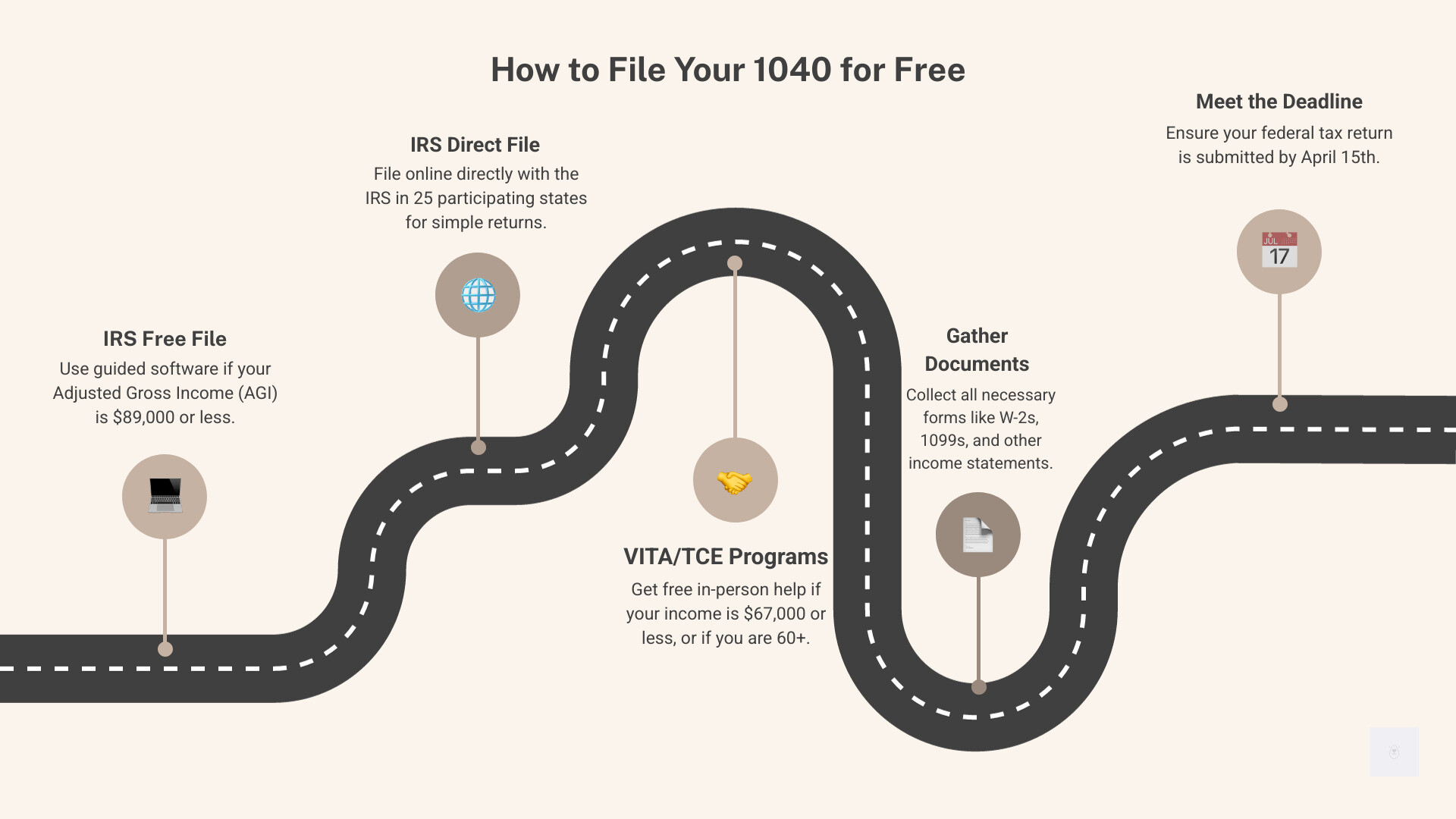
- IRS Free File – Free guided tax software if your adjusted gross income is $89,000 or less
- IRS Direct File – File directly with the IRS online in 25 participating states
- VITA/TCE Programs – Free in-person help if you earn $67,000 or less, have a disability, need language support, or are 60+
- Free File Fillable Forms – Electronic IRS forms for any income level (requires more tax knowledge)
Every year, millions of Americans pay for tax preparation services when they could file their Form 1040 completely free. The IRS offers several no-cost filing options, but many taxpayers don’t know they exist or how to access them.
Form 1040 is the standard federal income tax return that most Americans use to report their yearly income and calculate their tax liability. Whether you earned wages from an employer, worked as a freelancer, or had investment income, this is the form you’ll need. For 2024, single filers under 65 with gross income of at least $14,600 must file, while married couples filing jointly generally need to file if their income exceeds $29,200.
The good news? You don’t need to pay $200+ for tax software or hundreds more for a professional preparer if your tax situation is straightforward. The IRS has partnered with commercial tax software companies to offer free filing options, launched a new direct filing tool, and supports volunteer programs that provide free in-person assistance.
At Fillable W9, we specialize in helping freelancers and small businesses manage their tax forms with ease and security. While our main focus is simplifying the W-9 process, we believe in empowering you with knowledge for all your tax needs. This guide will walk you through every free option to file your Form 1040 so you can keep more of your hard-earned money.
Are You Eligible to File Your Taxes for Free?
Before we dive into the specific free filing options, let’s determine if you’re eligible to file 1040 for free. The IRS provides various programs designed to help different segments of the population based on income, age, and other factors. Understanding your eligibility is the first step to saving money on tax preparation.
Generally, you are required to file IRS Form 1040 if your gross income exceeds certain thresholds, which vary based on your filing status and age. For the 2024 tax year (filed in 2025):
- Single Filers (under 65): Must file if gross income is at least $14,600.
- Married Couples Filing Jointly (both under 65): Must file if joint income surpasses $29,200.
- Heads of Household (under 65): Must file if they earn at least $21,900.
It’s also important to note that self-employed individuals have a different threshold. If your net earnings from self-employment exceed $400, you must file a return, regardless of your age or other income.

Once you’ve established that you need to file, we can look at the income limits for the free programs. For instance, if your Adjusted Gross Income (AGI) is $89,000 or less, you can use IRS Free File. For in-person assistance through VITA/TCE, the income limit is $67,000 or less, or if you have a disability, need language support, or are age 60 or older. These programs are designed to ensure that a large portion of taxpayers can access free tax preparation services.
To check if you must file a tax return, you can always refer to the official IRS guidelines: Who must file a tax return.
Your Guide to IRS-Sponsored Free Filing Options
The IRS is committed to making tax filing accessible and affordable, which is why they offer several robust programs to help you file 1040 for free. These options range from guided software to in-person assistance, ensuring there’s a method that suits almost everyone’s needs. We’ll walk you through each one, detailing who qualifies and what types of tax situations they support.

Choosing the right free filing method can save you time and money. The key is to match your tax situation to the program’s offerings. To explore all the ways to file your federal taxes for free, visit the IRS’s dedicated page: E-file: Do your taxes for free.
IRS Free File: Guided Tax Software
This is perhaps the most widely known option for those looking to file 1040 for free. IRS Free File is a partnership between the IRS and several leading tax software companies. If your Adjusted Gross Income (AGI) is $89,000 or less, you can use brand-name commercial tax software to prepare and e-file your federal return at no cost. Some of these providers also offer free state tax filing, which is a fantastic bonus!
- Eligibility: Your AGI must be $89,000 or less. This covers a significant portion of taxpayers.
- Supported Tax Situations: These guided software options generally support common tax situations, including W-2 income, interest and dividends, student loan interest, and the Earned Income Tax Credit (EITC) or Child Tax Credit. If you have a simple Form 1040, this is likely your best bet.
- Limitations: While powerful, these free versions might not handle extremely complex tax situations (e.g., extensive self-employment income requiring multiple schedules, complex investments). However, many do offer free state tax filing, but always double-check the specific provider’s terms.
- How to Access: You must access IRS Free File through the IRS website to ensure you get the free offer. Do not go directly to the software company’s website, or you might be charged. You can find the list of participating partners here: IRS Free File partner list.
- Language Support: Some IRS Free File partners offer free filing in Spanish for qualifying taxpayers.
IRS Direct File: A New Way to file 1040 for free
A newer, exciting option for many taxpayers is IRS Direct File. This innovative program allows you to file 1040 for free online directly with the IRS. It’s designed to be straightforward and user-friendly, cutting out the middleman entirely for your federal return.
- Eligibility: Currently, IRS Direct File is available in 25 participating states. You’ll need to check if your state is one of them.
- Supported Tax Situations: This tool is best for common, simpler tax situations. It supports typical income types (W-2s, Social Security benefits, unemployment compensation) and common credits and deductions (like the standard deduction, EITC, and Child Tax Credit). It’s a great option if your tax return isn’t overly complicated.
- Limitations: IRS Direct File currently handles federal returns only. If you need to file a state tax return, you’ll need to use a separate method for that, though it often connects to a free state tax filing tool. It also doesn’t support all complex tax scenarios.
- How to Access: You can access this service directly through the IRS website: Use IRS Direct File. This is a fantastic step towards simplifying the tax process for millions!
VITA/TCE: In-Person Help to file 1040 for free
Sometimes, you just need a friendly face and a bit of guidance. That’s where the Volunteer Income Tax Assistance (VITA) and Tax Counseling for the Elderly (TCE) programs shine. These programs offer free, in-person tax preparation services from IRS-certified volunteers. It’s an invaluable resource for many in our communities, including those in Texas who prefer hands-on help.
- Eligibility:
- VITA: Generally, you qualify if you earn $67,000 or less, have a disability, or need language support.
- TCE: Specifically designed for individuals age 60 or older, offering specialized assistance with pensions and retirement-related issues.
- Supported Tax Situations: Volunteers can help with a wide range of common and moderate tax situations. They are trained to ensure you claim all eligible credits and deductions.
- Limitations: While volunteers are highly trained, they may not be equipped to handle extremely complex business returns or unusual investment scenarios. Availability can also be limited, so it’s wise to schedule an appointment early.
- How to Access: To find a VITA or TCE site near you, visit the IRS website: Find a VITA/TCE location. These sites are usually located in community centers, libraries, schools, and other convenient locations.
Preparing to File: Documents, Deadlines, and Deductions
Successfully navigating the tax season, especially when you file 1040 for free, starts with good preparation. Gathering your documents, understanding deadlines, and knowing how to maximize deductions and credits are crucial steps. Think of it like preparing for a big road trip – you wouldn’t leave home without your map and supplies, right?
What Documentation is Needed to File IRS Form 1040?
The first and most critical step is to gather all your necessary paperwork. This helps ensure accuracy and prevents delays. Here’s a checklist of common documents we recommend having on hand:
- Personal Information:
- Your Social Security number (SSN) or Individual Taxpayer Identification Number (ITIN)
- Your spouse’s and dependents’ SSNs/ITINs and dates of birth
- Your previous year’s tax return (it’s a great reference!)
- Income Documents:
- Form W-2: From your employer(s)
- Form 1099-NEC: For non-employee compensation (freelance or contract work)
- Form 1099-MISC: For miscellaneous income
- Form 1099-INT: For interest income
- Form 1099-DIV: For dividend income
- Form 1099-R: For retirement plan distributions
- Form 1099-G: For unemployment compensation or state tax refunds
- Schedule K-1: For income from partnerships, S corporations, and estates/trusts
- Records of any other income (e.g., rental income, gambling winnings)
- Deduction and Credit Documents:
- Form 1098: For mortgage interest
- Form 1098-E: For student loan interest
- Form 1098-T: For tuition expenses
- Receipts for medical expenses, charitable donations, or other itemized deductions
- Records of childcare expenses (for Child and Dependent Care Credit)
- Records of retirement contributions (IRA, 401k)
- Proof of Payments:
- Records of estimated tax payments made throughout the year
Having these documents organized makes the free filing process much smoother, whether you’re using software or working with a volunteer. For official IRS instructions on Form 1040, you can always refer to: About Form 1040.
Claiming All Eligible Deductions and Credits
When you file 1040 for free, ensuring you claim every deduction and credit you’re entitled to is key to maximizing your refund or minimizing your tax liability. This is where attention to detail pays off!
- Deductions vs. Credits: Deductions reduce your taxable income, while credits directly reduce your tax liability (the amount of tax you owe). Credits are generally more valuable dollar-for-dollar.
- Standard vs. Itemized Deductions: Most taxpayers take the standard deduction, which is a fixed amount based on your filing status. However, if your itemized deductions (like mortgage interest, state and local taxes, charitable contributions, and certain medical expenses) exceed your standard deduction, you should itemize. Free tax software will typically help you determine which is more beneficial.
- Adjustments to Income: Often called “above-the-line” deductions, these reduce your gross income to arrive at your Adjusted Gross Income (AGI). Examples include student loan interest, IRA contributions, and self-employment tax. These are reported on Schedule 1 of Form 1040.
- Common Credits: Don’t overlook credits like the Child Tax Credit, Earned Income Tax Credit (EITC), American Opportunity Tax Credit, Lifetime Learning Credit, and Credit for Other Dependents. Free filing software is designed to prompt you for information that might qualify you for these.
Our advice? Take your time. Review every section. If you’re using guided software, answer all questions honestly and thoroughly. If you’re working with VITA/TCE, bring all your documentation and ask questions. We want you to keep every penny you’re owed!
Tax Deadlines and Extensions
The infamous tax deadline. For most of us, the tax deadline for filing 2025 tax returns is April 15, 2026. If April 15th falls on a weekend or holiday, the deadline shifts to the next business day.
- Extensions to File: If you need more time to prepare your return, you can file for an extension using Form 4868. This typically grants you an additional six months to file, pushing the deadline to October 15th.
- Crucial Note: An extension to file is NOT an extension to pay. If you owe taxes, you must still pay your estimated tax liability by the original April 15th deadline to avoid penalties and interest. We recommend paying any amount you think you might owe to prevent unpleasant surprises.
- Penalties: The IRS can impose penalties for both failing to file on time and failing to pay on time. These can add up, so it’s always best to meet your obligations or file for an extension if needed.
As a freelancer or business owner, staying on top of all your tax forms is crucial. Don’t wait for a client request—complete your secure W-9 online in minutes.
Free Filing vs. Paid Services: Making the Right Choice
Deciding whether to file 1040 for free or pay for a service can feel like a big decision. While free options are fantastic, paid services and tax professionals offer different levels of support. We’ll help you weigh the pros and cons, including how online tools handle security and what happens if you make a mistake.
| Feature | Free Filing Options (IRS Free File, Direct File, VITA/TCE) | Paid Services (Commercial Software, Tax Professionals) |
|---|---|---|
| Cost | $0 | Varies, from ~$30 (software) to hundreds (professional) |
| Complexity Handled | Simple to moderate tax situations | Simple to highly complex tax situations |
| Guidance | Guided software, in-person volunteer help | Step-by-step software, expert advice, full preparation |
| Support | Limited (software FAQs), volunteer assistance | Extensive (phone, chat, expert review, audit support) |
| Accuracy Guarantees | Varies by software, VITA/TCE volunteers are IRS-certified | Strong guarantees, audit defense often available |
| State Filing | Often included (Free File) or separate (Direct File) | Usually included or an add-on fee |
Benefits of Using a Tax Professional vs. Free Filing Options
While we champion free filing, there are definite advantages to hiring a tax professional, especially if your situation is complex or you simply prefer peace of mind.
- Expertise for Complex Situations: If you have business income (beyond a simple Schedule C), multiple investments, foreign income, or significant life changes, a professional can offer custom advice and ensure compliance.
- Maximizing Deductions/Credits: A skilled professional can often identify deductions or credits you might overlook, potentially saving you more than their fee.
- Audit Support: Many professionals offer audit support or representation, which can be invaluable if the IRS questions your return.
- Time Savings: For busy individuals or business owners, offloading tax preparation can free up significant time and reduce stress.
- Personalized Advice: Professionals can provide year-round tax planning advice, helping you make financial decisions that minimize future tax liabilities.
However, for many, the free options provided by the IRS are perfectly adequate and can save a substantial amount of money.
Security Measures for Online Tax Filing Tools
When you file 1040 for free using online tools, security is a paramount concern. You’re entrusting sensitive financial and personal information to a third party. Reputable online tax tools, including those used by IRS Free File partners, employ robust security measures:
- Encryption: Look for 256-bit SSL (Secure Sockets Layer) encryption, which scrambles your data as it travels between your computer and the server, making it unreadable to unauthorized parties.
- Data Protection Standards: Compliance with regulations like GDPR (General Data Protection Regulation) and CCPA (California Consumer Privacy Act) indicates a commitment to user data privacy.
- Secure Servers: Data is stored on secure, protected servers with strict access controls.
- Multi-Factor Authentication (MFA): Many services offer MFA as an extra layer of security for your account.
At Fillable W9, we take your data security seriously. Our platform is built with these same stringent security standards, allowing you to complete and send forms like the W-9 with confidence. The IRS and its partners also continuously work to prevent tax fraud and protect taxpayer data. For more on protecting yourself, see: Protect yourself from tax scams.
What Happens if a Taxpayer Makes a Mistake When Filing for Free?
Mistakes happen, and it’s okay! If you realize you made an error after you file 1040 for free, don’t panic. The process for correcting it is generally the same whether you filed for free or paid for a service.
- Amended Returns: You will need to file an amended return using Form 1040-X, Amended U.S. Individual Income Tax Return. This form allows you to correct errors on previously filed Forms 1040, 1040-SR, or 1040-NR.
- How to Amend: You can typically amend a return using tax software (though the free versions might not support this, requiring an upgrade or manual filing) or by filling out Form 1040-X manually. If you used a VITA/TCE site, they might be able to assist you with an amended return.
- When to Amend: You generally have three years from the date you filed your original return, or two years from the date you paid the tax, whichever is later, to file an amended return to claim a refund.
We always recommend double-checking your entries carefully before submitting your original return to avoid the hassle of amending it later.
Can Taxpayers File Prior Year Returns for Free?
Yes, in many cases, you can still file 1040 for free for prior years, but your options might be more limited than for the current tax year.
- IRS Free File: The IRS Free File program typically only supports current-year returns. However, some individual Free File partners may offer free prior-year filing for those who qualify, often for a limited number of past years. You’ll need to check with each provider directly.
- Free File Fillable Forms: This option remains available for prior years. You can access the fillable forms directly from the IRS website for previous tax periods, allowing you to complete and print them to mail in.
- VITA/TCE: Many VITA/TCE sites can assist with prior-year returns, often going back several years. It’s best to contact your local site to confirm their capabilities and availability for prior-year assistance.
If you are due a refund for a prior year, you generally have three years from the tax deadline to claim it. After that, the money often becomes the property of the U.S. Treasury. So, if you’ve missed filing a return and think you’re owed money, don’t delay!
Frequently Asked Questions about Filing Your 1040 for Free
We know you might have more questions about how to file 1040 for free, so we’ve compiled some of the most common ones here to provide quick answers.
What is the main income limit for using IRS Free File guided software?
The primary eligibility requirement is having an Adjusted Gross Income (AGI) of $89,000 or less for the 2024 tax year (filed in 2025). If your AGI is above this threshold, you can still use the IRS Free File Fillable Forms, but that requires more tax knowledge as it doesn’t offer guided assistance.
Can I also file my state taxes for free?
Yes, many of the IRS Free File partner companies offer free state tax return preparation and filing, though some may charge a fee. It’s important to check the specific offer from each provider when you select one through the IRS Free File portal. IRS Direct File, being a federal-only program, may connect to a free state filing tool but doesn’t handle state returns directly.
What happens if I miss the tax deadline?
You should file your return as soon as possible to minimize potential penalties and interest. If you are due a refund, there is no penalty for filing late. An extension to file gives you more time to submit your return, but it is not an extension to pay any taxes you owe. If you anticipate owing money, pay as much as you can by the original deadline to reduce penalties.
Conclusion: Take Control of Your Taxes Today
Navigating taxes can seem daunting, but as we’ve shown, you absolutely can file 1040 for free! The IRS and its partners provide robust options designed to help millions of Americans fulfill their tax obligations without incurring extra costs. Whether you choose the convenience of IRS Free File software, the direct approach of IRS Direct File, or the personalized touch of VITA/TCE volunteers, there’s a free solution for you.
By utilizing these resources, gathering your documents, understanding your deductions and credits, and being mindful of deadlines, you can take control of your tax situation and keep more of your hard-earned money. We believe in empowering taxpayers with the knowledge and tools to manage their financial forms with confidence.
✅ Don’t let paperwork slow you down. Complete your secure W-9 form online now and be ready for your next client.