
Why Your S Corp Can’t Ignore the W-9

The W9 for S corp is a critical tax form that identifies your business tax classification and Taxpayer Identification Number (TIN) to payers who need to report payments to the IRS. Here’s what every S corporation needs to know:
Quick Answer: Completing Your W9 for S Corp
- Check the “S Corporation” box on Line 3 (Federal Tax Classification)
- Enter your business EIN (never your personal SSN) in Part I
- Use your legal entity name exactly as it appears on your IRS records
- Sign and date the certification in Part II
- Submit to any payer requesting tax information before they pay you
| W9 Element | What S Corps Must Do |
|---|---|
| Tax Classification | Check “S Corporation” on Line 3 |
| TIN Type | Use your Employer Identification Number (EIN) |
| Name | Enter exact legal name from tax returns |
| Exemptions | Enter code ‘5’ for backup withholding exemption |
| Certification | Sign to certify accuracy and U.S. status |
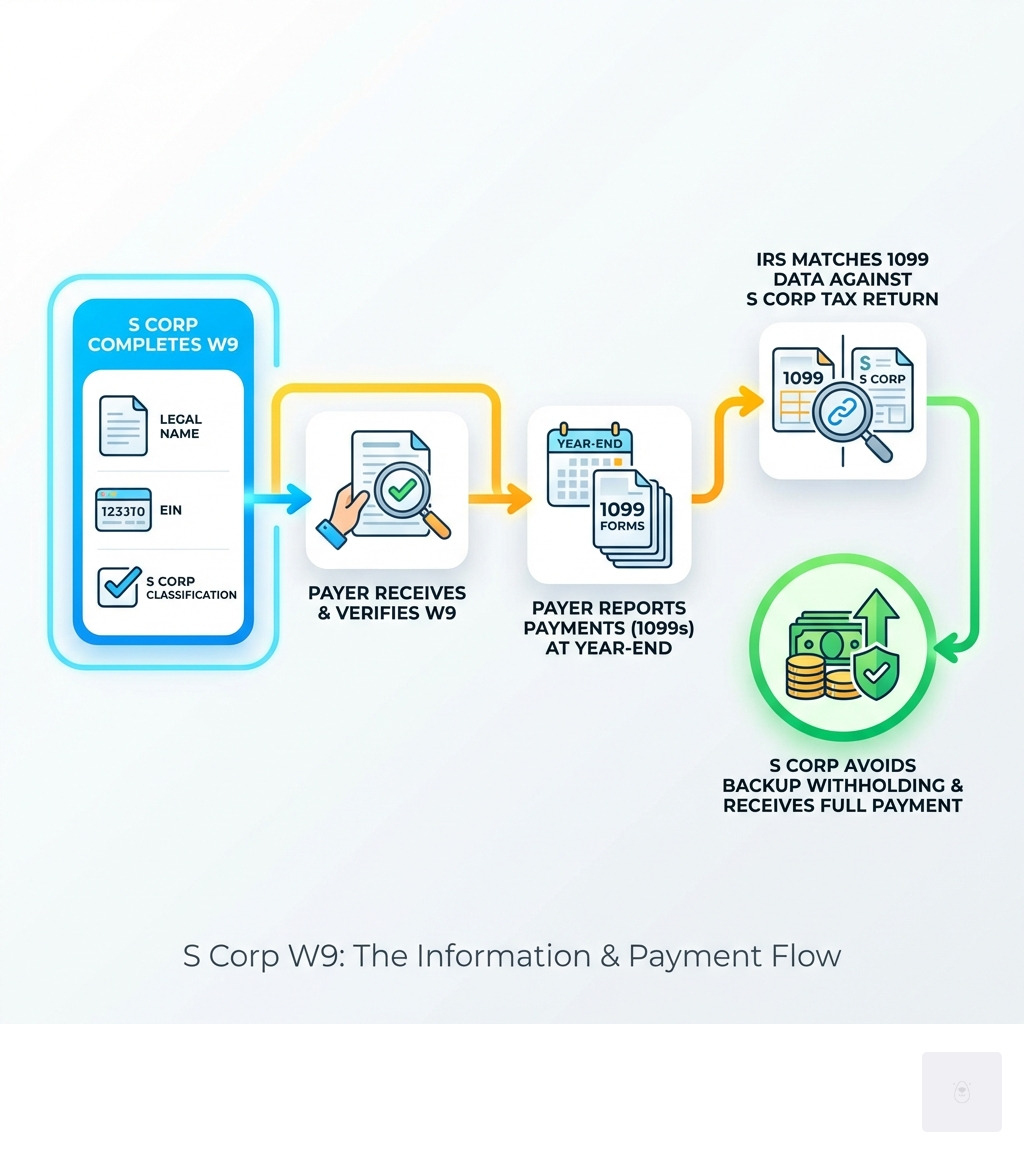
The W9 form serves a dual purpose for your S corporation. For payers, it provides the information they need to file accurate 1099 forms and avoid backup withholding (a 24% penalty withheld from your payments). For your S corp, it ensures you receive full payment and maintains proper IRS compliance.
Getting the W9 wrong creates real problems. If your classification doesn’t match IRS records, payers may be required to withhold 24% of your payments until you correct the form. If you accidentally check “C Corporation” instead of “S Corporation,” it can trigger incorrect tax reporting that follows you into tax season.
Start filling your W9 now at https://fillablew9.com/apply.
I’m Haiko de Poel, and through my work at Mass Impact and Palmetto Surety Corporation, I’ve helped hundreds of businesses steer tax compliance and administrative processes, including proper W9 for S corp completion that prevents payment delays and IRS complications. This guide will walk you through every detail so you get it right the first time.
S Corp Essentials: What to Know Before Filling Out a W-9
Before we dive into the specifics of completing your W-9, let’s ensure we’re all on the same page about what an S corporation is and why its tax classification is so important. This understanding forms the bedrock of accurate W-9 completion.
What is an S Corporation?
An S corporation is a special federal tax classification for certain small business corporations. Unlike a traditional C corporation, an S corp elects to pass corporate income, losses, deductions, and credits through directly to its shareholders for federal tax purposes. This means the S corporation itself generally does not pay federal income tax. Instead, shareholders report their share of the S corporation’s profits and losses on their personal tax returns (Form 1040) and pay taxes at individual income tax rates. This unique tax structure helps S corps avoid the “double taxation” that C corporations face, where corporate profits are taxed once at the corporate level and again when distributed to shareholders as dividends.
For more detailed information, you can always refer to the official IRS S corporations page: https://www.irs.gov/businesses/small-businesses-self-employed/s-corporations.
How to Qualify and Elect S Corp Status
Electing S corp status isn’t just a matter of checking a box; there are specific requirements set by the IRS that your business must meet. Once these are satisfied, you formally elect the status with the IRS.
To qualify as an S corporation, your business must meet several criteria:
- It must be a domestic corporation.
- It can have no more than 100 shareholders.
- Shareholders must be individuals, certain trusts, or estates. Partnerships, corporations, and non-resident alien shareholders are generally not allowed.
- The corporation can only have one class of stock.
- It must not be an ineligible corporation (e.g., certain financial institutions, insurance companies, and domestic international sales corporations).
Once your business meets these requirements, you elect S corporation status by filing IRS Form 2553, “Election by a Small Business Corporation.” This form must be signed by all shareholders and submitted to the IRS. Once approved, your business is taxed as an S corporation until you revoke the election or lose eligibility. You can find more information and download the form here: https://www.irs.gov/pub/irs-pdf/f2553.pdf.
How to Complete the W9 for S Corp: A Step-by-Step Guide
Now that we understand the foundations, let’s get down to the nitty-gritty of filling out the W9 for S corp. This section provides a line-by-line walkthrough to ensure your form is completed accurately and compliantly. The goal is to provide your correct Taxpayer Identification Number (TIN) and certification to any entity that needs to report payments made to your S corp.
Lines 1-7: Business Information and Exemptions
When a payer requests a W-9 from your S corporation, they are essentially asking for your business’s identity for tax reporting purposes. Here’s how to steer the first part of the form:
- Line 1: Legal Name
- Enter the full legal name of your S corporation exactly as it appears on your IRS tax documents and incorporation papers. Do not use trade names or abbreviations here.
- Line 2: Business Name/DBA
- If your S corporation operates under a different business name, trade name, or “doing business as” (DBA) name, enter it on this line. Otherwise, you can leave it blank.
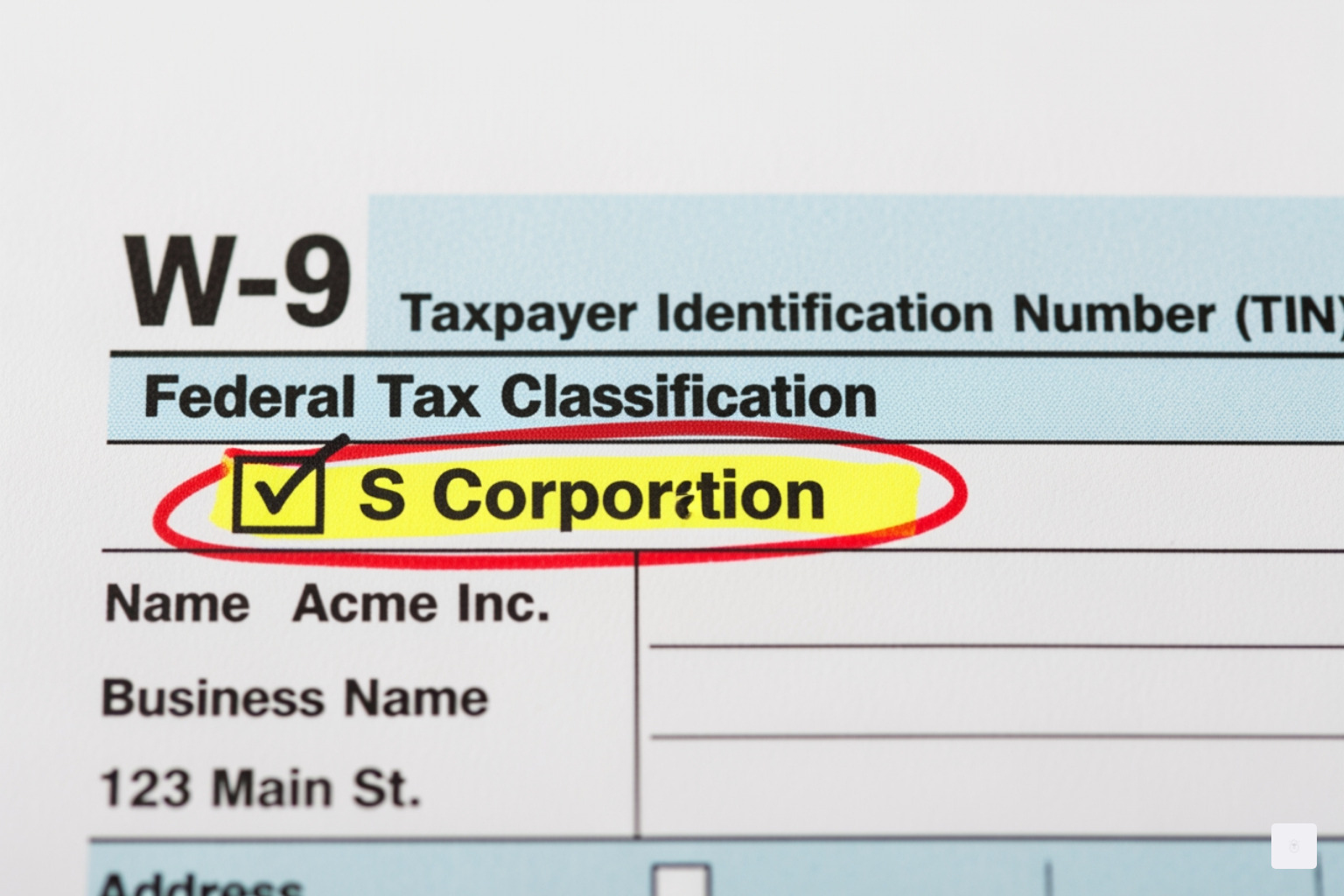
- Line 3: Federal Tax Classification
- This is where your S corp truly shines! You’ll see a series of checkboxes. Make sure to check the box labeled “S Corporation”. This tells the payer and the IRS exactly how your entity is classified for federal tax purposes.
- Line 4: Exemption code ‘5’ (if applicable)
- This line is for entities that are exempt from backup withholding and/or FATCA reporting. For most S corporations, you will enter ‘5’ in this box. Corporations are generally exempt from backup withholding, especially for payments like interest and dividends. However, it’s crucial to note that corporations are not exempt from backup withholding for payments made in settlement of payment card or third-party network transactions. Always consult the official instructions for Form W-9 or a tax professional if you’re unsure about specific exemption codes.
- Lines 5 & 6: Address
- Enter the mailing address of your S corporation. This should be the address where you receive mail, including tax documents. Line 5 is for the street address, and Line 6 is for the city, state, and ZIP code.
- Line 7: Account number (if required)
- This line is optional and typically used by the requester to help them track payments or accounts. If the entity requesting your W-9 asks you to include an account number (e.g., a customer account number or vendor ID), enter it here. Otherwise, you can leave it blank.
You can download the most recent version of Form W-9 directly from the IRS website: https://www.irs.gov/pub/irs-pdf/fw9.pdf.
Part I & II: TIN and Certification
These final sections of the W-9 are crucial for verifying your S corporation’s identity and confirming the accuracy of the information provided.
- Part I: Enter Employer Identification Number (EIN)
- For an S corporation, your Taxpayer Identification Number (TIN) is always your Employer Identification Number (EIN). Enter your nine-digit EIN in the designated box in Part I. Never use a shareholder’s Social Security Number (SSN) here. An S corporation is a separate legal entity, and its EIN is its unique identifier for tax purposes.
- Part II: Certification, signature, date
- This section requires you to certify, under penalties of perjury, that the information provided on the form is correct. You must confirm that:
- The EIN you provided is correct.
- You are not subject to backup withholding (or are exempt).
- You are a U.S. citizen or other U.S. person.
- Any FATCA code(s) entered (if applicable) are correct.
- An authorized officer of the S corporation must sign and date the form. By signing, you are confirming the accuracy of all the details. Providing false information or failing to furnish a correct TIN can lead to penalties, including fines.
- This section requires you to certify, under penalties of perjury, that the information provided on the form is correct. You must confirm that:
Completing your W9 for S corp accurately is a straightforward process when you know what to do. It helps ensure your payments are processed smoothly and that you avoid any tax compliance headaches down the road.
Don’t waste time with paper forms — complete your secure W9 online at https://fillablew9.com/apply.
S Corp vs. Other Entities: A W-9 Comparison
Understanding how your S corporation’s W-9 classification differs from other business structures is vital for compliance. It helps you grasp why your selection on Line 3 is so crucial and what potential errors could mean.
How S Corp W-9 Reporting Differs
The choice you make on Line 3 of Form W-9 directly impacts how payers report income to the IRS and, consequently, how the IRS expects your business to file its taxes.
Here’s a quick comparison of how different entity types fill out their W-9 and how that relates to their primary tax forms:
| Entity Type | W-9 Line 3 Classification | Primary IRS Tax Form | Key Tax Implication |
|---|---|---|---|
| S Corporation | “S Corporation” | Form 1120-S | Pass-through taxation; avoids double taxation; shareholders report income on personal returns (K-1). |
| C Corporation | “C Corporation” | Form 1120 | Corporation pays income tax; potential double taxation (corporate and shareholder levels). |
| LLC (default) | “Individual/sole prop” (single-member) or “Partnership” (multi-member) | Schedule C (sole prop) or Form 1065 (partnership) | Pass-through taxation; members report income on personal returns. |
| LLC (electing S Corp) | “Limited liability company (LLC)” AND “S=S corporation” | Form 1120-S | Pass-through taxation; avoids double taxation; shareholders report income on personal returns (K-1). |
As you can see, selecting “S Corporation” on your W-9 indicates to the IRS that your business will be reporting its income via Form 1120-S, with profits and losses passed through to shareholders. If you check “C Corporation,” the IRS anticipates a corporate tax return under Form 1120. This distinction is critical for accurate tax reporting.
Consequences of Misclassification
Marking the correct classification on your W9 for S corp is not just a formality; it’s a cornerstone of IRS compliance. If your classification on Form W-9 doesn’t match your actual tax election, the IRS may flag the discrepancy, leading to a cascade of problems.
The most immediate and impactful consequence of misclassification or providing an incorrect Taxpayer Identification Number (TIN) is backup withholding. If your W-9 information doesn’t match IRS records, the payer might be required to withhold 24% of your payments. Imagine a chunk of your earnings being held back until the issue is resolved – that’s a direct hit to your cash flow!
Other potential consequences include:
- Delayed Payments: Payers may hold payments until they receive a correctly completed W-9.
- IRS Notices and Scrutiny: Mismatched records can trigger IRS notices to both your S corporation and the payer, potentially leading to further audits or investigations.
- Incorrect 1099 Reporting: The payer will use the information on your W-9 to prepare 1099 forms (e.g., 1099-NEC for non-employee compensation). If your W-9 is incorrect, the 1099 issued to you will also be incorrect, potentially causing issues when you file your own tax return.
- Penalties: Both the payer and your S corporation could face penalties for inaccurate reporting. For instance, failing to supply a correct TIN can result in a $50 penalty. Providing false information that results in no backup withholding can incur a $500 penalty.
The IRS rules are clear: if you fail to supply your correct TIN on Form W-9, you may be subject to backup withholding at a flat 24% rate. This can be a significant headache and is easily avoidable by ensuring your W-9 is always accurate. You can learn more about backup withholding directly from the IRS: https://www.irs.gov/businesses/small-businesses-self-employed/backup-withholding.
W-9 Lifecycle for an S Corp: Updates and Related Filings
A W-9 isn’t a “set it and forget it” form. For your S corporation, it’s part of an ongoing compliance cycle that connects to your annual tax filings and requires updates when your business status changes.
Connecting the W-9 to Annual Tax Filings
The information you provide on your W9 for S corp is the starting point for a chain of tax reporting. Payers use it to issue Form 1099-NEC (for non-employee compensation) or other 1099 forms to your S corporation and the IRS. This external reporting then needs to align with your internal tax filings.
The primary tax form for an S corporation is Form 1120-S, “U.S. Income Tax Return for an S Corporation.” On this form, your S corp reports its income, deductions, gains, losses, etc. Crucially, the profits and losses are then passed through to your shareholders on Schedule K-1 (Form 1120-S), “Shareholder’s Share of Income, Deductions, Credits, etc.” Each shareholder uses their Schedule K-1 to report their share of the S corporation’s income on their personal Form 1040.
The correct classification on your W-9 ensures that the IRS expects to see an 1120-S from your entity, and that any 1099s issued to your S corp align with its pass-through nature. This consistency is key for smooth tax season operations. For more on Form 1120-S, visit: https://www.irs.gov/pub/irs-pdf/f1120s.pdf.
It’s also worth noting that S corporations may be responsible for other tax forms, such as employment taxes (Forms 941, 943, 940) if they have employees (which includes paying a reasonable salary to owner-employees). Starting in 2024, S corporations filing 10 or more returns are required to e-file their Forms 1120-S.
Updating Your W-9 and Requesting from Others
Your S corporation’s W-9 isn’t static. You’ll need to submit an updated W-9 to payers if there’s a change in your entity’s status or information. For example, if your business changes its legal name, address, or, most importantly, its tax classification (e.g., converting from a C corp to an S corp), you must provide a new W-9 to all relevant payers. Failing to do so can lead to mismatched records with the IRS and potential backup withholding.
Conversely, your S corporation will also act as a “requester” of W-9s from your vendors and independent contractors. If your S corp pays an independent contractor $600 or more for services in a calendar year, you are generally required to issue them a Form 1099-NEC. To do this, you first need a completed W-9 from them. It’s best practice to request a W-9 from any new vendor or contractor before services begin, to ensure you have their correct TIN for year-end reporting. If a contractor is hesitant to provide a W-9, the IRS rules state that you must request it in writing at least three times. If they still don’t provide it, you are required to withhold 24% of their payments until you obtain the information. This highlights why your S corp needs to be as diligent in collecting W-9s as it is in providing its own. This information is crucial for accurately reporting contract labor expenses and avoiding penalties.
Frequently Asked Questions about the W9 for S corp
We know tax forms can be confusing, so let’s tackle some common questions about the W9 for S corp.
Can an LLC check the “S Corporation” box on a W-9?
Yes, an LLC can absolutely check the “S Corporation” box on a W-9, but there’s a crucial prerequisite: the LLC must have first filed IRS Form 2553, “Election by a Small Business Corporation,” to formally elect S corporation tax status with the IRS and received approval. An LLC is a flexible business structure that, by default, is taxed as a sole proprietorship (if single-member) or a partnership (if multi-member). However, an LLC can elect to be taxed as a C corporation or an S corporation. If your LLC has made and received approval for the S corporation election, then on Line 3 of the W-9, you should select “Limited liability company (LLC)” and then specify “S=S corporation” to clarify your tax treatment. Without IRS approval via Form 2553, your LLC remains taxed as its default entity, and you must select that true classification on the W-9 form. You can find Form 2553 here: https://www.irs.gov/pub/irs-pdf/f2553.pdf.
What happens if I check the wrong box on the W9 for my S corp?
Checking the wrong box on your W9 for S corp can lead to several undesirable outcomes. If you incorrectly classify your entity, for example, as a “C Corporation” or “Partnership” when you are an S corp, or vice-versa, the IRS could treat payments made to you incorrectly. This discrepancy can trigger red flags in the IRS system, potentially leading to:
- Backup Withholding: Your payers might be required to withhold 24% of your payments, treating your S corp as if it hasn’t provided a correct TIN. This impacts your cash flow significantly.
- IRS Record Mismatches: The IRS will expect tax filings consistent with the classification you checked. If you check “C Corporation” but file an 1120-S, it creates a mismatch that can lead to IRS notices and requests for clarification.
- Delayed Payments: Payers might delay payments until they receive a corrected W-9, causing further financial strain.
- Incorrect 1099 Forms: The payer will issue a 1099 based on the incorrect classification, potentially complicating your S corp’s tax return.
Correcting the form quickly and submitting it to all relevant payers is essential to resolve these issues and ensure your payments and tax reporting remain accurate.
Do I use my SSN or EIN on the W9 for an S corp?
For an S corporation, you must always use your Employer Identification Number (EIN) on the W-9 form. An S corporation is a distinct legal entity separate from its owners for tax purposes, even though its profits and losses pass through to shareholders. Therefore, its federal tax identification number is its EIN, not an individual shareholder’s Social Security Number (SSN). Using an SSN on a W-9 for an S corp would be incorrect and could lead to the penalties and issues described above, including backup withholding and IRS mismatches. Ensure the EIN you provide on the W-9 matches the one assigned to your S corporation by the IRS.
Conclusion: Simplify Your S Corp’s W-9 Compliance
Mastering the W9 for S corp isn’t about navigating a maze; it’s about understanding a few key details that ensure your business runs smoothly and stays compliant with the IRS. By accurately selecting your S corporation classification, providing your correct EIN, and understanding the implications of your choices, you protect your cash flow, avoid penalties, and simplify your annual tax reporting.
Correctly completing the W-9 is a simple but powerful step for every S corporation to ensure smooth payments and tax compliance. Using a secure, streamlined solution like Fillable W9 removes the guesswork and protects your sensitive information. We offer an intuitive platform to help you complete your W-9 accurately and securely, taking the stress out of tax compliance.
✅ Ready to complete your W9 in minutes? Apply here now.