
Stop Licking Envelopes and Pay Your 1040 Estimated Tax Online
Pay Your Taxes Without Touching an Envelope: The Quick Guide to 1040 Estimated Tax Payment Online

Making a 1040 estimated tax payment online takes just a few minutes using free IRS tools — no envelope, no stamp, no waiting in line.
Here’s how to pay your estimated taxes online, fast:
- Go to IRS Direct Pay at IRS.gov
- Select “Estimated Tax” as your payment reason
- Choose Form 1040-ES as the applicable tax form
- Enter your bank account details (routing + account number)
- Pick your payment date and submit — no sign-in required
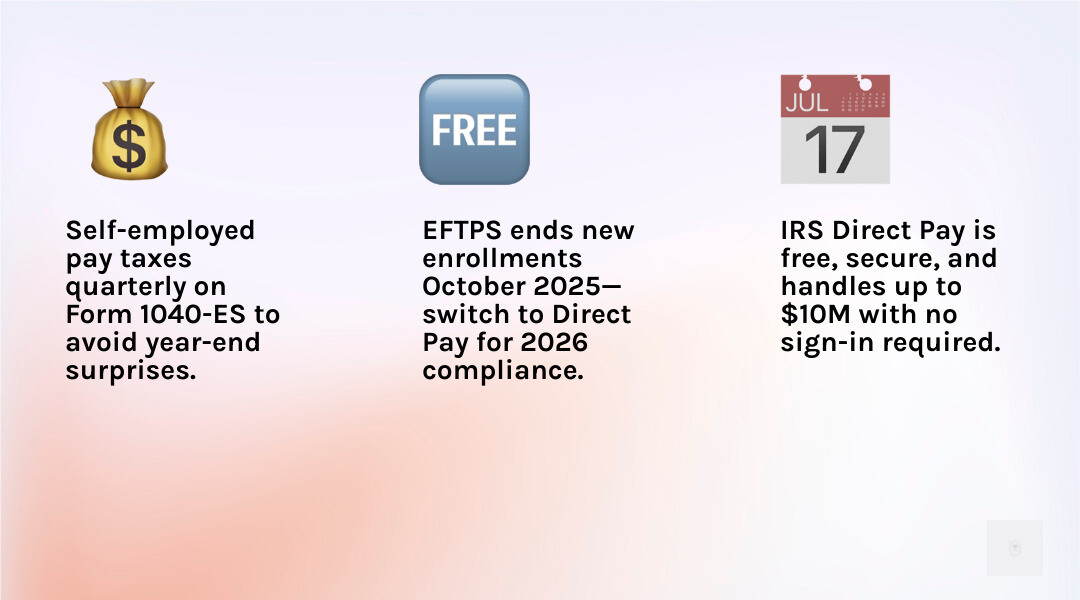
IRS Direct Pay is free, secure, and accepts payments up to $10 million per transaction. You can cancel or change a scheduled payment within 2 business days.
If you’re self-employed, freelancing, or earning income without automatic withholding, the IRS expects you to pay taxes as you earn — not just at year-end. That means four quarterly payments per year, and missing them can trigger penalties even if you settle up in April.
The good news? The IRS has made it easier than ever to pay online — and as of October 2025, the old EFTPS system is no longer accepting new individual enrollments, so IRS Direct Pay and your IRS Online Account are now the go-to options for most people.
I’m Haiko de Poel, a digital marketing strategist with deep experience helping freelancers and small business owners navigate online compliance tools — including 1040 estimated tax payment online workflows that save time and reduce costly errors. Let’s walk through exactly what you need to know to stay compliant and penalty-free in 2026.
Easy 1040 estimated tax payment online glossary:
Who Must Make a 1040 Estimated Tax Payment Online?
In the eyes of the IRS, everyone is on a “pay-as-you-go” plan. While W-2 employees have taxes sliced out of every paycheck, those of us running businesses or working as independent contractors have to handle that slice ourselves.

Generally, you must make a 1040 estimated tax payment online if you expect to owe at least $1,000 in tax for the year after subtracting your withholding and credits. This requirement typically applies to:
- Self-employed individuals and sole proprietors.
- Freelancers and gig economy workers.
- Partners in a partnership or S corporation shareholders.
- Individuals with significant income from interest, dividends, alimony, or rent.
If you are just starting your freelance journey, the first step to compliance is often providing your clients with a fillable W9 so they can report your earnings correctly. Once you start receiving those payments, it is your responsibility to use Form 1040-ES to calculate and submit your share to Uncle Sam.
How to Calculate Your 1040 Estimated Tax Payment Online
To figure out your payment, you’ll need to estimate your expected adjusted gross income (AGI), taxable income, taxes, deductions, and credits for the year. Using your prior year’s tax return is the best starting point.
For 2026, keep these key figures in mind:
- Standard Deductions: $32,200 for Married Filing Jointly, $24,150 for Head of Household, and $16,100 for Single filers.
- Self-Employment Tax: This covers Social Security and Medicare. For 2026, the Social Security tax applies to the first $184,500 of earned income.
- Safe Harbor Rules: To avoid penalties, you generally need to pay the smaller of 90% of your current year’s tax or 100% of the tax shown on your prior year’s return.
2026 Quarterly Due Dates and Deadlines
The IRS doesn’t just want one lump sum; they want their cut in four installments. If you don’t pay enough by each specific deadline, you could face an underpayment penalty even if you are due a refund when you file your return.
For the 2026 tax year, the deadlines for a 1040 estimated tax payment online are:
- 1st Payment: April 15, 2026 (Income earned Jan 1 – March 31)
- 2nd Payment: June 15, 2026 (Income earned April 1 – May 31)
- 3rd Payment: September 15, 2026 (Income earned June 1 – Aug 31)
- 4th Payment: January 15, 2027 (Income earned Sept 1 – Dec 31)
Note: If a due date falls on a Saturday, Sunday, or legal holiday, the payment is considered timely if made on the next business day.
Want to stay ahead of the curve? You can learn more about how it works and set up reminders so you never miss a quarterly window.
Best Ways to Submit Your 1040 Estimated Tax Payment Online
Gone are the days of paper vouchers and “check’s in the mail” anxiety. Today, you have several secure digital paths to ensure your money reaches the Treasury instantly.
- IRS Direct Pay: The gold standard for individuals. No registration required.
- IRS Online Account: Great for tracking your payment history and seeing what you owe.
- IRS2Go App: Perfect for making a payment from your phone while waiting for a flight or a coffee.
- Debit/Credit Cards: Available through third-party processors (fees apply, so use this as a last resort).
- Same-Day Wire: Necessary if you are moving massive amounts of money quickly.
Before you pay, ensure your initial paperwork is in order. You can check our features to see how we help you manage the W-9 process that kicks off your tax cycle.
Using IRS Direct Pay for 1040 Estimated Tax Payment Online
IRS Direct Pay is the most popular method for a reason: it’s free. You pay directly from your checking or savings account.
Key Benefits:
- No Sign-in: You verify your identity using info from a prior year’s tax return.
- High Limits: You can pay up to $10 million per transaction.
- Flexibility: You can schedule payments up to 365 days in advance and cancel or change them within a two-day window of the scheduled date.
To use it, simply visit the IRS website, select “Make a Payment,” and follow the prompts for “Estimated Tax.” You will receive a confirmation number immediately—save this for your records! You can also view our pricing for tools that help you stay organized throughout the year.
The Shift from EFTPS for 1040 Estimated Tax Payment Online
There is a major change coming to the Electronic Federal Tax Payment System (EFTPS). Historically, many high-earners used EFTPS for its advanced scheduling features. However, effective October 17, 2025, individual taxpayers can no longer create new EFTPS enrollments.
The IRS is pushing all individuals toward Direct Pay or the IRS Online Account. By September 2026, the transition for individuals is expected to be complete. If you are an existing user, you can still use it for now, but don’t get too comfortable—it’s time to get used to the Online Account interface. If you have questions about these shifts, read our FAQ for more details.
Avoiding Underpayment Penalties and Understanding Exceptions
The IRS isn’t known for its leniency, but there are “Safe Harbor” rules designed to protect you from penalties.
To avoid the sting of Form 2210 (the underpayment penalty form), aim for one of these targets:
- The 90% Rule: Pay at least 90% of the tax you expect to owe for the current year.
- The 100% Rule: Pay 100% of the tax shown on your return for the prior year.
- The 110% Rule: If your AGI was over $150,000 ($75,000 if married filing separately), you must pay 110% of the prior year’s tax.
Exceptions to the Rule:
- No Prior Liability: If you had no tax liability last year, were a U.S. citizen for the full year, and your prior tax year covered 12 months, you generally don’t owe estimated taxes.
- Farmers and Fishermen: You have different rules and can often make a single payment by mid-January.
- Disaster Relief: If you live in a federally declared disaster area, the IRS often grants automatic extensions for estimated payments.
Frequently Asked Questions about Estimated Taxes
What happens if I overpay or underpay my estimated taxes?
If you overpay, don’t sweat it. When you file your annual return, you can either get that money back as a refund or apply it to next year’s estimated taxes. If you underpay, the IRS will calculate a penalty based on how much you owed and how many days it remained unpaid. They essentially charge you interest for “borrowing” the money you should have sent in quarterly.
Can I make payments more frequently than once a quarter?
Absolutely. While the IRS sets four specific deadlines, you aren’t restricted to them. If it’s easier for your cash flow, you can make a 1040 estimated tax payment online every week or every month. As long as your total for the quarter hits the required mark by the deadline, the IRS is happy.
Are there special rules for high-income taxpayers?
Yes. As mentioned earlier, if your adjusted gross income exceeds $150,000, the “Safe Harbor” threshold jumps from 100% of your prior year’s tax to 110%. This prevents high-earners from significantly underpaying when their income spikes year-over-year.
Conclusion
Managing your taxes doesn’t have to involve a drawer full of stamps and a trip to the post office. By switching to a 1040 estimated tax payment online workflow, you gain security, speed, and a digital paper trail that makes tax season a breeze.
At Fillable W9, we are committed to making tax compliance simple and paperless. Whether you’re a freelancer sending out your first W-9 or a seasoned pro managing multiple income streams, using digital tools is the best way to stay on the right side of the IRS.
Start filling your W9 now at https://fillablew9.com/apply.
Don’t waste time with paper forms — complete your secure W9 online at https://fillablew9.com/apply.
✅ Ready to complete your W9 in minutes? Apply here now