
Why the W9 Form for Churches Matters More Than You Think

The W9 form for churches is a critical tax document for religious organizations, used when paying contractors and receiving payments for services. Here’s what you need to know:
When Churches Need a W9:
- Requesting a W9: When you pay contractors, vendors, or speakers $600+ annually (to issue them a 1099-NEC)
- Providing a W9: When another organization pays your church for services and requests your tax information
- Key Information Required: Your church’s legal name, EIN (Employer Identification Number), and 501(c)(3) status
- Important Note: Churches do NOT need W9s from employees (they use W-4 forms instead) or from other nonprofits receiving grants/donations
Many church administrators struggle with the W9. While typically tax-exempt under 501(c)(3), churches have reporting obligations. When paying independent contractors $600 or more, you must report it to the IRS on Form 1099-NEC. The W9 is how you collect the necessary information to do so correctly.
I’m Haiko de Poel. Through my work with nonprofits on financial compliance, I’ve helped countless organizations steer tax forms like the W9. My experience shows that understanding this simple form can save ministries from costly penalties and administrative headaches.
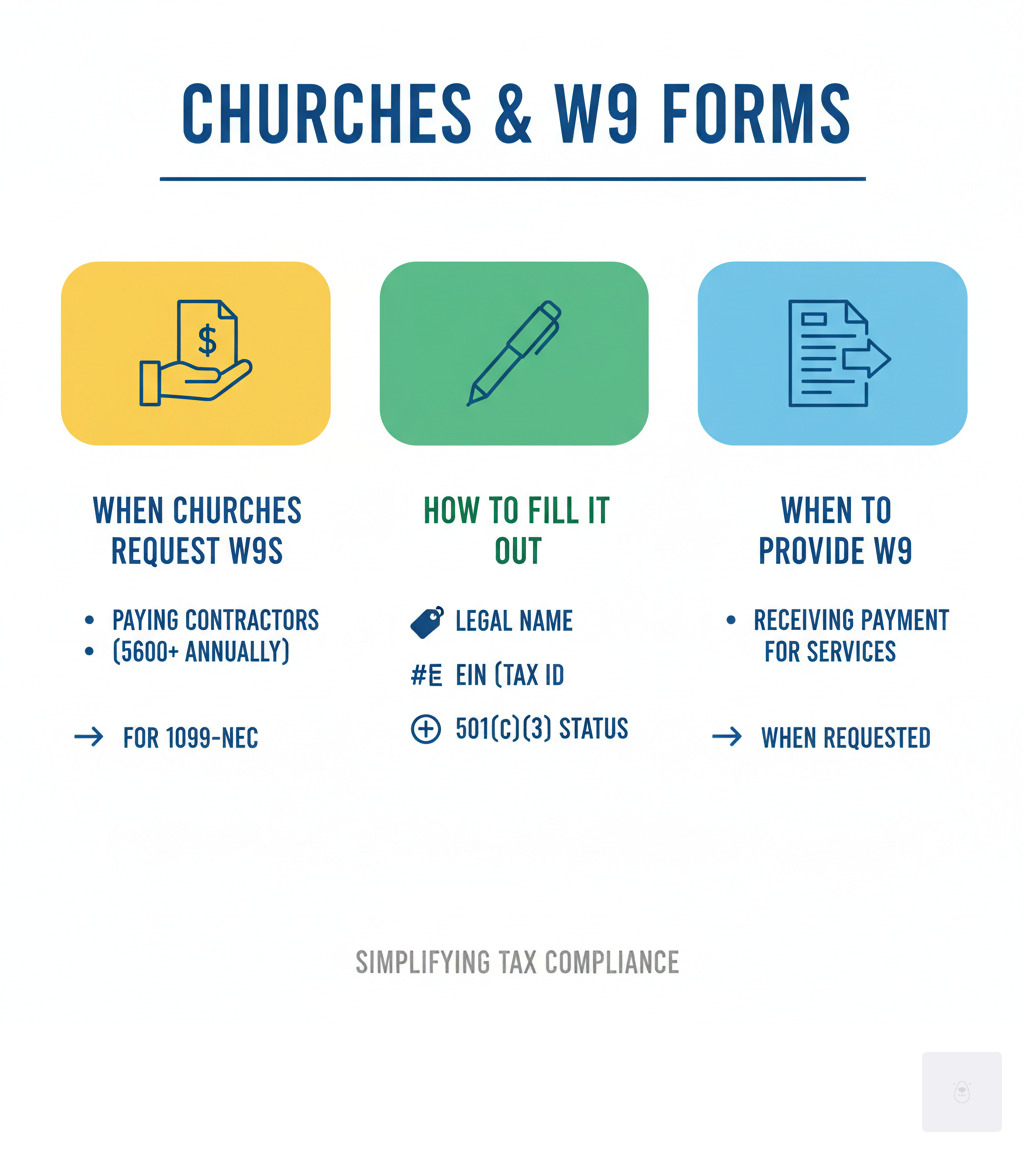
When Does Your Church Need to Use a W-9?
Let’s clarify when your church needs to handle a W9 form for churches. It’s simpler than you might think once you understand the two roles your church plays.
Your church interacts with W-9 forms in two ways: as the payer (requesting a W-9 from someone you hire) and as the payee (providing your church’s W-9 to someone paying you). Both are vital for IRS compliance and accurate financial records.
Here’s the basic principle: when your church pays an independent contractor $600 or more during a calendar year, you must report those payments to the IRS using Form 1099-NEC (Nonemployee Compensation). To complete the 1099-NEC accurately, you need the contractor’s Taxpayer Identification Number, which the W-9 provides.
The other side of this coin happens when your church receives payment for services. For example, you might rent out your fellowship hall or provide consulting services. When the $600 threshold applies to what they’re paying you, that organization will likely request your church to complete a W-9 to fulfill their own reporting obligations.
An important distinction is donations versus payments for services. If someone gives your church a pure donation, a W-9 generally isn’t required. However, some organizations have internal policies requiring W-9s from all recipients, even for gifts. While not legally obligated for a true donation, providing one can maintain good relationships.
The official name for this document is the “Request for Taxpayer Identification Number and Certification,” and you can learn more directly from the source at the IRS website’s page about Form W-9.
Requesting a W-9 from Vendors and Contractors
When hiring independent contractors, requesting a W9 form for churches should be a first step. This isn’t busy work—it’s due diligence to ensure you have what you need for tax compliance.
Think about the talented people your church brings in: guest speakers, musicians for special services, maintenance services, consultants, freelance graphic designers, and construction workers.

If you anticipate paying any of these contractors $600 or more in a calendar year, get their W-9 on file from the start. This triggers your obligation to issue Form 1099-NEC at year-end, and having the W-9 ready prevents frantic December phone calls. Your future self will thank you.
Once you receive a completed W-9, treat it with care. These forms contain sensitive vendor information like Taxpayer Identification Numbers, so protection is essential. Store them securely in a locked cabinet or your accounting software’s secure storage. Good record keeping means maintaining W-9s for the duration of your relationship with a contractor, plus at least four years after filing their final 1099. This protects your church in case of future IRS questions.
Providing a W-9 When Your Church Receives Payment
Your church will also need to provide its own W9 form for churches. This happens when another organization pays your church for services and needs your tax information for their own IRS reporting.
The most common scenarios are building rental and consulting services. If your church receives $600 or more annually for renting out facilities or for staff providing training, expect to provide a W-9.
Grant requirements may also involve W-9 requests. Granting organizations might ask for your W-9 to confirm your tax-exempt status and for their internal records, though grants don’t trigger 1099 reporting like service payments do.
When your church provides a W-9, you confirm your legal name, address, and Employer Identification Number (EIN). Never use a Social Security Number. This simple form helps the paying organization correctly report payments to the IRS if required.
Even with tax-exempt status under 501(c)(3), providing a W-9 when requested for services allows other organizations to maintain proper IRS compliance. It’s a straightforward process that keeps everyone in good standing.
Ready to complete your W9 in minutes? Apply here now.
How to Fill Out the W9 Form for Churches and Non-Profits
Completing a W9 form for churches is manageable. You’re providing your church’s official name, address, and tax ID, then certifying its accuracy. The key is to ensure the information exactly matches what the IRS has on file for your church.

Always use the most current version of the official IRS form W-9 from the IRS website. Tax forms are updated occasionally, so downloading a fresh copy ensures you’re using the latest revision.
Step-by-Step Guide to the W9 form for churches
Let’s walk through each section of the form for your church:
Line 1: Name (as shown on your income tax return) requires your church’s complete legal name as it appears in IRS records (e.g., from your articles of incorporation or EIN letter). No abbreviations.
Line 2: Business name/disregarded entity name, if different from above is for a DBA (doing business as) name. If your legal name is long but you’re known by a shorter name, enter it here. Otherwise, leave this line blank.
Line 3: Federal tax classification is critical. Check the box for “Other,” and in the blank space, write: “Nonprofit Corporation Exempt Under IRC Section 501(c)(3)” or a similar designation. This clarifies your tax-exempt status.
Line 4: Exemptions can usually be left blank for most churches. While nonprofits are generally exempt from backup withholding, you typically don’t need to enter a code unless specifically advised by an accountant.
Lines 5 & 6: Address should be your church’s complete mailing address. Ensure it’s current and accurate for receiving tax documents.
Part I: Taxpayer Identification Number (TIN) is where you enter your church’s nine-digit Employer Identification Number (EIN). Never use a Social Security Number. Your EIN is your church’s unique identifier with the IRS.
Part II: Certification requires a signature from an authorized person, like a pastor, treasurer, or board president. An unsigned W-9 is not valid.
Providing Your Church’s Taxpayer Identification Number (TIN)
Your church’s Taxpayer Identification Number is always its Employer Identification Number (EIN). While individual contractors might use an SSN, organizations like churches must use their EIN.
An EIN is a unique nine-digit number the IRS assigns for tax purposes. If your church needs an EIN, you can apply using IRS Form SS-4 online, by fax, or by mail. The online application is fastest, providing an EIN immediately.
If your church has applied for an EIN but hasn’t received it, you can write “Applied For” in the TIN box. You must provide the EIN once you receive it. Be aware that some organizations may hold payment or apply backup withholding until they get your valid EIN.
Protecting your church’s EIN is essential. Transmit completed W-9 forms through secure channels like encrypted email or secure file sharing, and limit access to authorized personnel.
Don’t waste time with paper forms—complete your secure W9 online at https://fillablew9.com/apply/.
W-9 vs. W-4 and Worker Classification: Avoiding Costly Mistakes
A common and costly mistake for churches is worker misclassification. Is a worker an employee or an independent contractor? Getting it wrong can lead to penalties, back taxes, and major headaches. Understanding the difference, and how it relates to the W9 form for churches versus the W-4, is essential for financial management.
The IRS uses a “control test” to determine worker classification. It examines three categories to clarify the working relationship:
- Behavioral Control: Does the church control what the worker does and how they do their job?
- Financial Control: Does the church control business aspects like how the worker is paid, if expenses are reimbursed, and who provides tools?
- Type of Relationship: Are there written contracts or employee-type benefits (insurance, vacation)? Is the relationship ongoing and the work a key part of church operations?
The level of control your church exercises is the key indicator. Misclassifying an employee as an independent contractor can lead to penalties, back taxes, and fines. When in doubt, it’s often wiser to treat a worker as an employee or consult a tax professional.

Understanding the W9 form for churches vs. Form W-4
The W9 form for churches and Form W-4 serve different, often confused, purposes. They are distinct tools in your financial toolkit.
Form W-9 is for independent contractors and vendors—people paid for services but not on your payroll. It collects their Taxpayer Identification Number so you can report payments of $600 or more on Form 1099-NEC. The contractor is responsible for their own taxes, including self-employment tax. No withholding occurs.
Form W-4 is exclusively for employees. New staff members complete a Form W-4 (Employee’s Withholding Certificate) to tell you how much federal income tax to withhold from their paychecks. As the employer, you also handle Social Security and Medicare taxes. Employees receive a Form W-2 at year-end, not a 1099.
Here’s a quick comparison:
| Feature | Form W-9 | Form W-4 |
|---|---|---|
| Purpose | Collects TIN for independent contractors/vendors for 1099 reporting | Helps employers withhold the correct federal income tax from employee wages |
| Who Fills Out | Independent contractors, vendors, or other entities receiving payment for services | Employees |
| Tax Implications | No tax withholding by the payer; contractor handles their own taxes including self-employment tax | Employer withholds federal income tax, Social Security, and Medicare taxes |
| Year-End Form | Form 1099-NEC issued by the payer to the contractor | Form W-2 issued by the employer to the employee |
| Example | Guest speaker or cleaning service | Church administrator or youth pastor |
When bringing on a new worker, you must decide whether to treat them as an employee (requiring a W-4) or a contractor (requiring an IRS form W-9).
Special Considerations for Clergy
Clergy have a unique “dual-status” for tax purposes. For federal income tax, a minister is typically a church employee. However, for Social Security and Medicare taxes, clergy are generally considered self-employed and must pay their own self-employment taxes (SECA).
This dual status means clergy are not automatically subject to W-4 withholdings, but they can elect to have federal income tax withheld by submitting a W-4. Many find this helpful for managing their tax liability.
Another critical consideration is the housing allowance. This benefit allows ordained ministers to exclude a portion of their income used for housing from their gross income. This allowance must be formally designated in advance by the church’s governing board.
Navigating clergy tax rules can be complex. The IRS Minister Audit Technique Guide offers in-depth information. Consulting a tax professional who understands clergy taxation is highly recommended to avoid costly mistakes.
Ready to complete your W9 in minutes? Apply here now.
Frequently Asked Questions about the W9 form for churches
Managing church finances means getting tax forms right. Here are common questions about the W9 form for churches, answered simply.
What happens if a contractor refuses to provide a W-9?
This scenario is common and puts your church in a tricky position. If a contractor refuses to provide a W-9, the IRS requires you to implement “backup withholding.”
You must withhold 24% of every payment to that contractor and send it to the IRS. This isn’t a penalty on your church; it’s how the IRS collects taxes from contractors who don’t provide a TIN. The contractor loses 24% of their payment, which usually motivates them to provide the W-9. Always request a W-9 before making payments. The IRS provides detailed guidance on requirements for backup withholding.
Does a church need to get a W-9 from another non-profit it pays for services?
This question often confuses church administrators. The short answer is yes: if you pay another nonprofit $600 or more for services in a year, you should request a W-9.
The W-9 helps you determine if you need to issue a Form 1099-NEC. While you generally don’t issue 1099s to corporations (including nonprofits), the W-9 confirms their tax classification. If the nonprofit is structured differently (e.g., a partnership), a 1099-NEC might be required.
Think of the W-9 as an insurance policy. Requesting one ensures you have the information to comply with reporting obligations. Purely charitable grants or donations don’t typically require a W-9 for 1099 reporting. For details, review the Form 1099 instructions.
Where can I get the official IRS Form W-9 and its instructions?
Always go straight to the source. The official IRS Form W-9 (Rev. March 2024) – IRS and its instructions are available for free on the IRS website.
Search “Form W-9 IRS” to find the latest version. Using the current revision is important, as forms are occasionally updated. The downloadable PDF can be printed or filled out digitally. We recommend reading the instructions carefully, as they provide comprehensive details.
To streamline the process, you can also complete your W9 form for churches online in minutes at https://fillablew9.com/apply/.
Conclusion: Streamline Your Church’s Compliance
Managing your church’s tax compliance doesn’t have to be overwhelming. This guide has shown that the W9 form for churches is a cornerstone of good financial stewardship. Properly handling W-9s builds a foundation of transparency, professionalism, and trust.
Every correctly completed W-9 means fewer potential issues during tax season, less scrambling for vendor information, and more peace of mind. It allows your staff to spend less time on paperwork and more time focused on ministry.
Accurate record-keeping is about more than avoiding penalties; it’s about honoring the resources entrusted to your church. Handling administrative tasks with excellence demonstrates good stewardship. The W9 form for churches may seem like a small detail, but getting it right reflects a commitment to doing all things well.
Paperwork is a distraction from ministry. That’s why we created Fillable W9—to make a tedious process simple, secure, and efficient. Whether sending a W-9 for a grant or collecting forms from contractors, our streamlined digital solution saves time and reduces stress.
Your church’s mission is too important to get bogged down in administrative complexity. Let us handle the technical details so you can focus on what you do best—serving your community.
Ready to complete your W9 in minutes? Start filling your W-9 online now at https://fillablew9.com/apply/.