
Why Knowing What Time Taxes Are Due Can Save You From Penalties

Understanding what time taxes are due is critical for every freelancer, contractor, and small business owner. Missing the deadline—even by minutes—can trigger penalties, interest charges, and unnecessary stress.
Here’s what you need to know right away:
Key Tax Time Deadlines:
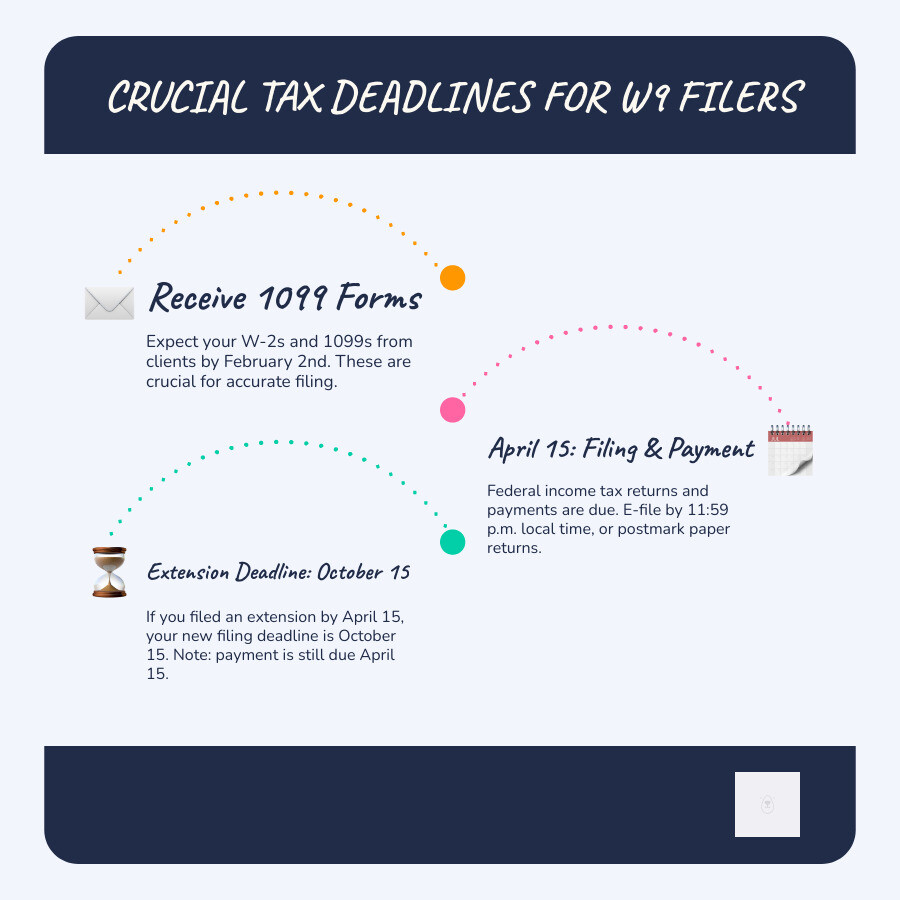
- Federal Tax Returns (e-filed): April 15 by 11:59 p.m. in your local time zone
- Paper Tax Returns: Must be postmarked by April 15
- Payment Deadline: April 15, regardless of whether you file an extension
- Tax Extension Filing: April 15 (extends filing deadline to October 15, but not payment)
- W-2 and 1099 Forms: You should receive these by February 2
If April 15 falls on a weekend or holiday (like Emancipation Day in Washington, D.C.), the deadline shifts to the next business day. The IRS considers e-filed returns on time if transmitted by 11:59 p.m. local time on the due date. For paper filers, your return must be properly addressed, have enough postage, and be postmarked by the deadline.
Why This Matters for W9 Filers:
If you’re a freelancer or contractor, your W9 form directly impacts your tax filing. Your clients use your W9 to issue 1099 forms by late January. Without an accurate W9 on file, you risk delayed 1099s, which means delayed tax filing—and potential penalties if you miss the April 15 deadline. Filing even one day late when you owe taxes triggers a 5% penalty on your unpaid balance for each month you’re late, up to 25%.
The good news? You can avoid this entirely by staying organized and knowing exactly when your forms and payments are due.
Start filling your W9 now at https://fillablew9.com/apply.
I’m Haiko de Poel, and through my work helping businesses streamline their processes and ensure compliance, I’ve seen how confusion around what time taxes are due leads to costly mistakes for freelancers and small business owners. My experience in digital change and business consulting has taught me that simple, secure solutions—like completing your W9 online—eliminate stress and keep you compliant.
Why Tax Deadlines Matter for W9 Filers
For individuals operating as freelancers, independent contractors, or small business owners, the W9 form is often the first step in a chain of tax-related obligations. A W9, or Request for Taxpayer Identification Number and Certification, is used by a business or individual (the payer) to request a Taxpayer Identification Number (TIN) from another business or individual (the payee) to report certain payments made to them. This information is crucial because it allows the payer to accurately issue a Form 1099, which then informs the IRS of income you’ve received.
Why does the IRS care so much about these deadlines? Because they are the backbone of our tax system. Without timely and accurate reporting, the system can’t function efficiently. For freelancers, gig workers, and small businesses, missing these deadlines can have significant repercussions. Not only can it lead to financial penalties, but it can also create administrative headaches, delay potential refunds, and even trigger unwanted attention from the IRS. Imagine the stress of an IRS letter arriving because a client didn’t have an up-to-date W9 from you, leading to a missing 1099 and an incomplete tax return.
We understand that managing these details can feel overwhelming, especially when you’re focused on running your business. That’s why tools like Fillable W9 are so vital. They simplify the process of providing your W9 information securely, ensuring that your clients have what they need to report your income correctly and on time. This proactive approach helps you avoid a cascade of problems down the line, setting you up for a smoother tax season.

The Main Event: What Time Taxes Are Due on Tax Day
The general deadline for filing federal income tax returns for individuals is typically April 15 each year. This is the date when most of us mark our calendars and start gathering our documents. However, this date isn’t set in stone for every single year. If April 15 falls on a weekend or a legal holiday, the deadline is automatically shifted to the next business day. For instance, if April 15th is a Saturday or Sunday, the deadline moves to the following Monday. Similarly, if it coincides with a federal holiday, like Emancipation Day in Washington, D.C., which impacts federal tax deadlines nationwide), the due date adjusts accordingly.
This primary deadline applies to individuals filing federal income tax returns (Form 1040). However, as we’ll explore, there are different deadlines for various entity types and payment schedules. For a comprehensive overview of when to file, the IRS provides valuable resources.
Don’t waste time with paper forms — complete your secure W9 online at https://fillablew9.com/apply.
What Time Are Taxes Due on Tax Day?
When we talk about what time taxes are due, it’s not just about the date, but the precise hour and minute. For electronic filers, the IRS considers your return timely if it’s transmitted by 11:59 p.m. in your local time zone on the due date. So, if you’re in Texas, your e-filed return needs to be sent by 11:59 p.m. Central Time. This local time rule applies universally across the United States, giving everyone until the very end of their day to hit “submit.”
For those who still prefer the traditional method of paper filing, the rules are slightly different. Your return is considered filed on time if it’s properly addressed, has sufficient postage, and is postmarked by the due date. This means you need to get it into the mail stream, with a legible postmark, before the post office closes or the last collection for that day occurs. It’s always a good idea to send it a few days early to avoid any last-minute stress or postal delays.
This precision is crucial because as long as your return is time-stamped on or before the due date, it will be considered on time. This applies to both electronic and paper submissions. For electronic payments, the payment must also be submitted by 11:59 p.m. in your local time zone on the due date to be considered timely.
Filing vs. Payment Deadline: What’s the Difference?
Understanding the distinction between the filing deadline and the payment deadline is key to avoiding penalties. The filing deadline is the date by which your completed tax return (e.g., Form 1040) must be submitted to the IRS. This is the day you declare your income, deductions, and calculate your tax liability.
The payment deadline, on the other hand, is the date by which any taxes you owe must be paid to the IRS. For most individual taxpayers, these two deadlines coincide: April 15. However, this can change if you request an extension. An extension typically grants you more time to file your return, but it does not extend the time you have to pay any taxes you owe. We’ll dig deeper into extensions shortly, but if you anticipate owing taxes, you should pay them by the original April 15 deadline, even if you’re filing an extension. The IRS’s Topic No. 301 provides further clarity on when, how, and where to file.
W9s, 1099s, and Tax Deadlines: What You Need to Know
For freelancers, independent contractors, and small businesses, the journey to tax day often begins with the W9 form. When a client or payer needs to report payments of $600 or more to you, they’ll first request a W9. This form provides them with your correct Taxpayer Identification Number (TIN) – usually your Social Security Number (SSN) or Employer Identification Number (EIN) – and certifies that you are an independent contractor, not an employee.
Once they have your W9, your clients use this information to generate Form 1099, which reports the income they paid you throughout the year. These 1099 forms (such as 1099-NEC for nonemployee compensation or 1099-MISC for miscellaneous income) are typically required to be sent to you by January 31 of the year following the tax year. For example, for income earned in one calendar year, you should receive your 1099s by January 31 of the next year. This is a critical deadline for you because you need these forms to accurately prepare your own tax return.
Why does an accurate W9 matter so much for timely tax filing? Without a correct W9 on file with your clients, they might not be able to issue your 1099 forms on time, or they might issue them with incorrect information. This can lead to delays in your ability to file your own tax return, potentially pushing you past the April 15 deadline and exposing you to penalties. Ensuring your W9 is accurate and submitted promptly to all your payers is a foundational step in your tax preparedness.
The IRS also makes updates to various tax forms from year to year. These changes highlight the evolving complexity of tax reporting and the need for accurate foundational documents like the W9.
Here’s a quick table to help you keep track of these interconnected deadlines:
| Form/Action | Deadline (Generally) | Description -|
| W9 Submission | As soon as you start work | Provide to any client who will pay you $600 or more in a year. -|
| 1099-NEC/MISC Receipt | By January 31 | You should receive these forms from your clients detailing your non-employee compensation. -|
| Tax Filing Deadline | April 15 | The deadline to file your federal income tax return (Form 1040). -|
| Tax Extension Deadline| October 15 | If you filed for an extension, this is your new deadline to file your return (but not to pay). -|