
Why Students Need to Know How to Fill Out a W-9

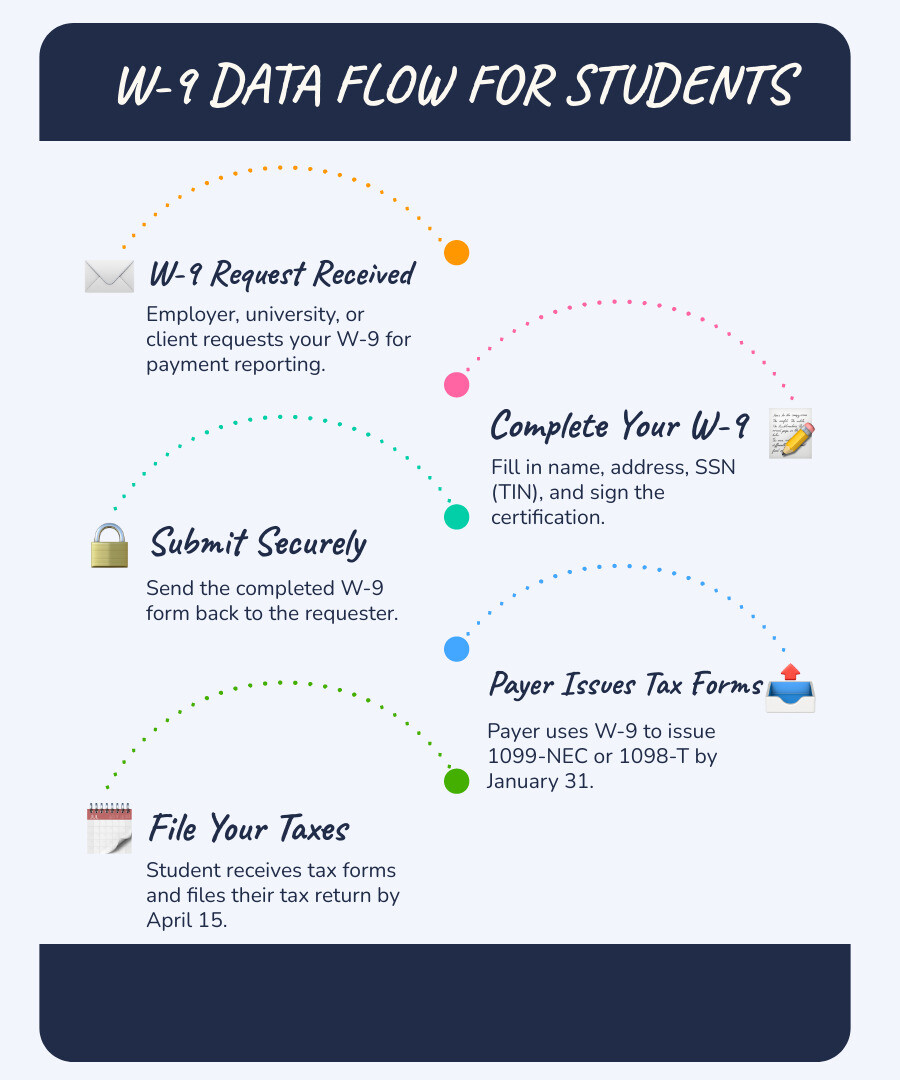
How to fill out a w9 as a student is straightforward once you understand the basics. Here’s the quick answer:
- Enter your name exactly as shown on your tax return (Line 1)
- Skip the business name line unless you operate under a DBA (Line 2)
- Check “Individual/sole proprietor” for your tax classification (Line 3)
- Provide your Social Security Number (SSN) in Part I
- Sign and date the certification in Part II
- Submit securely to whoever requested it
Students often encounter W-9 forms in situations they don’t expect. You might receive one when starting a paid internship, doing freelance work for a client, or even when your university needs to report scholarship or fellowship payments. Unlike the W-4 form you fill out for traditional employment, a W-9 is used when someone pays you as an independent contractor or needs to report certain types of income to the IRS.
The form itself requests your Taxpayer Identification Number (TIN)—usually your SSN—so the payer can issue you a Form 1099 or Form 1098-T at tax time. Educational institutions may also use a similar form called W-9S specifically for student loan reporting and tuition statements. Getting this form right matters because errors can lead to a $50 IRS penalty or 24% backup withholding on your payments.
At Fillable W9, our work involves helping businesses, contractors, and freelancers streamline tax compliance and documentation. We’ve guided countless individuals—including students entering the gig economy—on how to fill out a w9 as a student correctly and securely. Let us walk you through exactly what you need to know.
W-9 vs. W-9S: What’s the Difference for Students?
When you’re a student, you might hear about two different but related forms: the standard Form W-9 and the specialized Form W-9S. While both serve to collect your Taxpayer Identification Number (TIN), their specific uses and who requests them differ. Understanding this distinction is crucial for knowing which fillable W9 form you need to complete.
The standard Form W-9, Request for Taxpayer Identification Number and Certification, is a common IRS form that individuals and businesses use to provide their TIN to an entity that will pay them. This is typically required when you’re working as an independent contractor, freelancer, or vendor, and the payer needs your information to report payments to the IRS, usually on a Form 1099. For example, if you’re a student doing freelance graphic design work for a client, they’ll likely ask you to fill out a W-9 before they pay you. The information you provide on this W9 form allows them to accurately prepare a Form 1099-NEC (Nonemployee Compensation) at the end of the year, detailing the income they paid you. Without this, they might face penalties or be required to withhold taxes from your payments.
Then there’s Form W-9S, Request for Student’s or Borrower’s Taxpayer Identification Number and Certification. This form is specifically designed for eligible educational institutions and student loan lenders. Its primary purpose is to collect your TIN so the institution can accurately report information to the IRS concerning your tuition payments (on Form 1098-T, Tuition Statement) or student loan interest (on Form 1098-E, Student Loan Interest Statement).
According to the IRS, Form W-9S is used by eligible educational institutions to request the taxpayer identification number of students for whom the institution must report 1098-T Tuition Statement information to the Internal Revenue Service. This means if you’re enrolled in credit-based courses and made reportable payments, and your institution has a missing or invalid Social Security Number (SSN) on file, they will likely send you a W-9S. While the use of Form W-9S is optional for institutions—they can use their own forms to gather this information—many choose to use it due to its clear purpose.
Essentially, a W-9 is for income you earn from work as a non-employee, while a W-9S is specifically for educational or student loan-related tax reporting. Both are vital for ensuring accurate tax reporting to the IRS.
Here’s a quick comparison to help clarify the differences:
| Feature | Standard Form W-9 | Form W-9S |
|---|---|---|
| Purpose | To provide TIN for income reporting (e.g., freelance work, rental income). | To provide TIN for educational reporting (e.g., tuition, student loan interest). |
| Who Requests It | Businesses, clients, individuals paying you for services or other income. | Eligible educational institutions or student loan lenders. |
| Common Student Scenarios | Freelance gigs, paid internships, independent contractor work, side hustles. | Enrollment in courses, applying for student loans, receiving scholarships/grants. |
| Related Tax Form | Form 1099 (e.g., 1099-NEC, 1099-MISC). | Form 1098-T (Tuition Statement), Form 1098-E (Student Loan Interest Statement). |
You can find more official information about Form W-9S directly from the IRS. Check out the official IRS page for Form W-9S.
How to Fill Out a W-9 as a Student: A Line-by-Line Guide
Filling out a W9 form doesn’t have to be intimidating. Whether it’s for a freelance client or your university, the process is quite similar. We’ll walk you through each section of the standard fillable W9 form, ensuring you understand exactly what to put where. Accuracy is key to avoiding issues down the line.

When you receive a request for a W-9, the first step is to obtain the official form. You can always download the latest version of the W9 form directly from the IRS website. Once you have it, let’s go line by line.
Part 1: Your Personal Information
This section is all about identifying you to the IRS. For most students, this will be straightforward personal information.
- Line 1: Name (as shown on your income tax return). This is crucial. Enter your full legal name exactly as it appears on your Social Security card and your federal income tax return. If you’ve changed your name, ensure it matches your most recent tax documents.
- Line 2: Business name/disregarded entity name, if different from above. As a student, you’ll generally leave this line blank unless you’re operating a business under a “doing business as” (DBA) name that is different from your legal name, and you’re providing services under that DBA. For example, if you’re a freelance photographer named Jane Doe, but your business is called “Jane’s Photography,” you might put “Jane’s Photography” here. However, if you’re just doing odd jobs under your own name, leave it blank.
- Line 3: Federal tax classification. This is where most students will check the first box: “Individual/sole proprietor/single-member LLC.” If you’re a freelancer or independent contractor, even if you don’t think of yourself as a “business,” the IRS generally considers you a sole proprietor. Only check other boxes if you’ve formally established a different business structure (e.g., C Corporation, S Corporation, Partnership), which is rare for most students.
- Line 4: Exemptions. Most students will leave this blank. This section is typically for specific entities that are exempt from backup withholding or from Foreign Account Tax Compliance Act (FATCA) reporting requirements. If you are unsure, it’s best to consult the W-9 instructions or a tax professional.
- Lines 5 & 6: Address (street address, city, state, and zip code). Enter your complete mailing address. This should be the address where you receive your mail and the one you’ll use on your federal income tax return. If you live in Texas, this would be your Texas street address. Even if you have a temporary address for school, use the address that aligns with your primary tax filing.
- Line 7: List account number(s) here (optional). This line is optional and usually left blank unless the requester specifically asks you to include an account number or a client reference number to help them track payments.
Part I: Providing Your Taxpayer Identification Number (TIN)
This is perhaps the most critical part of the W9 form as it identifies you to the IRS. Your Taxpayer Identification Number (TIN) is a nine-digit number used by the IRS to identify individuals and businesses.
- Social Security Number (SSN): For most U.S. citizens and resident aliens, your TIN will be your Social Security Number (SSN). You’ll enter this in the designated box in Part I.
- Individual Taxpayer Identification Number (ITIN): If you are a non-resident alien or other individual who is required to have a U.S. TIN for tax purposes but is not eligible for an SSN, you would use an Individual Taxpayer Identification Number (ITIN). An ITIN is a nine-digit number issued by the IRS, always beginning with the number 9. International students who need a U.S. TIN but are not eligible for an SSN might use an ITIN.
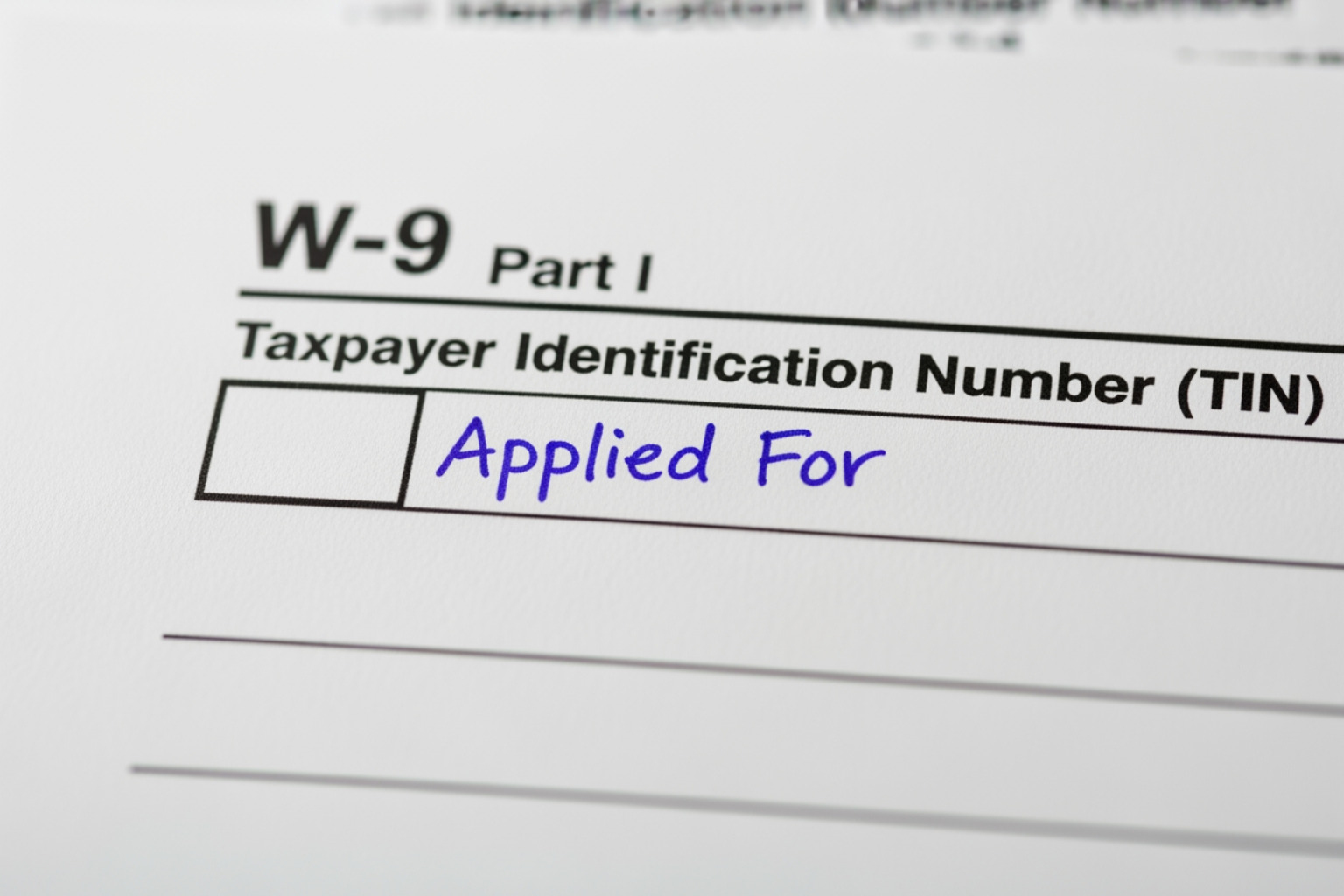
- What to do if TIN is pending: If you have applied for an SSN or ITIN but haven’t received it yet, you can write “applied for” in the space provided for the TIN. However, you must provide your TIN to the requester once you receive it. Be aware that if you write “applied for” and don’t provide a valid TIN within 60 days (or before payments are made, if sooner), the payer might be required to withhold taxes from your payments at a rate of 24%.
Part II: Certification – The Final Step in how to fill out a w9 as a student
The certification section is where you confirm that the information you’ve provided is true and accurate. By signing this part, you are making a legal declaration under penalty of perjury.
The certification has four statements:
- You are a U.S. citizen or other U.S. person (defined below).
- Your TIN is correct.
- You are not subject to backup withholding, OR you are exempt from backup withholding (and you have not been notified by the IRS that you are subject to backup withholding as a result of a failure to report all interest or dividends, or the IRS has notified you that you are no longer subject to backup withholding).
- You are exempt from FATCA reporting (if applicable).
For most students, you will simply sign and date the form. You would only cross out item 2 of the certification if you have been notified by the IRS that you are currently subject to backup withholding. Backup withholding is a mechanism where the payer is required to withhold taxes from your payments and send them directly to the IRS. This usually happens if you fail to provide a correct TIN or underreport income. The backup withholding rate is a flat 24% for 2024 and 2025.
- Signature and Date: Sign your name in the “Signature of U.S. Person” box and enter the date. This certifies that all the information you’ve provided is correct.
- Secure submission methods: After completing and signing your fillable W9, it’s crucial to submit it securely. Never send an unencrypted W-9 via email, as it contains sensitive personal information. If you must send it electronically, ensure both the document and the email are encrypted. Better yet, use a secure online platform or return it in person or by mail. We offer advanced security features to help you send your W9 form securely. Learn more about our secure submission methods.
Special Considerations for International Students
International students, particularly those who are not U.S. citizens or resident aliens, have specific tax considerations when it comes to filling out tax forms. While domestic students typically use their SSN on a W-9, international students may need to steer different requirements.
If you are an international student in Texas, your tax status (non-resident alien or resident alien for tax purposes) determines which form you should complete.
- ITIN vs. SSN: As mentioned earlier, if you are an international student in the U.S. and need a TIN for tax reporting but are not eligible for an SSN, you would apply for an Individual Taxpayer Identification Number (ITIN). This is common for international students who receive taxable scholarships or fellowships, or who earn income from certain types of work. If you have an ITIN, you would use it on the W-9 or W-9S form.
- “Applied For” Status: If you are an international student and have applied for an SSN or ITIN but haven’t received it yet, you can write “applied for” in the TIN section of the W-9S. This is a common allowance for international students who are in the process of obtaining their identification numbers.
- W-8 BEN Form: If you are a non-resident alien and are receiving certain types of U.S. source income (like interest, dividends, royalties, or certain services), you might be asked to complete a Form W-8 BEN, Certificate of Foreign Status of Beneficial Owner for United States Tax Withholding and Reporting (Individuals), instead of a W-9. The W-8 BEN certifies your foreign status and helps determine the correct amount of U.S. tax to withhold from your income. If you’re unsure whether you’re a resident or non-resident alien for tax purposes, or which form to complete, it’s always best to consult with your institution’s international student office or a qualified tax advisor.
- Reporting Income and Currency Exchange: For international students who might be dealing with income in foreign currency, understand that all amounts reported on a U.S. tax return must be expressed in U.S. dollars. If you have income or expenses in a foreign currency, you must translate them into U.S. dollars using the exchange rate prevailing when the item was received, paid, or accrued. The IRS provides guidance on this; you can find more information on their page about foreign currency and currency exchange rates.
Frequently Asked Questions about Filling Out a W-9 as a Student
We understand that navigating tax forms as a student can bring up many questions. Here are some of the most common ones we hear, along with our expert answers.
What happens if I don’t provide my TIN on a W-9 or W-9S?
Failing to provide your Taxpayer Identification Number (TIN) when requested on a W-9 or W-9S can lead to several negative consequences. First, the IRS may fine you $50.00 for each failure to provide a correct TIN unless it was not due to willful neglect.
Second, the entity requesting the form (whether it’s an employer, client, or educational institution) may be required to subject your payments to backup withholding. This means they would withhold 24% of your payment and send it directly to the IRS. So, if you’re expecting a $1,000 payment for freelance work or a taxable scholarship, you might only receive $760. This can significantly impact your cash flow as a student.
Finally, for educational institutions, a missing TIN on a W-9S can complicate the issuance of your Form 1098-T Tuition Statement. While many institutions will still report your 1098-T information to the IRS with or without a TIN, having an accurate TIN ensures that the IRS can properly match the information to your tax record, which is crucial if you plan to claim education tax credits or deductions. Without a correct TIN, you might face delays or issues when filing your tax return.
My scholarship or grant requires a W-9. Is this income taxable?
Receiving a request for a W9 form for a scholarship or grant does not automatically mean that the entire amount is taxable. The W-9 (or W-9S) is simply a mechanism for the institution to collect your TIN for reporting purposes.
Generally, scholarship or grant money used for qualified education expenses is not taxable. Qualified education expenses typically include tuition, fees, and course-related expenses like books, supplies, and equipment required for enrollment or attendance. However, any portion of a scholarship or grant used for non-qualified expenses, such as room and board, travel, or optional equipment, is usually considered taxable income.
For example, if you receive a $10,000 scholarship and $8,000 goes directly to tuition and required fees, that $8,000 is likely non-taxable. But if the remaining $2,000 is used for your off-campus housing, that $2,000 would generally be taxable income. Your educational institution will report these amounts on Form 1098-T.
It’s always a good idea to keep detailed records of how you use your scholarship or grant money. When in doubt, or if you receive a substantial scholarship, we recommend consulting a tax advisor or referring to resources like the Tax filing guide for college students for personalized guidance.
I’m a student doing freelance work. How do I fill out a W-9 as a student for a client?
If you’re a student earning income from freelance work, independent contracting, or a side gig, you’ll almost certainly be asked to fill out a W-9 by your clients, especially if they pay you $600 or more in a calendar year. Here’s how you should approach it:
- Tax Classification: On Line 3 of the W9 form, you will check the box for “Individual/sole proprietor/single-member LLC.” Even if you don’t have a formal business name, the IRS considers you a sole proprietor when you’re working for yourself.
- Using Your SSN: In Part I, you will provide your Social Security Number (SSN) as your Taxpayer Identification Number. Unless you’ve applied for and received an Employer Identification Number (EIN) for your freelance activities (which is optional for sole proprietors), your SSN is the correct TIN to use.
- Receiving Form 1099-NEC: Your client will use the information from your W-9 to prepare and send you a Form 1099-NEC (Nonemployee Compensation) at the end of the year, reporting the income they paid you. This form will detail your gross earnings from them for the year.
- Reporting Self-Employment Income: When you file your own tax return, you’ll use the information from your 1099-NEC (and any other income records) to report your self-employment income on Schedule C (Form 1040), Profit or Loss From Business. This is where you’ll calculate your net profit or loss after deducting eligible business expenses. You may also need to pay self-employment taxes (Social Security and Medicare) on your net earnings if they are $400 or more.
Completing the W9 form accurately for your freelance clients is a critical step in fulfilling your tax obligations as a self-employed student.
Conclusion: From W-9 to Tax Time – What’s Next?
Understanding how to fill out a w9 as a student is an essential skill in today’s economy, whether you’re juggling coursework with a freelance gig or navigating scholarship requirements. We’ve covered the key aspects, from differentiating between the W-9 and W-9S, to a line-by-line guide for filling out the form, and special considerations for international students.
The core message remains: accuracy in providing your Taxpayer Identification Number (TIN) is paramount. It ensures that the entities paying you or reporting on your behalf can fulfill their IRS obligations, and it helps you avoid potential penalties or issues with your own tax filing. Remember to always provide your correct SSN or ITIN, sign the certification, and submit your W9 form securely.
Once you’ve submitted your W-9, you’ve done your part. The next step will happen at tax time when you receive your income statements. If you completed a W-9 for freelance work, expect to receive a Form 1099-NEC from each client who paid you $600 or more. If you submitted a W-9S to your educational institution, you’ll likely receive a Form 1098-T detailing your qualified tuition and related expenses. These forms are crucial for preparing your annual income tax return.
We know that managing tax documents can feel overwhelming, but with the right tools and information, it doesn’t have to be. Our platform, Fillable W9, is designed to simplify this process, allowing you to complete and send your fillable W9 forms securely and efficiently.
✅ Ready to complete your W-9 in minutes? Apply here now