
Fast Track to Tax-Exempt Status: Your Online Filing Solution

The 1023 ez online application is the IRS’s streamlined, electronic-only process for small nonprofits seeking 501(c)(3) tax-exempt status. If your organization anticipates gross receipts of $50,000 or less annually and has total assets under $250,000, you can apply entirely online through Pay.gov in a matter of hours instead of weeks.
Quick Facts: Filing Form 1023-EZ Online
- Where to File: Pay.gov (electronic filing only—no paper applications accepted)
- Filing Fee: $275 (compared to $600 for the full Form 1023)
- Processing Time: Approximately 1-3 months for IRS review
- Eligibility: Organizations with projected annual gross receipts ≤ $50,000 and total assets ≤ $250,000
- Requirements: EIN, organizational documents, and completed eligibility worksheet
Starting a nonprofit comes with big dreams and even bigger paperwork. Form 1023-EZ simplifies the path to federal tax exemption by reducing a traditionally complex 25+ page application to just three pages of essential information. Unlike the full Form 1023, this streamlined version requires no attachments—no bylaws, no financial projections, just straightforward attestations about your organization’s structure and activities.
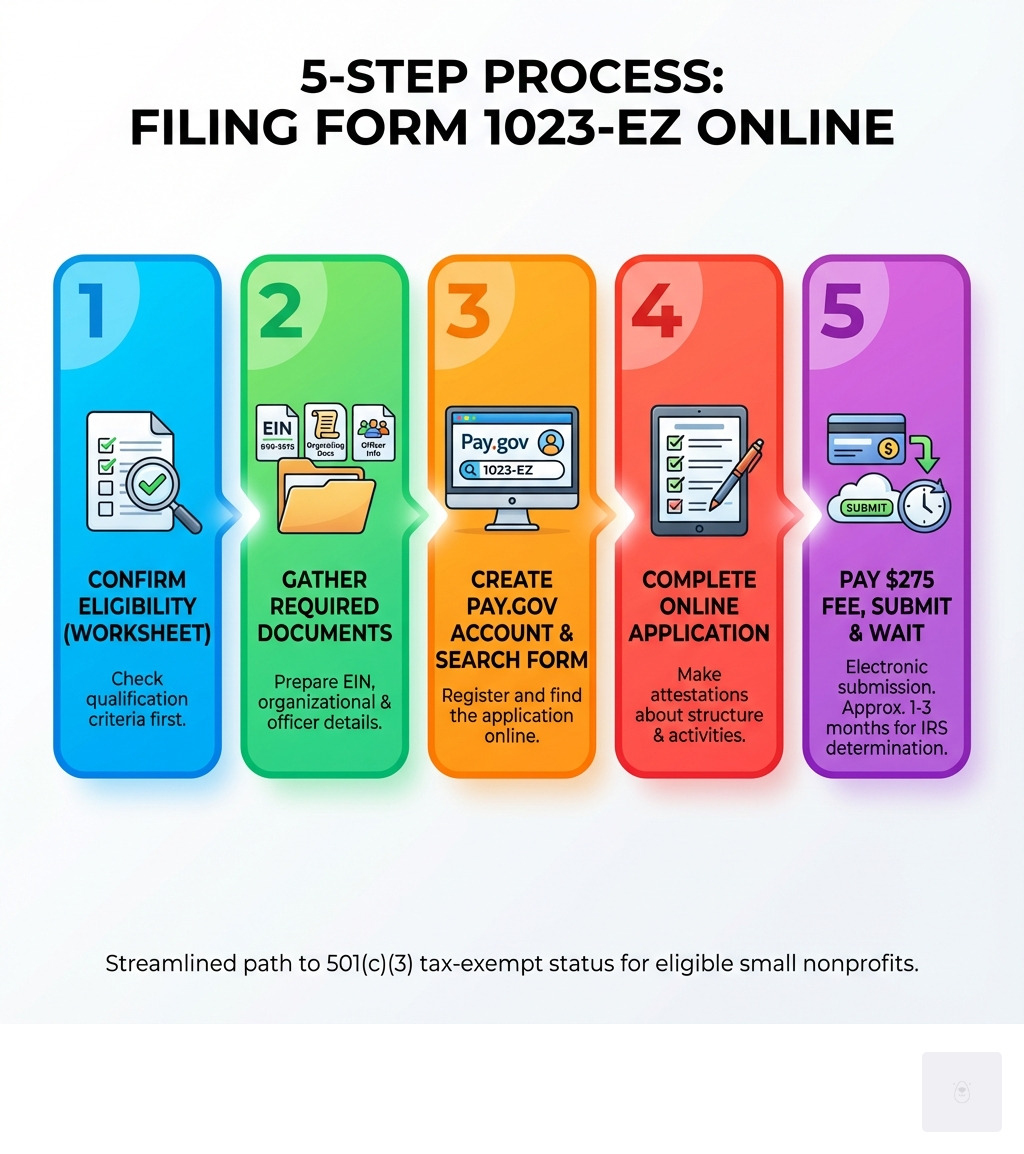
The entire process happens online through the federal government’s payment portal, Pay.gov. You’ll need your Employer Identification Number (EIN), basic information about your organization’s officers and activities, and about 30 minutes to complete the form. Once submitted with the $275 user fee, the IRS typically reviews applications within three months.
However, not every organization qualifies for this expedited route. Churches, schools, hospitals, and certain other entities must use the full Form 1023. That’s why the IRS requires you to complete an eligibility worksheet before you even begin—answering “yes” to any of its questions means you’ll need to take the longer path.
Navigating complex regulatory requirements is a common challenge for new nonprofits. Understanding the 1023 ez online application process is critical for securing your tax-exempt status efficiently. This guide will walk you through each step to ensure your organization can get its tax documentation in order and achieve its mission.
Ready to start your nonprofit’s journey to tax-exempt status? While Form 1023-EZ handles your federal exemption, you’ll need proper tax documentation for contractors and vendors. Complete your W-9 forms securely at FillableW9.com/apply to keep all your tax paperwork organized from day one.
Are You Eligible? Key Requirements for Form 1023-EZ
Before you even think about starting your 1023 ez online application, the first and most crucial step is to determine if your organization actually qualifies for this streamlined process. The IRS created Form 1023-EZ specifically for smaller organizations, and they’ve laid out clear eligibility criteria. Missing these can lead to delays or even rejection, so let’s make sure we’re on the right track.
The cornerstone of eligibility is the Form 1023-EZ Eligibility Worksheet. You’ll find this essential tool within the official instructions for Form 1023-EZ. This worksheet is designed to help you quickly assess whether your organization fits the IRS’s definition of a “small” nonprofit for this application. We strongly recommend completing this worksheet thoroughly before proceeding. If you answer “yes” to any of the questions on this worksheet, it generally means you’ll need to file the longer, more comprehensive Form 1023 instead.
The primary qualifications for using Form 1023-EZ revolve around your organization’s financial capacity:
- Gross Receipts Threshold: Your organization must anticipate receiving $50,000 or less in annual gross receipts. This isn’t just about your first year; it’s about your projected normal receipts. For a brand-new organization, this means a good-faith estimate of what you expect to bring in each year.
- Total Assets Threshold: Your organization must possess total assets valued at $250,000 or less. This includes everything your organization owns, from cash in the bank to equipment and property.
These thresholds are designed to ensure that the streamlined process is used by organizations with less complex financial structures.
Beyond these financial benchmarks, certain types of organizations are explicitly ineligible for the Form 1023-EZ, regardless of their size or assets. These include:
- Churches and Integrated Auxiliaries: These organizations have specific rules and often don’t need to apply for 501(c)(3) status, but if they choose to, they must use the full Form 1023.
- Schools: Organizations primarily operating as schools, colleges, or universities.
- Hospitals: Organizations operating as hospitals or medical research organizations.
- Private Operating Foundations: While other private foundations might qualify, those specifically seeking “private operating foundation” status cannot use Form 1023-EZ.
- Limited Liability Companies (LLCs): Even though LLCs can be eligible for 501(c)(3) status, the IRS specifies that they cannot use Form 1023-EZ and must file the full Form 1023.
- Successor Organizations: If your organization is a successor to a for-profit entity, you’ll likely need to file the full Form 1023.
- Previously Revoked Organizations (non-automatic): If your tax-exempt status was revoked for reasons other than failing to file annual returns for three consecutive years (which we’ll discuss later), you might not be eligible for the EZ form.
The IRS provides detailed guidance in the official Instructions for Form 1023-EZ, which we highly recommend reviewing. This document is your go-to resource for understanding all the nuances of eligibility. Taking the time to confirm your eligibility now will save you a lot of headaches down the road.
Your Step-by-Step Guide to the 1023 EZ Online Application
Once you’ve confirmed your organization’s eligibility, it’s time to dive into the 1023 ez online application process itself. The good news is that the IRS has made this entire application electronic-only, meaning no messy paper forms to mail! Everything happens through the federal government’s Pay.gov portal.

Step 1: Gather Your Organizational Documents
Even though the Form 1023-EZ doesn’t require you to submit your organizational documents, you must have them ready and ensure they contain the necessary provisions. You’ll be attesting, under penalties of perjury, that these documents meet IRS requirements for 501(c)(3) status. This is a critical distinction from the full Form 1023, which demands attachments.
Here’s what you’ll need to have in order:
- Organizational Documents: This typically includes your Articles of Incorporation (for corporations), Articles of Association (for unincorporated associations), or Trust Instrument (for trusts). These documents must clearly:
- Limit your purposes to those described in Section 501(c)(3) (e.g., charitable, religious, educational, scientific).
- Prohibit activities that don’t further your exempt purposes, except for insubstantial amounts.
- Include a dissolution clause that dedicates your assets to another 501(c)(3) organization or a government entity for a public purpose upon your organization’s dissolution.
- Bylaws: While not strictly required to be submitted, your bylaws should align with your organizational documents and govern your internal operations.
- EIN (Employer Identification Number): Every organization applying for tax-exempt status needs an EIN, regardless of whether you have employees. You cannot submit your application without one.
- NTEE Code: This is a three-character code from the National Taxonomy of Exempt Entities that best describes your organization’s purpose. You can find a comprehensive list and definitions at nccs.urban.org. This helps the IRS categorize your nonprofit.
Here’s a quick checklist of information you’ll need to have at your fingertips before you start filling out the form:
- Your organization’s legal name and any “care of” name.
- Mailing address and contact person’s details (name, title, phone, email).
- Your organization’s EIN.
- The month your tax year ends (e.g., December for a calendar year).
- Names, titles, and mailing addresses of your principal officers, directors, and/or trustees (up to five).
- Your organization’s website and email address (if applicable).
- Your organization’s formation date and state of formation.
- A brief description of your mission or most significant activities (up to 250 characters).
- Your chosen NTEE code.
- Confirmation of your foundation classification (public charity or private foundation).
Step 2: Steer Pay.gov and Understand the Process
With your documents in order and information gathered, it’s time to steer the online portal. The IRS mandates that all Form 1023-EZ applications are submitted electronically through Pay.gov.
- Create a Pay.gov Account: If you don’t already have one, your first step is to register for an account on Pay.gov. This will allow you to save your progress and return to your application if needed.
- Search for Form 1023-EZ: Once logged in, use the search box on Pay.gov and type “1023-EZ.” You should see the “Streamlined Application for Recognition of Exemption Under Section 501(c)(3)” available. You can directly access the form via Streamlined Application for Recognition of Exemption Under Section ….
- Acknowledge the Government System Warning: Before you proceed, you’ll encounter a standard U.S. Government Information System Warning. This notice informs you that by using the system, you consent to monitoring and should have no expectation of privacy regarding data stored on or passed through the system. This is boilerplate government language, but it’s important to be aware of it.
Step 3: Completing and Submitting Your 1023 EZ Online Application
Now for the main event: filling out the form itself! The 1023 ez online application is designed to be user-friendly, guiding you through each section.
The form has several parts, including:
- Part I: Identification of Applicant: This is where you’ll input all the basic organizational information we discussed in Step 1.
- Part II: Organizational Structure: You’ll select your entity type (corporation, unincorporated association, or trust) and confirm that your organizing documents meet the IRS requirements.
- Part III: Your Specific Activities: Here, you’ll provide your mission statement, NTEE code, and attest that your activities are exclusively for exempt purposes and don’t involve prohibited actions (like political campaigning or private inurement).
- Part IV: Foundation Classification: You’ll classify your organization as either a public charity or a private foundation. This is a crucial distinction with different ongoing compliance requirements. Most organizations filing Form 1023-EZ will aim for public charity status.
- Part V: Reinstatement After Automatic Revocation: This section is only for organizations applying for reinstatement of their tax-exempt status (we’ll cover this more in the FAQ).
- Part VI: Signature: This is where you’ll electronically sign the form. You’ll attest, under penalties of perjury, that the information provided is true, correct, and complete. This is a serious legal declaration, so double-check everything!
Once you’ve carefully completed all sections, you’ll proceed to payment. The filing fee for Form 1023-EZ is a non-refundable $275. This user fee must be paid electronically through Pay.gov at the time of submission. Make sure you have a valid payment method ready.
After successful payment, your 1023 ez online application will be submitted to the IRS. Congratulations! You’ve completed a major step toward securing your organization’s tax-exempt status.
Form 1023-EZ vs. The Full Form 1023: What’s the Difference?
Understanding the distinction between the Form 1023-EZ and the full Form 1023 is crucial, as it determines which application path your organization must take. The “EZ” in 1023-EZ truly signifies a simplified, streamlined process, but it’s not for everyone. Let’s break down the key differences:
| Criteria | Form 1023-EZ | Full Form 1023 |
|---|---|---|
| Eligibility | Projected annual gross receipts of $50,000 or less AND total assets of $250,000 or less. Not available for certain entities (e.g., churches, schools, hospitals, LLCs, private operating foundations). | All other organizations seeking 501(c)(3) status that do not meet 1023-EZ eligibility criteria or are specifically excluded from using it. No financial caps. |
| Filing Fee | $275 | $600 |
| Processing Time | Approximately 1-3 months | Can take 3-6 months or even longer, depending on complexity and IRS backlog. |
| Form Length | 3 pages | 25+ pages, plus numerous schedules and attachments. |
| Document Submission | None required to be submitted with the application; applicants attest to having proper documents. | Required to submit articles of incorporation, bylaws, financial data (past 3-5 years + projections), detailed narrative of activities, conflict of interest policy, etc. |
| Complexity | Simplified, attestation-based. Focuses on basic confirmations of compliance. | Highly detailed, evidence-based. Requires extensive narrative, financial projections, and supporting documentation. |
| Filing Method | Exclusively online via Pay.gov | Exclusively online via Pay.gov |
The primary advantage of the 1023 ez online application is its speed and simplicity. It allows smaller, less complex organizations to gain tax-exempt status much faster and with significantly less administrative burden. Instead of providing extensive documentation and detailed financial projections, you simply attest that your organization meets the requirements. This trust-based system relies heavily on the penalties of perjury for accuracy.
Conversely, the full Form 1023 is designed for organizations with more substantial operations, complex funding, or those specifically excluded from the EZ form. It requires a deep dive into every aspect of your organization, demanding detailed narratives, comprehensive financial statements, and copies of all governing documents. This thorough review process contributes to its higher fee and longer processing times.
Choosing the correct form is paramount. If your organization is eligible for the Form 1023-EZ, it’s almost always the preferred route due to its efficiency. However, if you don’t meet the strict eligibility criteria, attempting to file the EZ form will only result in rejection and wasted time and money. Always complete that eligibility worksheet!
After You File: What to Expect and Next Steps
You’ve successfully submitted your 1023 ez online application – congratulations! Now comes the waiting game. The IRS review process is generally straightforward for the EZ form, but it’s important to know what to expect and what your responsibilities are moving forward.
Processing Times and Checking Your Application Status
For Form 1023-EZ applications, the IRS typically reviews and processes them in approximately 1-3 months. This is significantly faster than the full Form 1023, which can take much longer. While this is the general timeframe, individual cases can vary.
If you haven’t received a determination letter from the IRS after 90 days, you can proactively check on the status of your application. You can visit the IRS website for information or contact them directly by calling 877-829-5500. It’s always a good idea to keep a record of your submission date and any confirmation numbers you received from Pay.gov.
Once your application is approved, the IRS will send you a determination letter. This official document confirms your organization’s 501(c)(3) tax-exempt status and is essential for many aspects of your nonprofit’s operations, including applying for grants, receiving tax-deductible donations, and potentially obtaining state tax exemptions. Keep this letter in a safe place!
What if You Exceed the $50,000 Gross Receipts Threshold?
One common question for organizations that file the 1023 ez online application is what happens if their gross receipts unexpectedly exceed the $50,000 threshold in a future year. This is a scenario the IRS has not fully clarified, but it’s important to be prepared.
While Form 1023-EZ eligibility is based on anticipated gross receipts, a sudden influx of funds (like a large, unexpected grant) could push your organization over the $50,000 limit in year two or three. The IRS has hinted that they may address this situation in the future. Potential consequences could include:
- Additional Fees: The IRS might require your organization to pay the difference between the $275 Form 1023-EZ fee and the $600 fee for the full Form 1023.
- Retroactive Filing: In more extreme cases, the IRS could potentially require your organization to retroactively complete and file the full Form 1023, which would involve providing all the detailed documentation initially bypassed by the EZ form.
While there’s no definitive IRS guidance on this yet, it’s a good practice to monitor your gross receipts closely. If your organization experiences significant growth that consistently puts you above the $50,000 threshold, it might be wise to consult with a tax professional to discuss proactive steps, even if it means eventually filing the full About Form 1023, Application for Recognition of Exemption Under ….
Annual Filing Requirements for Your New Nonprofit
Receiving your tax-exempt status isn’t a one-and-done deal; it comes with ongoing compliance obligations. The IRS requires most tax-exempt organizations to file an annual information return. For organizations that received their exemption via the 1023 ez online application, these requirements are often simpler, but they are still mandatory.
If your organization normally has gross receipts of $50,000 or less, you are generally not required to file a full annual return (like Form 990 or 990-EZ). Instead, you must furnish an annual electronic notice on Form 990-N, also known as the e-Postcard. This is a very brief online form that confirms your organization’s existence and tax-exempt status. It’s quick, easy, and essential.
Critical Warning: Automatic Revocation
Failure to file a required annual return or notice (including the Form 990-N) for three consecutive years will result in the automatic revocation of your organization’s tax-exempt status. This is a severe consequence that can be costly and time-consuming to reverse. The IRS publishes a Revocation List for organizations that have lost their status. We cannot stress enough how important it is to meet your annual filing obligations. Set reminders, mark your calendar, and ensure this small but vital task is completed every year.
Frequently Asked Questions about the 1023-EZ
We know that even with a streamlined process, questions can arise. Here are some of the most common queries we encounter regarding the 1023 ez online application.
Can I use Form 1023-EZ to reinstate my tax-exempt status?
Yes, in some specific cases, you can use Form 1023-EZ to apply for reinstatement of your tax-exempt status if it was automatically revoked. This typically applies if your status was revoked for failing to file required annual returns (like the Form 990-N) for three consecutive years.
To determine if you’re eligible for reinstatement using the EZ form, you must consult IRS Revenue Procedure 2014-11. Specifically, organizations that qualify for reinstatement under Sections 4 or 7 of this revenue procedure may use Form 1023-EZ. This often depends on whether your organization was eligible to file Form 990-N or 990-EZ before revocation and the timing of your reinstatement application. Always review the revenue procedure carefully or seek professional advice if you’re in this situation.
Do I have to submit my bylaws with the Form 1023-EZ?
No, this is one of the significant advantages of the 1023 ez online application compared to the full Form 1023. You do not have to submit your bylaws, articles of incorporation, or any financial statements with Form 1023-EZ.
However, and this is a critical point, you must attest, under penalties of perjury, that your organization has the proper organizing documents in place and that these documents contain all the necessary provisions required to obtain federal tax-exempt status under Section 501(c)(3). This includes the purpose clause, dissolution clause, and limitations on activities as discussed earlier. Even though you don’t attach them, the IRS expects you to have legally compliant documents. For reference, the full IRS Form 1023 does require these attachments.
Where can I find additional resources for my 1023 EZ online application?
The IRS provides a wealth of information to help organizations steer the tax-exempt application process. Here are some essential resources:
- Official Instructions: Always refer to the most current Instructions for Form 1023-EZ (01/2025) for detailed guidance on eligibility and how to complete the form.
- IRS Website for Charities & Non-Profits: The IRS has a dedicated section on its website for charities and nonprofits, which includes FAQs, publications, and important updates. You can find a good starting point on the Pay.gov homepage which links to further IRS resources.
- IRS Publication 557: This comprehensive publication, “Tax-Exempt Status for Your Organization,” provides in-depth information about the requirements for 501(c)(3) status and other types of tax-exempt organizations.
- Online Training Courses: The IRS offers free online courses and webinars for tax-exempt organizations, which can be incredibly helpful for understanding your obligations and maintaining compliance. Look for these on the IRS website under the “Charities & Non-Profits” section.
We always recommend leveraging these official resources. While we strive to provide clear guidance, the IRS website is the ultimate authority for all tax-exempt matters.
Conclusion: Finalizing Your Path to Tax-Exempt Status
Securing 501(c)(3) tax-exempt status is a monumental step for any nonprofit organization, and the 1023 ez online application has made this journey significantly more accessible for smaller entities. We’ve walked through the key aspects, from determining eligibility to the step-by-step online filing process, and what to expect afterward.
The key takeaways are clear:
- Verify Eligibility First: Always, always complete the eligibility worksheet in the Form 1023-EZ instructions before you begin. It’s your gatekeeper to this streamlined process.
- Prepare Your Documents (and Information): Even without attachments, having properly drafted organizational documents and all necessary information (like your EIN and NTEE code) ready is crucial for a smooth online application.
- Accept the Online Process: The entire application is electronic through Pay.gov, simplifying submission and payment.
- Understand Ongoing Compliance: Your tax-exempt status isn’t passive. Be diligent with your annual Form 990-N (e-Postcard) filings to avoid automatic revocation.
At Fillable W9, we understand that navigating tax forms can feel overwhelming, whether it’s your initial exemption application or ongoing compliance. Our mission is to simplify these processes, helping organizations like yours focus on their charitable work, not endless paperwork. Just as the 1023-EZ streamlines your exemption, we streamline your W-9 compliance, ensuring your organization is always on solid ground.
✅ Ready to complete your W9 in minutes? Apply here now