
Why Every Business Needs a Federal Tax ID Number

When you file for federal tax id, you’re taking a crucial step in establishing your business legally with the IRS. An Employer Identification Number (EIN) acts like a Social Security Number for your business—it’s required to hire employees, open business bank accounts, pay federal taxes, and apply for licenses and permits.
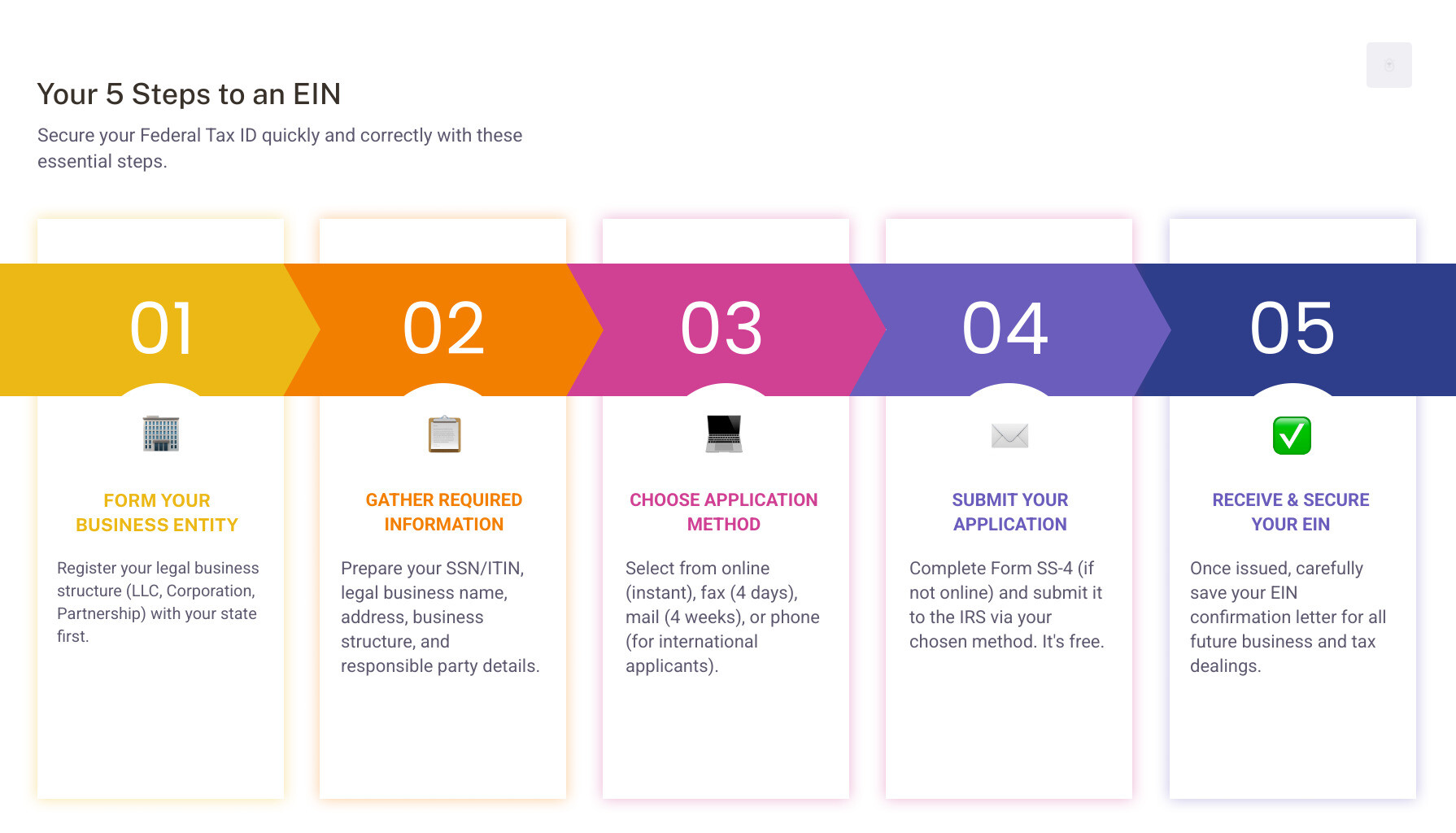
Here’s how to file for a federal tax id quickly:
- Apply online at IRS.gov (free, get your EIN immediately)
- Fax Form SS-4 (receive EIN in 4 business days)
- Mail Form SS-4 (takes about 4 weeks)
- Call if you’re an international applicant (267-941-1099)
What you’ll need:
- Your Social Security Number (SSN) or Individual Taxpayer Identification Number (ITIN)
- Legal business name and address
- Business structure (LLC, corporation, partnership, etc.)
- Responsible party information
The IRS provides this service completely free—never pay anyone for what the government offers at no cost.
As Haiko de Poel, I’ve guided hundreds of small businesses and freelancers through tax compliance processes, including helping them file for federal tax id numbers as they establish their operations. Understanding this foundational step has helped countless entrepreneurs avoid costly mistakes and maintain proper business records.
Whether you’re a freelancer landing your first big client, opening a landscaping business, or launching a tech startup, getting your EIN is often one of the first official steps you’ll take.
Start filling your W9 now at https://fillablew9.com/apply/
What is a Federal Tax ID (EIN) and Who Needs One?
Think of an Employer Identification Number (EIN) as your business’s Social Security Number. It’s a nine-digit number that the IRS assigns to identify your business for tax purposes. Just as the government uses your SSN to track your personal taxes, they use your EIN to monitor your business’s tax obligations and compliance.
This number becomes your business’s official identity when dealing with federal agencies, banks, and other businesses. It’s how the IRS knows who you are when you file taxes, and it’s what your bank will ask for when you open a business account. The IRS information on Federal Tax ID Numbers provides the official details, but here’s what you really need to know.
The real question is: do you actually need one? While some sole proprietors can operate using their personal SSN, most businesses will need to file for federal tax id at some point. The moment you hire your first employee, you’ll need one. Opening a business bank account? You’ll need one. Forming an LLC or corporation? Definitely need one.
Corporations and partnerships must have an EIN—no exceptions. If you’re hiring employees, even just one person, you’re required to get an EIN to handle payroll taxes and employment reporting. Businesses that file certain tax returns, like excise taxes or withhold taxes on payments to non-resident aliens, also fall into the “must have” category.
Beyond these requirements, businesses with Keogh plans (a type of retirement plan for self-employed individuals), tax-exempt organizations, trusts and estates, and even farmers’ cooperatives need EINs. Real Estate Mortgage Investment Conduits (REMICs) are another specialized entity that requires one.
But here’s the practical reality: even if you’re not technically required to file for federal tax id, having an EIN makes business life significantly easier. It adds professionalism to your operations, creates a clear separation between your personal and business finances, and opens doors to business credit and licensing opportunities that might otherwise remain closed.
Still wondering if you need one? The IRS offers helpful guidance at Do I need a Federal Tax ID Number? to help you determine your specific situation. When in doubt, getting an EIN is almost always the safer choice for protecting your personal information and establishing your business properly.
Before You Apply: Gathering Your Information
Before you file for federal tax id, take a moment to gather everything you’ll need. Think of it like packing for a trip – having everything ready beforehand makes the journey so much smoother. The IRS application process is actually quite straightforward, but it does require accurate information, and there’s nothing more frustrating than getting halfway through only to realize you’re missing a crucial detail.

Here’s something critical that trips up many new business owners: you must form your business entity with your state before applying for your EIN. This is especially important if you’re setting up an LLC or corporation. The IRS expects your business to be officially registered at the state level first. Trying to get your federal tax ID before your state paperwork is complete can create delays and headaches you don’t need. Texas business owners, for instance, should complete their state registration before heading to the IRS. The IRS guidance on getting an employer identification number specifically addresses this requirement.
When you’re ready to file for federal tax id, you’ll need your legal business name – and this must match exactly what’s on your state registration documents. The IRS systems are particular about formatting, accepting only letters, numbers, hyphens, and ampersands. If your business name includes other symbols, you’ll need to spell them out or substitute appropriate alternatives. You’ll also need your trade name if you operate under a “doing business as” (DBA) name that’s different from your legal name.
Your business address needs to be a physical street address, not a P.O. box. The IRS limits addresses to 35 characters and often verifies them against USPS records, so accuracy matters here. You’ll also specify your type of entity – whether you’re a sole proprietorship, partnership, LLC, corporation, trust, or another structure – along with your reason for applying. Common reasons include starting a new business, hiring employees, opening a business bank account, or changing your organizational structure.
The application asks for practical details like the date your business started or was acquired, your closing month for accounting purposes (typically December unless you use a fiscal year), and a brief description of your principal line of business. You’ll also estimate your expected number of employees over the next 12 months.
Perhaps the most important piece of information is your responsible party details. The responsible party is the individual who ultimately owns or controls your business – this must be a real person, not another company. This person needs a valid Social Security Number (SSN) or Individual Taxpayer Identification Number (ITIN). The IRS has a daily limit: you can only apply for one EIN per responsible party per day, so plan accordingly.
If you want to see exactly what the application looks like, you can review Form SS-4, Application for Employer Identification Number beforehand. Familiarizing yourself with the form helps you understand what information you’ll provide when you file for federal tax id.
Having all this information organized and ready to go means you can complete your application in one sitting without interruptions. It’s a small investment of preparation time that pays off with a smooth, stress-free application process.
How to File for a Federal Tax ID: 4 Official Methods
Here’s the best news you’ll hear all day: every official method to file for federal tax id is completely free. Zero dollars. Zilch. The IRS provides this service at no charge, so if you encounter a website asking for your credit card to get an EIN, run the other way. We’ve seen too many business owners unnecessarily hand over $50, $100, or even more for something the government offers for free.
Your choice of application method really comes down to timing and your specific situation. If you need your EIN yesterday (or at least today), you’ve got options. If you can wait a few weeks, those work too. Let’s walk through each approach so you can pick the one that fits your needs.

Don’t waste time with paper forms — complete your secure W9 online at https://fillablew9.com/apply/
Method 1: Apply Online (Fastest & Recommended)
If you’re based in the United States or U.S. territories and have a Social Security Number or ITIN for your responsible party, the online application is hands-down your best option. We recommend this route to nearly every client we work with in Texas and beyond.
The beauty of the IRS online tool is its speed—you’ll receive your EIN immediately upon completing the application. We’re talking minutes from start to finish. For entrepreneurs eager to open that business bank account or submit their first invoice, this instant access is invaluable.
There are a few quirks to keep in mind, though. The application has a 15-minute timeout, meaning if you step away to answer a phone call or hunt down a document, you might find yourself starting over from scratch. Our advice? Grab your coffee, gather all your information from the previous section, close your email, and focus for those 15 minutes. You can also only submit one EIN application per responsible party per day, so if you’re launching multiple ventures, you’ll need to space them out.
The online system operates Monday through Friday, 7 a.m. to 10 p.m. Eastern time. If you’re a night owl in Texas working at midnight, you’ll need to wait until morning or choose a different method.
Method 2 & 3: Apply by Fax or Mail
Sometimes the online system isn’t available—maybe it’s down for maintenance, or you’re applying outside business hours. That’s when the traditional methods of fax and mail come into play. Both require you to complete Form SS-4, the paper application for an EIN.
Faxing your application strikes a nice balance between speed and accessibility. After you complete Form SS-4 (and please, type it or print clearly—illegible handwriting causes delays), fax it to 855-641-6935. The IRS typically processes faxed applications within 4 business days, which is pretty reasonable if you’re not in a major rush.
Mailing your application is the slowest route, taking about 4 weeks to process. This works fine if you’re planning ahead and don’t need immediate access to your EIN. The mailing address varies depending on your location, so check the instructions included with Form SS-4 for the correct address for Texas or your state.
For complete details on both methods, the IRS provides helpful guidance on their Employer identification number page.
Method 4: Special Considerations when you file for a federal tax id
Not everyone fits neatly into the standard application process, and the IRS recognizes that. If your business operates internationally or you’re navigating the system without a U.S. tax identification number, you’ll need to take a slightly different path.
International applicants whose principal business location sits outside the United States or U.S. territories cannot use the online application system. Instead, you’ll need to call the IRS directly at 267-941-1099, available Monday through Friday from 6 a.m. to 11 p.m. Eastern time. Yes, you might experience hold times, but the representatives who answer this line specialize in helping international businesses and can walk you through the process. You can also fax or mail your Form SS-4 using the methods described above.
If the responsible party doesn’t have an SSN or ITIN, you’ll need to obtain an ITIN first before you file for federal tax id. An ITIN (Individual Taxpayer Identification Number) serves as a tax processing number for individuals who need a U.S. taxpayer identification number but aren’t eligible for a Social Security Number. To get one, complete Form W-7, attach a federal tax return, and provide documentation proving both your identity and foreign status. It adds an extra step to the process, but it’s necessary to keep everything above board.
Whatever method you choose, the goal remains the same: getting your EIN correctly and efficiently so your business starts on solid legal footing.
Federal EIN vs. State Tax ID: Understanding the Difference
Navigating business identification numbers can sometimes feel like learning a new language. You’ve just mastered the Federal Employer Identification Number (EIN), but then you hear whispers of a “State Tax ID.” Are they the same? Do you need both? Let’s clear up the confusion, especially for our Texas businesses.
Here’s the simple truth: your Federal EIN comes from the IRS and handles all your federal tax obligations—think payroll taxes, business income taxes, and anything else Uncle Sam needs to track. Your State Tax ID number (sometimes called a State Employer ID Number or state tax registration number), on the other hand, is issued by your state government for state-level tax purposes. Think of your federal EIN as your business’s passport for dealing with Washington, D.C., and your State Tax ID as its driver’s license for dealing with your home state.
The tricky part? Every state handles this differently. In Texas, whether you need a State Tax ID depends entirely on what type of taxes your business owes. While Texas doesn’t have a personal income tax (one of the perks of doing business in the Lone Star State!), your business may still need to register for the state franchise tax. If you hire employees, you’ll need a state employer account number to report and pay state unemployment insurance taxes to the Texas Workforce Commission. And if you’re selling goods or certain services, you’ll likely need a sales tax permit from the Texas Comptroller of Public Accounts.
Here’s what catches many new business owners off guard: when you file for federal tax id, you’re not automatically registered for state taxes. These are completely separate application processes. The federal government and your state government don’t share a common database (if only it were that easy!). You’ll need to apply for each one independently, though having your federal EIN first often makes the state application smoother since many states ask for it.
For Texas businesses, you’ll typically interact with the Texas Comptroller of Public Accounts for sales tax and franchise tax registration, and the Texas Workforce Commission for unemployment tax setup. The Texas Comptroller offers an online registration system that’s relatively straightforward once you have your federal EIN in hand. You can access Texas tax registration through the Texas Online Tax Registration Application, or learn more about how EINs work specifically for Texas businesses at Get an EIN for your Texas business – Texas Registered Agent.
The Small Business Administration provides excellent general guidance on navigating both federal and state requirements at Get federal and state tax ID numbers – SBA. We always recommend checking with the relevant state agencies in Texas to ensure you’re compliant with all state-specific requirements for your particular business type. After all, staying compliant from day one saves you headaches (and potential penalties) down the road.
Frequently Asked Questions About Your Federal Tax ID
We know that even after understanding the basics, questions often pop up. Here are some of the most common inquiries we receive about Federal Tax IDs, answered with clarity and precision.
Do I need to file for a federal tax id if my business changes?
This is a common question, and the answer, like many things tax-related, is “it depends!” The IRS views certain changes as creating a new legal entity, even if your business name stays exactly the same.
When you need a new EIN: If there’s a change in ownership or a change in business structure, you’ll typically need to file for federal tax id again. For example, if you’ve been operating as a sole proprietor using your Social Security Number, and you decide to convert to an LLC, that’s a structural change that requires a new EIN. The same applies if a partnership incorporates or if a sole proprietor brings on partners. The IRS sees these as fundamentally different business entities.
When you don’t need a new EIN: Not every change necessitates a new number, though. You generally keep your existing EIN if you’re simply changing your business name or changing your address. These are administrative updates, not structural changes. If you change the responsible party, you don’t need a new EIN either, though you should inform the IRS of this change.
It’s always best to err on the side of caution. If you’re unsure whether your specific situation requires a new EIN, we recommend checking with the IRS or consulting a tax professional. Getting this right the first time saves headaches later.
Can an EIN be changed or canceled?
Here’s something important to understand: an EIN is a permanent number. Once the IRS assigns it to your business, that’s it—it cannot be changed or canceled. Think of it like your business’s DNA; it’s unique and unchangeable.
However, if you no longer need your EIN—perhaps you’ve closed your business or you’re a sole proprietor who no longer has employees—the IRS can deactivate it. Deactivation doesn’t delete the number from existence; it simply marks it as no longer in use. The number itself remains permanently assigned to your former entity.
To properly close things out, you’ll need to close your business account with the IRS and file all final tax returns. The IRS provides helpful guidance on what to do if you no longer need your EIN, along with general information on closing a business. Taking these steps ensures you won’t receive unexpected tax notices after your business has wound down.
What should I do if I receive an EIN I didn’t request?
Receiving an EIN that you didn’t apply for is a serious red flag for identity theft or a fraudulent application. This isn’t something to ignore, and we advise you to act quickly.
First, take a breath and confirm it wasn’t legitimate. Sometimes an accountant, business partner, or legal representative might apply for an EIN on your behalf without your immediate knowledge. The IRS recommends you confirm that it was not a legitimate request on your behalf before assuming the worst.
If you verify that nobody authorized applied for this EIN, you need to report it to the IRS immediately. You can file the IRS’s Business Identity Theft Affidavit, which helps the IRS investigate the unauthorized issuance. This form is specifically designed for situations where someone has fraudulently obtained an EIN in your business’s name.
Beyond that, follow the IRS’s comprehensive steps to report business identity theft. This may involve contacting credit bureaus, notifying your bank, and taking other protective measures. Protecting your business’s identity—including its EIN—is just as important as protecting your personal information. Stay vigilant, and don’t hesitate to reach out for help if something feels off.
Conclusion
Taking the time to properly file for federal tax id is one of those foundational steps that sets your business up for success from day one. Whether you’re launching a new venture here in Texas or expanding an existing operation, understanding the EIN process—from what it is to how to get it—removes uncertainty and helps you move forward with confidence.
Throughout this guide, we’ve walked through the entire journey together. You’ve learned that your EIN is essentially your business’s Social Security Number, that the IRS provides this service completely free of charge, and that in most cases you can have your number in hand within minutes using the online application. We’ve covered the information you’ll need to gather beforehand, explored the differences between federal and state tax IDs, and answered the most common questions that trip up business owners.
The most important thing to remember? The IRS is your only official source for EINs, and the service is free. If someone is asking you to pay for an EIN, you’re not dealing with the right people. We’ve seen too many businesses waste money on services they could have gotten directly from the government at no cost.
Beyond just getting your EIN, staying on top of tax compliance means having all your documentation organized and ready when you need it. That’s where we come in. At Fillable W9, we’re passionate about making tax compliance less of a headache and more of a simple checkbox on your business to-do list. From understanding your EIN to securely managing your W-9 forms, we’ve built our platform to save you time and eliminate the stress of paperwork.
Your business deserves to run smoothly, and having your tax documentation handled correctly is a big part of that. We’re here to help you every step of the way.