
One Form You Fill Out, One Form You Receive

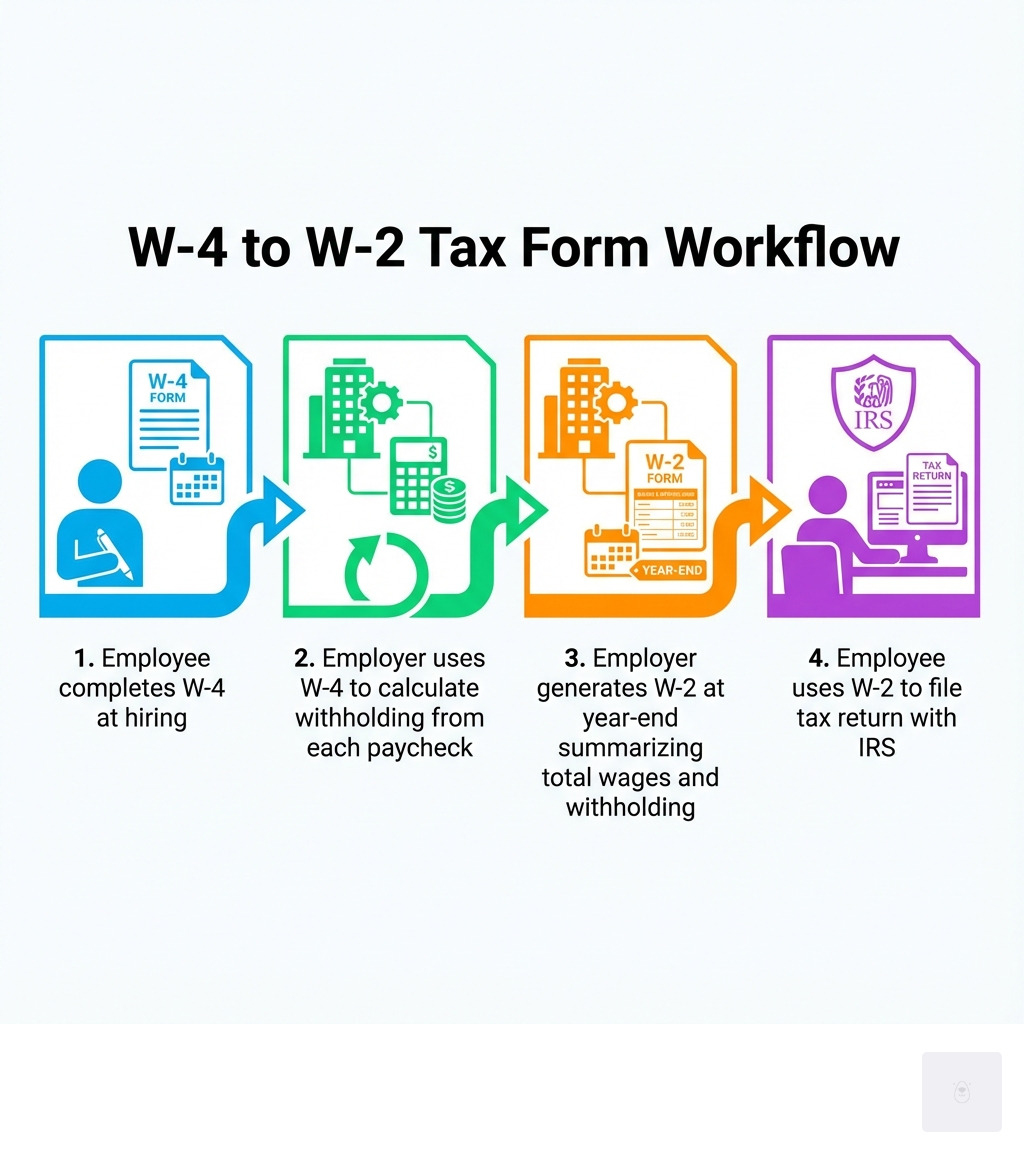
The difference between W2 and W4 comes down to direction and timing: Form W-4 is what you fill out to tell your employer how much tax to withhold, while Form W-2 is what your employer sends you at year-end to report your earnings and taxes withheld.
Here’s the quick breakdown:
| Form W-4 | Form W-2 |
|---|---|
| You fill it out when you start a job | Your employer sends it to you by January 31 |
| Tells your employer how much tax to withhold from each paycheck | Reports what you earned and what was withheld during the year |
| Controls your paycheck size throughout the year | Used to file your tax return and calculate refund or amount owed |
| Updated whenever your life changes (marriage, kids, new job) | Generated once per year for each employer |
| Input document — you provide instructions | Output document — employer provides summary |
Every working professional encounters these two forms at some point. If you’re starting a new job, your employer will hand you a W-4 before your first paycheck. Then, at the end of the year, that same employer will send you a W-2 summarizing everything that happened financially.
Understanding this difference matters because the W-4 affects how much money you take home each pay period, while the W-2 determines whether you get a refund or owe taxes when you file. Getting the W-4 right upfront can prevent an unpleasant surprise in April.
Many people confuse these forms or don’t realize they have control over their tax withholding throughout the year. If you claim too few allowances on your W-4, you’ll see smaller paychecks but likely get a refund. If you claim too many, you’ll have more money now but might owe the IRS later — potentially with penalties.
I’m Haiko de Poel, and through my work helping companies streamline financial operations and compliance processes, I’ve seen how confusion about the difference between W2 and W4 can create unnecessary stress for employees and employers alike. My experience in digital change and process optimization has shown me that understanding these core tax forms is fundamental to financial confidence.
Understanding Form W-4: Your Instruction to Your Employer
The IRS Form W-4, officially known as the Employee’s Withholding Certificate, is your direct line of communication to your employer about your federal income tax withholding. Think of it as your personal instruction manual for your employer’s payroll department. It’s a crucial document that dictates how much federal income tax should be deducted from each of your paychecks.

Who Fills Out Form W-4?
You, the employee, are responsible for completing and submitting Form W-4. Every new employee must complete a W-4 before receiving their first paycheck. This ensures that your employer knows how to accurately calculate and withhold taxes from your earnings right from the start.
When to Fill Out Form W-4
While you generally complete a W-4 when you begin a new job, it’s not a one-and-done form. We recommend reviewing and updating your W-4 whenever significant life events occur that might impact your tax situation. These life changes include:
- Marriage or Divorce: Your filing status can significantly change your tax liability.
- New Child or Dependent: Claiming dependents can reduce your withholding through tax credits.
- Taking on a Second Job: Having multiple income streams often requires careful adjustment to avoid under-withholding.
- Significant Change in Income: A raise or a decrease in pay might necessitate an update.
- Major Deductions: If you anticipate substantial deductions beyond the standard deduction, you might adjust your W-4 to reduce withholding.
Keeping your W-4 up-to-date helps ensure your withholding accurately reflects your current financial and family situation. For more insights into how these forms work, you can explore our resources on how our service works.
How Form W-4 Affects Your Paycheck
Your Form W-4 directly influences the size of your paycheck throughout the year. The primary goal of the W-4 is to ensure that the correct amount of federal income tax is withheld, helping you avoid a large tax bill or a surprisingly small refund at tax time.
- More Withholding: If you elect to have more tax withheld (e.g., by claiming fewer dependents or adding an additional withholding amount), your paychecks will be smaller. However, this often results in a larger tax refund when you file your annual return, as you’ve overpaid your taxes throughout the year. While a refund can feel like a bonus, it essentially means you’ve given the government an interest-free loan.
- Less Withholding: Conversely, if you elect to have less tax withheld (e.g., by claiming more dependents or having significant deductions), your paychecks will be larger. This puts more money in your pocket during the year, but it increases the risk of owing taxes when you file. If you under-withhold significantly, you might even face IRS penalties for underpayment.
The key is to strike a balance. It’s important to fill out your W-4 accurately to avoid either extreme. Inaccurate withholdings can lead to you owing taxes or overpaying and receiving a big tax refund. The IRS even suggests using their Tax Withholding Estimator tool to help you fine-tune your withholding, especially if you have multiple jobs or other complex income situations.
What Happens if You Don’t Fill Out a W-4?
If you’re a new employee and fail to provide a completed W-4 form to your employer, we’ve got you covered. Your employer is legally required to still withhold taxes from your pay. However, they won’t have your specific instructions. In such cases, your employer will typically default to withholding taxes as if you are a single filer with no other adjustments.
This means:
- Single Filer Status: Your taxes will be calculated based on the tax rates for a single individual.
- No Adjustments: No allowances for dependents, other income, or deductions will be factored in.
- Maximum Standard Withholding: This default setting often results in the maximum amount of federal income tax being withheld from your pay.
While this ensures you’re paying taxes, it can lead to significantly smaller paychecks than necessary. You might end up with a substantial refund at the end of the year, but you’ll have missed out on having that money available throughout the year. It’s always in your best interest to complete and submit your W-4 promptly and accurately to maintain control over your take-home pay.
Understanding Form W-2: Your Annual Wage and Tax Statement
Form W-2, officially known as the Wage and Tax Statement, is a year-end document that summarizes your earnings and the taxes withheld from your pay during the calendar year. Unlike the W-4, which you provide to your employer, the W-2 is provided to you by your employer. It’s an essential record for tax filing purposes, detailing your gross wages, tips, and other compensation, as well as federal, state, and local taxes withheld.

Who Provides Form W-2?
Your employer is responsible for generating and distributing Form W-2 for every employee from whom they withheld income, Social Security, or Medicare taxes, or if they paid you at least $600 during the year. This includes full-time, part-time, seasonal, and temporary employees.
The January 31 Deadline
Employers are required by law to send out Form W-2 to employees by January 31 of the year following the tax year. For example, for the 2024 tax year, you should receive your W-2 by January 31, 2025. Employers also file copies of these W-2s with the Social Security Administration (SSA) by the same deadline, which then shares the data with the IRS. This ensures the IRS has a record of your reported income and withheld taxes.
This annual statement is a cornerstone of our tax system, providing a clear summary of your earnings and contributions. To learn more about how we can help simplify other tax-related processes, check out our features.
How Form W-2 Impacts Your Tax Return
Form W-2 is the single most important document you’ll use to file your annual income tax return. Without it, accurately reporting your income and taxes paid becomes significantly more challenging.
Here’s how your W-2 impacts your tax return:
- Reporting Your Income: Your W-2 shows your gross wages, salary, tips, and other compensation for the year. This is the foundation for calculating your total income on your tax return.
- Verifying Withheld Taxes: The form details the amounts of federal income tax, Social Security tax, Medicare tax, and any state or local taxes that your employer withheld from your paychecks. These withheld amounts are credited against your total tax liability.
- FICA Taxes: Your W-2 is crucial for reporting Federal Insurance Contributions Act (FICA) taxes, which include Social Security and Medicare taxes. These are statutory amounts that employers are required to withhold.
- IRS and SSA Verification: Employers send copies of your W-2 to the Social Security Administration (SSA), which then forwards the federal tax information to the IRS. When you file your tax return, the IRS cross-references the income and withholding information you report with the data they received from your employer. This helps ensure accuracy and prevent fraud.
- Multiple W-2s: If you worked for more than one employer during the year, you will receive a separate W-2 from each employer. You’ll need all of them to accurately report your total income and total taxes withheld for the year.
Your W-2 helps you determine whether you’ve overpaid your taxes (resulting in a refund) or underpaid (meaning you owe the IRS) for the tax year.
What to Do if Your W-2 Has Errors
Finding an error on your W-2 can be a bit unsettling, but it’s a fixable problem. It’s crucial to address any inaccuracies promptly, as filing your tax return with incorrect information could lead to delays in your refund or even trigger an IRS audit.
Here’s a step-by-step guide on what to do if you find an error on your W-2:
- Contact Your Employer Immediately: This is your first and most important step. Notify your employer’s payroll or human resources department about the specific error. Common errors include incorrect names, Social Security numbers, wages, or withheld tax amounts. Provide them with details and any supporting documentation you have (like pay stubs).
- Request a Corrected W-2c: If your employer confirms the error, they are required to issue a corrected W-2, known as a Form W-2c, Corrected Wage and Tax Statement. They should send this to you and file it with the Social Security Administration.
- Allow Time for Correction: Employers have until January 31 to issue correct W-2 forms. If you don’t receive a corrected form by this date, or if your employer is unresponsive, you may need to take further action.
- Contact the IRS (If Necessary): If you’ve contacted your employer multiple times and they haven’t issued a corrected W-2c, or if you can’t reach them (e.g., the business is no longer operating), you can contact the IRS for assistance. The IRS can reach out to your employer on your behalf.
- Filing with Form 4852: If you’re approaching the tax filing deadline and still haven’t received a corrected W-2, you can file your tax return using Form 4852, Substitute for Form W-2, Wage and Tax Statement. You’ll need to estimate your wages and withholding using information from your final pay stub or other records. Be aware that using Form 4852 might delay your refund, as the IRS will need to verify the information.
It’s vital to ensure your W-2 is accurate before filing your taxes to avoid complications.
The Core Difference Between W2 and W4 at a Glance
To reiterate, the difference between W2 and W4 boils down to their distinct functions within the tax ecosystem. While both are federally required IRS tax forms, one is your personal instruction to your employer, and the other is your employer’s annual report to you and the government.
Let’s quickly recap their key attributes:
| Feature | Form W-4 (Employee’s Withholding Certificate) | Form W-2 (Wage and Tax Statement) |
|---|---|---|
| Purpose | Tells employer how much federal income tax to withhold from pay. | Reports annual wages, tips, and other compensation, plus taxes withheld. |
| Who Completes It | Employee | Employer |
| When It’s Used | Upon hiring, or when personal/financial situation changes. | Annually, by January 31, for the previous calendar year. |
| Information Flow | Employee to Employer | Employer to Employee and to the IRS/SSA |
| Primary Impact | Affects the size of each paycheck (take-home pay). | Used to prepare your income tax return and determine tax liability/refund. |
| Filing with IRS/SSA | Generally, kept by employer (not filed with IRS/SSA). | Filed by employer with SSA (which shares with IRS). |
How W-4 and W-2 Affect Your Finances: The Key Difference Between W2 and W4
Understanding the difference between W2 and W4 is crucial for effective financial management. We often describe the W-4 as an “input document” and the W-2 as an “output document” because they represent different stages of your tax journey.
-
W-4: The Proactive Input
The W-4 is your proactive tool. By carefully completing it, you are providing your employer with instructions on how much federal income tax to withhold. This is where you have direct control over your take-home pay and, consequently, your end-of-year tax outcome. Proper W-4 settings can help you avoid giving the government an interest-free loan (over-withholding) or facing unexpected tax bills and penalties (under-withholding). It’s about managing your cash flow throughout the year. -
W-2: The Reactive Output
The W-2 is the reactive summary. It documents what actually happened during the year based on the instructions you provided (or the default settings if no W-4 was filed). It’s a comprehensive report of your annual earnings and the specific amounts withheld for various taxes. This information is indispensable when you prepare your income tax return, as it forms the basis for calculating your final tax liability or refund.
Here’s a list of financial impacts stemming from your W-4 settings:
- Paycheck Size: Directly increases or decreases your net pay.
- Tax Refund/Bill: Determines whether you receive a refund or owe taxes at tax time.
- Penalty Avoidance: Helps prevent underpayment penalties from the IRS.
- Financial Planning: Allows for better budgeting by stabilizing your monthly cash flow.
- Investment Opportunity: Money not over-withheld can be saved or invested throughout the year.
Who is Responsible for Each Form? The Difference Between W2 and W4 in Action
The clear distinction in responsibilities highlights the difference between W2 and W4 in their practical application.
-
Employee Responsibility for Form W-4:
As an employee, you are primarily responsible for accurately completing your Form W-4. This includes providing correct personal information, selecting the appropriate filing status, claiming eligible dependents, and making any necessary adjustments for other income or deductions. The accuracy of this form is vital, as it directly impacts your tax withholding. If your personal or financial situation changes, it’s your responsibility to submit a new W-4 to your employer to update your withholding. -
Employer Responsibility for Form W-2:
Your employer bears the responsibility for generating and distributing accurate Form W-2s. This includes correctly calculating and reporting your annual wages, tips, and other compensation, as well as all federal, state, and local taxes withheld. Employers must also file these W-2s with the Social Security Administration (SSA) by the January 31 deadline. The IRS and SSA then use this data to verify the income and tax payments reported on your personal tax return. Employers are also required to keep W-4 forms on file for at least four years after filing, in case of an IRS request.
Understanding who is accountable for each part of this process ensures smooth tax compliance for both parties. For detailed information on our service offerings and pricing, please visit our pricing page.
Frequently Asked Questions about W-2 and W-4 Forms
We understand that tax forms can be confusing, and we’re here to help clarify common questions about the difference between W2 and W4. For even more answers to your pressing questions, check out our FAQs.
Can I change my W-4 information at any time?
Yes, absolutely! You have the right to change your W-4 information at any point during the year. If your personal or financial situation changes, we strongly recommend submitting a new Form W-4 to your employer. This could include:
- Getting married or divorced.
- Having a child or adding other dependents.
- Starting a second job or your spouse starting a new job.
- Experiencing a significant change in income.
- Having a major deductible expense or credit.
Your employer is required to implement the changes from your revised W-4 no later than the start of the first payroll period ending on or after the 30th day from the date they receive it. So, while you can update it at any time, it will take a little while for the changes to reflect in your paycheck.
Are W-2 and W-4 forms only for full-time employees?
No, the W-2 and W-4 forms are not exclusively for full-time employees. They are applicable to all employees, regardless of their employment status (full-time, part-time, seasonal, or temporary). The key determining factor is whether you are classified as an “employee” by your employer. If you receive regular wages and your employer withholds taxes from your pay, you will fill out a W-4 and receive a W-2.
However, if you are an independent contractor, freelancer, or gig worker, you are generally not considered an employee. Instead, businesses will typically have you complete a W-9 form (Request for Taxpayer Identification Number and Certification) before paying you. Then, if they pay you $600 or more in a calendar year, they will issue you a Form 1099-NEC (Nonemployee Compensation) instead of a W-2. This is a significant difference between W2 and W4 and how independent contractors manage their taxes.
What should I do if I never received my W-2?
If January 31 has passed and you still haven’t received your W-2 form, don’t panic! Here’s a step-by-step approach to resolve the issue:
- Contact Your Employer: Your first step should always be to contact your employer’s payroll or human resources department. Verify that they have your correct mailing address and ask when they sent out the W-2. They may be able to provide you with a copy or access to an online portal to retrieve it.
- Check Your Mail and Email: Sometimes W-2s get lost in the mail or accidentally sent to spam folders if delivered electronically. Double-check all possible locations.
- Use Your Final Pay Stub: If you can’t get a W-2 from your employer, your final pay stub from the tax year can serve as a good estimate for filing your taxes. It should show your year-to-date wages and withheld taxes.
- Contact the IRS: If your employer is unresponsive or unable to provide your W-2 by mid-February, you can contact the IRS directly. They can reach out to your employer on your behalf and provide you with further instructions, potentially including how to file using Form 4852, Substitute for Form W-2, Wage and Tax Statement.
Even if you don’t have your W-2, you are still responsible for filing your taxes by the deadline.
Conclusion: Taking Control of Your Tax Withholding
Understanding the difference between W2 and W4 is more than just knowing tax jargon; it’s about financial empowerment. The W-4 form is your opportunity to proactively manage your tax withholding, directly influencing your take-home pay and helping you avoid unwelcome surprises at tax time. It’s a powerful tool for controlling your cash flow. The W-2, on the other hand, is your official year-end record, providing a comprehensive summary of your earnings and taxes paid, which is essential for accurately filing your tax return.
By ensuring the accuracy of your W-4 throughout the year and carefully reviewing your W-2 when you receive it, you take an active role in your financial well-being. This knowledge empowers you to make informed decisions, whether you’re starting a new job, experiencing life changes, or simply aiming for better tax planning.
Just as understanding W-2 and W-4 is key to managing employee taxes, mastering other essential tax forms like the W-9 is crucial for independent contractors and businesses. We at Fillable W9 are dedicated to simplifying tax compliance for everyone.
✅ Ready to complete your W9 in minutes? Apply here now