
Why Getting a Tax ID Number for Your LLC is the First Step to Business Legitimacy

Getting a tax id number for llc is one of the first critical tasks after forming your business. Here’s the quick answer:
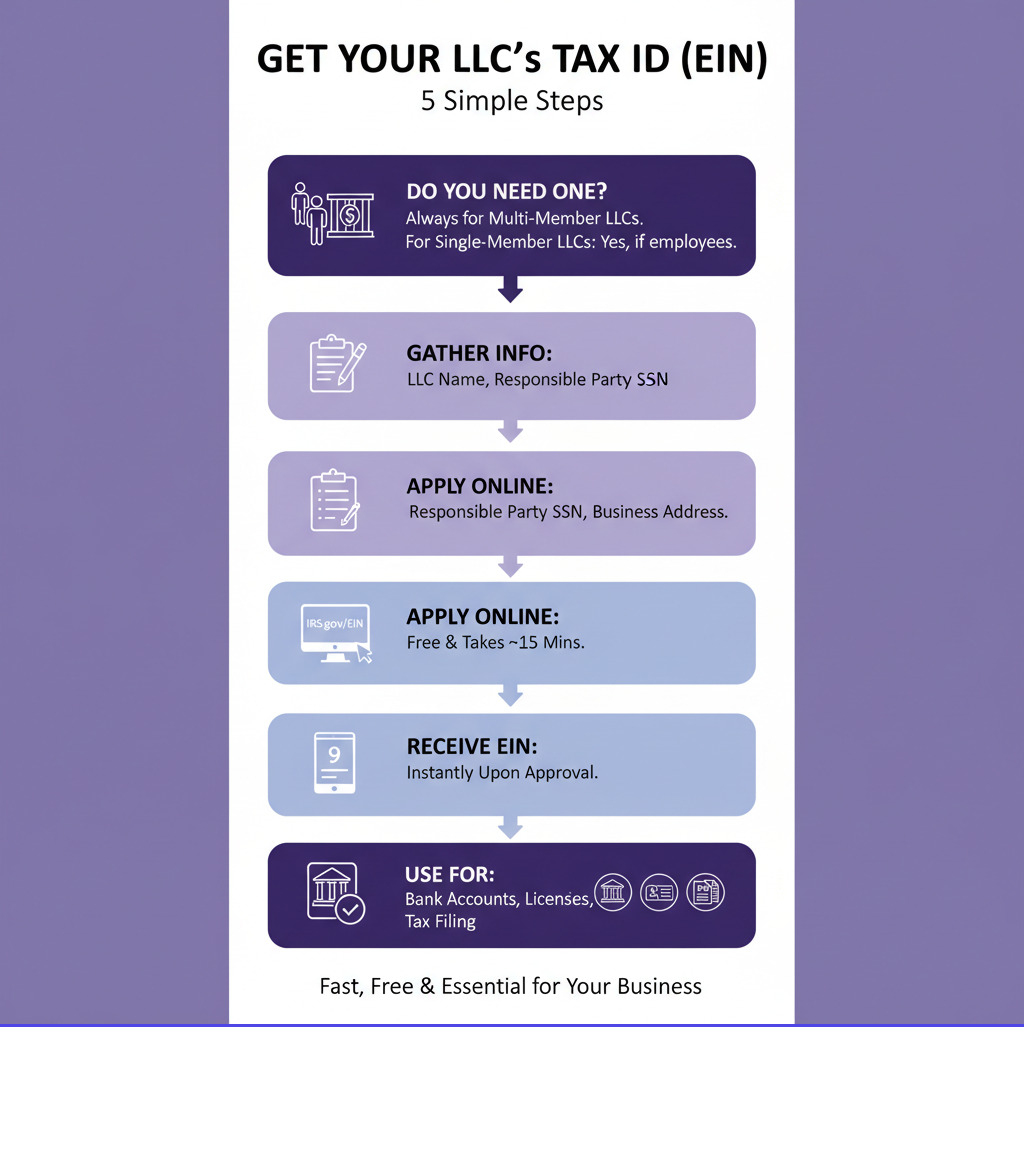
How to Get a Tax ID Number (EIN) for Your LLC:
- Visit the IRS website at IRS.gov/EIN (completely free)
- Complete the online application in one 15-minute session
- Provide basic information: LLC name, responsible party’s SSN, business address
- Receive your EIN immediately upon approval
- Use it right away for banking, licenses, and hiring
Alternative methods: Fax (4 business days), Mail (4 weeks), or Phone (international applicants only)
Starting an LLC feels exciting until you hit the paperwork wall. You’ve filed your Articles of Organization with your state, but now clients are asking for a W-9 form, your bank won’t open a business account without a tax ID, and you’re wondering if you can just use your Social Security Number instead.
The answer is your Employer Identification Number (EIN) — often called a Federal Tax ID. Think of it as your business’s Social Security Number. Whether you’re a solo freelancer operating as an LLC or building a team, this nine-digit number is what the IRS uses to track your business taxes.
Do you actually need one? All multi-member LLCs must have an EIN. Single-member LLCs need one if they have employees or pay certain federal taxes. But even if you’re not legally required to get one, most banks demand it to open a business account, and using an EIN instead of your SSN protects your personal information when working with clients and vendors.
The good news: getting an EIN is completely free and takes about 15 minutes online. The bad news: there’s a lot of confusing information out there, including paid services trying to charge you for something the IRS does for nothing.
I’m Haiko de Poel, and through my work as a fractional CMO helping companies with business formation and compliance strategy, I’ve guided countless entrepreneurs through getting a tax id number for llc and ensuring they start on solid legal footing. Let me walk you through exactly what you need to know.
What is a Federal Tax ID (EIN) and Why Your LLC Needs One
Think of your business as a person trying to steer the world without identification. That’s essentially what your LLC is without an Employer Identification Number (EIN) — also called a Federal Tax ID. This nine-digit number issued by the IRS is your business’s official identity in the eyes of the government.
Here’s what might surprise you: despite the name “Employer Identification Number,” you don’t need employees to need one. Your EIN is essential for opening a business bank account, applying for business licenses, filing taxes, and yes, eventually hiring employees. Without this number, your LLC can’t fully function as the separate legal entity you worked so hard to create.
The moment you try to open that business bank account or a client asks for your W-9 form, you’ll understand why getting a tax id number for llc operations is non-negotiable. It’s the key that open ups your business’s ability to operate professionally and compliantly. The Internal Revenue Service: Employer Identification Numbers (EINs) page provides the official details, but let’s break down what this really means for you.
Why an EIN is Your Business’s Social Security Number
Your Social Security Number identifies you as an individual. Your EIN identifies your LLC as a business entity. It’s that simple — and that important.
The distinction matters because of how the IRS views your LLC’s tax classification. Depending on your setup, the IRS classifies an LLC as either a disregarded entity (single-member LLCs), a partnership (multi-member LLCs), or a corporation (if you’ve elected S-corp or C-corp status). Each classification has different tax implications and reporting requirements.
If you’re a single-member LLC without employees, you technically could use your personal SSN for tax purposes. But here’s why that’s usually a bad idea: every time you fill out paperwork for a client, vendor, or service provider, you’re handing out your Social Security Number. Using an EIN instead protects your personal SSN from identity theft and keeps your personal and business finances properly separated — which is the whole point of forming an LLC in the first place.
For multi-member LLCs, there’s no choice to make. You must have an EIN because the IRS treats your business as a partnership by default. Even if you’re the sole owner now, getting an EIN provides professional credibility that clients and vendors recognize. When someone receives a W-9 form with an EIN instead of a personal SSN, it signals you’re running a legitimate business operation, not just a side hobby.
The bottom line: your EIN is what transforms your LLC from a stack of formation documents into a functioning business entity that can transact, hire, and grow.
The Ultimate Guide to Getting a Tax ID Number for an LLC
Now that we understand the “why,” let’s dive into the “how.” The process for getting a tax id number for llc is straightforward and, thankfully, free when you go through the official channels.
Step 1: Determine if Your LLC Needs an EIN
Before you rush to apply, let’s clarify if your LLC actually needs an EIN. While many businesses benefit from having one, the IRS has specific requirements that depend on your LLC’s structure.
If you have a multi-member LLC, the decision is simple: you absolutely must obtain an EIN. The IRS automatically treats multi-member LLCs as partnerships for tax purposes, which means you’re required to have a Federal Tax ID number.
For single-member LLCs, the situation is more nuanced. The IRS typically considers your single-member LLC a “disregarded entity,” meaning it’s not separate from you for tax purposes. In this case, you can generally use your personal SSN for federal tax filings. However, you’ll definitely need an EIN if your single-member LLC has employees, files certain excise taxes (like alcohol, tobacco, or firearms taxes), withholds taxes on income paid to nonresident aliens, or offers a Keogh plan for retirement. You’ll also need one if you elect to be taxed as a corporation.
Even if your single-member LLC doesn’t technically need an EIN, I strongly recommend getting one anyway. Here’s why: it protects your personal SSN from being used in business transactions, which is a huge privacy win. Most banks require an EIN to open a dedicated business bank account, which is crucial for maintaining your LLC’s limited liability protection. And let’s be honest—having an EIN just looks more professional when clients and vendors request your tax information.
| Feature | Single-Member LLC (Disregarded, No Employees) | Multi-Member LLC (or Single-Member with Employees/Corporate Election) |
|---|---|---|
| EIN Legally Required? | No, can use SSN | Yes, always |
| For Privacy? | Recommended (protects SSN) | N/A (already required) |
| For Business Bank Account? | Generally required by banks | Required |
| For Hiring Employees? | Yes | Yes |
| Default Tax Treatment | Sole Proprietorship | Partnership |
Step 2: Gather the Required Information for Your Application
Once you’ve determined you need an EIN, the next step is gathering all the necessary information. The IRS uses Form SS-4, “Application for Employer Identification Number,” to collect this data. While you might not physically fill out the paper form if applying online, the information requested is the same across all application methods.
You’ll need your LLC legal name—the exact legal name as registered with your state. Have your business address ready, which must be a physical street address (the IRS limits street addresses to 35 characters). If your mailing address differs from your physical location, you’ll need that too.
The responsible party information is crucial. This is the individual or entity that controls, directs, or manages the business operations. For most LLCs, this will be one of the owners. You’ll need their full legal name and their Taxpayer Identification Number (TIN), which is usually their Social Security Number (SSN) or Individual Taxpayer Identification Number (ITIN). That the IRS limits the issuing of EINs to one per responsible party per day.
You’ll also need to specify your type of entity (Limited Liability Company) and whether it’s single-member or multi-member. Have your business start date ready—the month, day, and year your business officially started operations. You’ll need to describe your principal business activity (like “Consulting,” “E-commerce,” or “Real Estate”) and potentially provide a NAICS Code, which categorizes your business type.
Finally, estimate the highest number of employees you expect to have in the next 12 months, and if you plan to hire, know the first date you expect to pay wages. Having all this information at your fingertips before you start the application will make the process much smoother and faster.
Step 3: Choose Your Free Application Method
The IRS provides several ways to apply for an EIN, and all of them are completely free of cost. I can’t stress this enough: never pay a third-party service to get something the IRS provides for free.
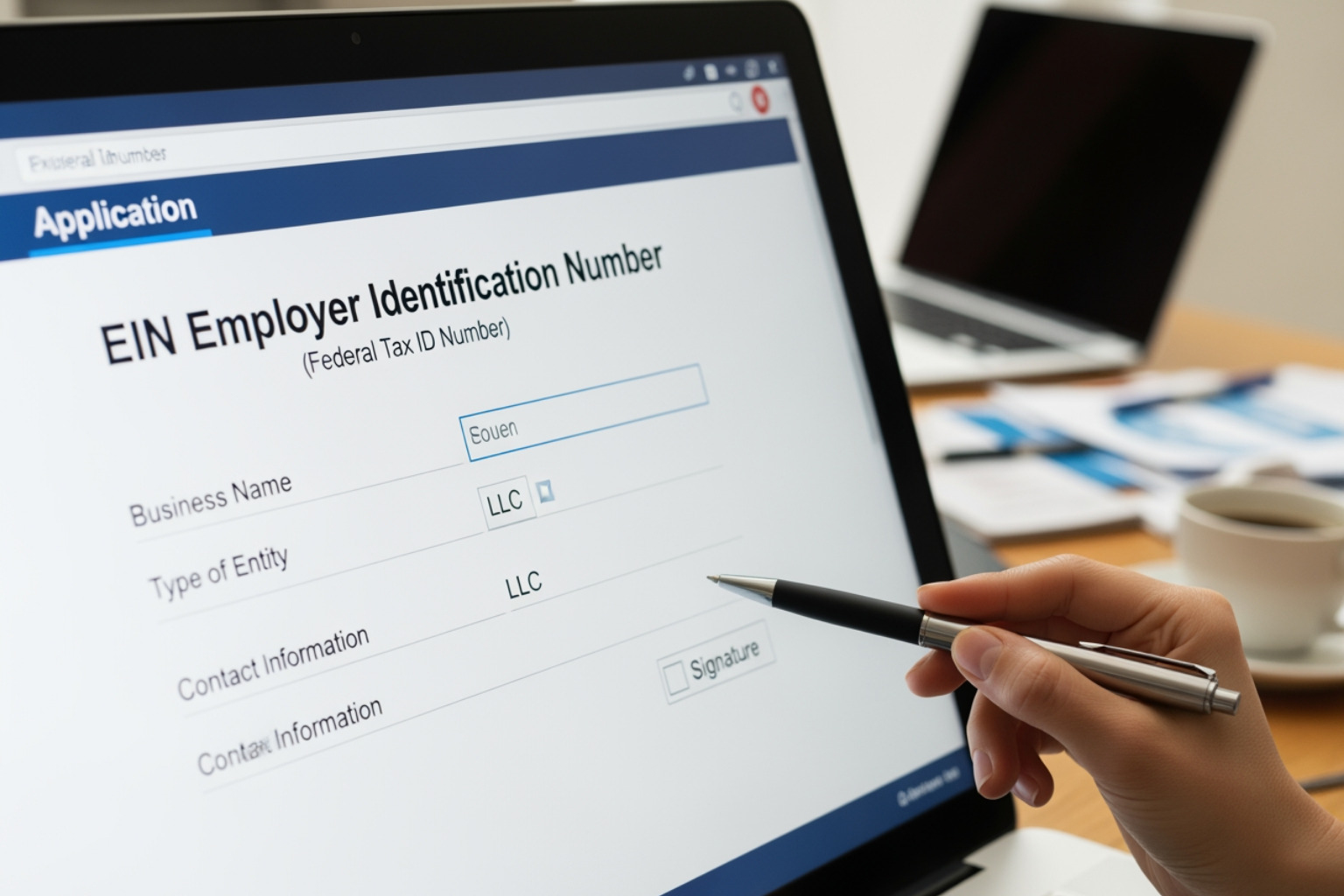
The online application is hands-down the best method for U.S.-based businesses. It’s available Monday to Friday, 7 a.m. to 10 p.m. Eastern Time, and it’s blazingly fast—if your application is approved, you get your nine-digit federal tax ID immediately upon verification. You can save and print the confirmation notice right then and there. The catch? You must complete the application in one session, as it expires after 15 minutes of inactivity. You can’t save it to finish later, so have all your information ready before you start. This tool works for businesses with their principal place of business in the U.S. or U.S. territories, where the responsible party has an SSN or ITIN.
If you prefer the fax application, complete Form SS-4 and fax it to the appropriate Fax-TIN number. Make sure to include your fax number so the IRS can fax the EIN back to you, which typically happens within four business days.
The mail application is the slowest option, with processing times around four to six weeks. Complete Form SS-4 and mail it to the IRS service center for your state. This method works fine if you’re not in a hurry, but most business owners need their EIN sooner rather than later.
International applicants who have no legal residence, principal place of business, or office in the U.S. can call 267-941-1099 (not a toll-free number) Monday through Friday, 6 a.m. to 11 p.m. Eastern Time. If approved, you’ll get your EIN immediately over the phone.
Remember: you can only apply for one EIN per responsible party per day, regardless of which method you choose. So make sure your application is complete and accurate the first time around.
Managing Your LLC’s EIN: Post-Application Essentials
You’ve made it through the application process—congratulations! Your EIN is now in hand, and you’re officially ready to operate as a legitimate business entity. But getting a tax id number for llc is really just the starting line. What you do with that nine-digit number in the days and weeks ahead will set the foundation for your business’s financial health and compliance.
What to Do After You Receive Your EIN
Think of your new EIN as the key that open ups your business’s full potential. The first place you’ll likely use it is at your bank. Opening a business bank account is critical—not just for convenience, but for maintaining that all-important legal separation between your personal finances and your LLC’s assets. Most banks won’t even consider opening a business account without an EIN, so this becomes your immediate next step.
Beyond banking, your EIN will be requested when you’re applying for business licenses and permits. Depending on your industry and location, you might need federal, state, or local permits to operate legally. Your EIN proves to these agencies that you’re a registered business entity with the IRS.
If you’re planning to grow your team, your EIN becomes absolutely essential for hiring employees. You’ll need it for payroll processing, withholding taxes, and reporting employment information to the IRS. Without an EIN, you simply can’t legally pay employees.
When tax season rolls around, your EIN will appear on all your federal tax returns. Here’s a small but important timing note: while you can use your EIN immediately for banking and most business transactions, it’s wise to wait about two weeks before e-filing tax returns or making electronic tax deposits. This gives the IRS time to fully process your EIN across all their systems.
Don’t forget about state tax ID numbers. Your federal EIN doesn’t automatically cover state-level obligations. If you have employees or collect sales tax, your state will likely require a separate state tax ID. This is completely independent of your federal EIN and varies by state.
There’s also a newer compliance requirement you should know about: Beneficial Ownership Information (BOI) reporting. The Financial Crimes Enforcement Network (FinCEN) now requires many LLCs to report information about their beneficial owners—the real people who ultimately own or control the company. Your EIN will be part of this reporting process. You can find the full details and filing requirements at Beneficial Ownership Information Reporting | FinCEN.gov.
Help! I Lost My EIN or Need a New One
Let’s be honest—running a business means juggling a thousand details, and sometimes important numbers slip through the cracks. If you’ve misplaced your EIN, take a breath. It’s easier to find than you might think.
Start by checking your past tax returns, IRS notices, or that original EIN confirmation letter you received. If you’ve already opened a business bank account, your bank will have your EIN on file—just give them a call. Any state or local licensing agencies where you registered your business will also have it in their records.
If you’ve exhausted these options, the IRS can help directly. Call the IRS Business & Specialty Tax Line at 800-829-4933. Once they verify you’re the responsible party for the business, they’ll provide your EIN over the phone. You can find more details about getting assistance at Telephone Assistance for Businesses.
Now, what about getting a new EIN? The general rule is simple: your business entity should only have one EIN. You typically don’t need a new one if you change your business name, move to a new address, or switch who the responsible party is. These are administrative changes that don’t alter your business’s fundamental structure.
However, significant changes to your ownership or legal structure usually do require a new EIN. If you’re converting from a sole proprietorship to an LLC, changing from a single-member LLC to a multi-member LLC, or changing your LLC into a corporation, you’ll need to apply for a new EIN. Similarly, if you dissolve one LLC and form a brand new one, that new entity needs its own EIN. When in doubt, Check with the IRS about whether your specific situation requires a new number.
Closing Your Business: Can an EIN Be Canceled?
Sometimes businesses run their course. Whether you’re pivoting to a new venture or simply closing up shop, you might wonder what happens to your EIN.
Here’s the reality: an EIN is permanent. Once the IRS issues that nine-digit number to your business entity, it’s yours forever. You cannot cancel an EIN the way you might cancel a subscription or close a credit card account. It remains permanently associated with your business in the IRS database.
That said, if your business has truly ceased operations—you’ve liquidated all assets, filed all final tax returns, and paid any outstanding taxes—the IRS can deactivate your EIN. This doesn’t erase it from existence, but it essentially closes your business account with the IRS.
To request deactivation, you’ll need to send a letter to the IRS explaining why you no longer need the EIN. Make absolutely certain that you’ve filed all required tax returns and settled any tax liabilities before making this request. The IRS provides specific guidance on this process at deactivate it for organizations that are closing their doors.
Frequently Asked Questions about Getting a Tax ID Number for an LLC
We understand that getting a tax id number for llc can raise a lot of questions, especially when you’re navigating the paperwork maze of starting your business. Let’s tackle some of the most common concerns we hear from new LLC owners.
Is it free to get a tax ID number for an LLC?
Yes, obtaining an EIN from the IRS is completely free. This is important to emphasize because there’s a cottage industry of third-party websites that charge anywhere from $50 to $300 for something you can do yourself at no cost. These services aren’t necessarily scams—they might offer bundled services like registered agent assistance or compliance tracking—but the EIN application itself is always free when you go directly through the IRS.
The official IRS assistance tool is the best way to apply online at no cost. It takes about 15 minutes, and you’ll receive your EIN immediately upon approval. Don’t let anyone convince you that you need to pay for this basic service—your tax dollars already fund the IRS to provide it for free.
Does a single-member LLC need a tax ID number?
This is where it gets a bit nuanced. Technically, a single-member LLC only needs an EIN if it has employees or files certain federal excise taxes. From the IRS’s perspective, if you’re a solo operation with no employees, you can use your personal Social Security Number for tax purposes.
However—and this is a big however—we strongly recommend getting an EIN even if you’re not legally required to have one. Here’s why: most banks require an EIN to open a business account, and keeping your business finances separate from your personal accounts is essential for maintaining your LLC’s liability protection. Beyond banking, using an EIN instead of your SSN when working with clients helps protect your personal information from identity theft. It also adds a layer of professionalism to your business dealings.
All multi-member LLCs must have an EIN, no exceptions. The IRS treats multi-member LLCs as partnerships by default, and partnerships always need their own tax identification number.
What are the specific requirements for getting a tax ID number for an LLC in New York?
After getting your federal EIN from the IRS, if your New York-based LLC has employees, you must also register with the New York State Department of Labor. This is a separate state-level requirement for managing unemployment insurance taxes and other employee-related obligations.
New York is particularly strict about employer registration. You’ll need to set up accounts for unemployment insurance, withholding tax (if required), and potentially other state-specific programs. Your federal EIN will be required during this state registration process, which is why getting your EIN first is so important. The state can’t process your employer registration without it.
That state requirements vary significantly. What applies in New York might be completely different in Texas, California, or Florida. Always check with your specific state’s department of labor and revenue agencies to ensure you’re meeting all local compliance requirements beyond your federal EIN.
Your Next Step: Secure Your Business’s Future
You’ve made it through the maze of getting a tax id number for llc, and that’s something to celebrate. This nine-digit number might not seem like much at first glance, but it’s actually the foundation that everything else in your business is built on. Without it, you can’t open that business bank account you need. You can’t bring on your first employee. You can’t file your taxes properly or apply for most business licenses.
But here’s the beautiful part: the process is completely free when you go directly through the IRS. No hidden fees, no complicated paperwork that requires a law degree to understand. Just a straightforward application that takes about 15 minutes of your time. And once you have it, you’re officially in business—not just in name, but in the eyes of the federal government, your bank, and every client who asks for your tax information.
Think of your EIN as your business’s first real credential. It separates your personal finances from your business finances, protects your Social Security Number from being scattered across dozens of W-9 forms, and gives you the professional legitimacy that helps clients and vendors take you seriously. Whether you’re a solo freelancer who just formed a single-member LLC or you’re building a team with a multi-member structure, this number is your ticket to operating like a real business.
The paperwork side of entrepreneurship can feel overwhelming, especially when you’re trying to focus on actually building something meaningful. But don’t let administrative tasks become roadblocks. Getting your EIN is quick, free, and completely manageable—even if you’ve never dealt with the IRS before. And once you have it, you’re ready to tackle the next steps with confidence.
✅ Ready to handle your business’s tax forms with confidence? While we’ve focused on getting your EIN, the next step is often managing vendor payments with Form W-9. FillableW9.com makes it easy to create, fill, and send secure W-9 forms online. Start filling your W-9 online now at https://fillablew9.com/apply/