
Why Nonprofits Must Understand W-9 Requirements for Contractors

Does a nonprofit need a w9 for contractors? Yes. If your nonprofit pays an independent contractor $600 or more during the tax year, you must collect a completed Form W-9 from them before issuing Form 1099-NEC to report those payments to the IRS.
Quick Answer:
- When to request: Before making the first payment to a contractor
- Payment threshold: $600 or more in a calendar year
- Purpose: Collect the contractor’s Taxpayer Identification Number (TIN) and other information needed to file Form 1099-NEC
- Consequences of not collecting: 24% backup withholding requirement, IRS penalties up to $50 per form, potential liability for uncollected taxes
If your not-for-profit is perpetually shorthanded, you may have decided to engage independent contractors or freelancers to pick up some of the slack. But hiring contractors comes with tax reporting responsibilities that many nonprofit leaders find confusing.
The W-9 form is your starting point for staying compliant. It’s the document you use to gather essential tax information from contractors before you pay them. Without it, you can’t accurately complete Form 1099-NEC at year-end, and that puts your organization at risk for penalties and backup withholding requirements.
Start filling your W9 now at https://fillablew9.com/apply.
Understanding when and how to collect W-9 forms protects your nonprofit from IRS penalties while keeping your financial reporting accurate. Whether you’re hiring a graphic designer for a fundraising campaign, a consultant for strategic planning, or a contractor for facility maintenance, the $600 threshold means most contractor relationships will require this form.
This guide will walk you through exactly when your nonprofit needs to request a W-9, how to fill one out if you’re acting as a contractor yourself, and the best practices for managing these forms to avoid costly mistakes.
I’m Haiko de Poel, and through my work with nonprofits on financial systems and compliance at organizations like The Church of Eleven22, I’ve seen how critical it is for nonprofits to understand does a nonprofit need a w9 for contractors and implement proper documentation processes. Let me show you how to get this right from the start.
Why Does a Nonprofit Need a W9 for Contractors?
For many nonprofits, the idea of tax forms can feel overwhelming. After all, we’re tax-exempt, right? While our organizations don’t typically pay income tax, we still have crucial tax reporting responsibilities, especially when we engage independent contractors. The answer to “does a nonprofit need a w9 for contractors” is a resounding yes, and it all boils down to the IRS’s need for transparency in income reporting.
The IRS uses Form W-9, officially titled “Request for Taxpayer Identification Number and Certification,” to obtain a taxpayer’s Social Security number (SSN) or Federal Employer Tax ID number (EIN). This information is vital because it allows us to fulfill our obligation to issue annual Form 1099-NEC (Nonemployee Compensation) to contractors who receive $600 or more for services during a tax year.
Consider this: if your nonprofit pays an independent contractor $600 or more during the tax year, we are legally required to issue them a Form 1099-NEC and file it with the IRS. Without the W-9, we won’t have the necessary Taxpayer Identification Number (TIN) to complete that 1099-NEC. This isn’t just a suggestion; it’s a critical part of our legal compliance and helps us avoid significant IRS penalties.
The Critical Link Between Form W-9 and Form 1099-NEC
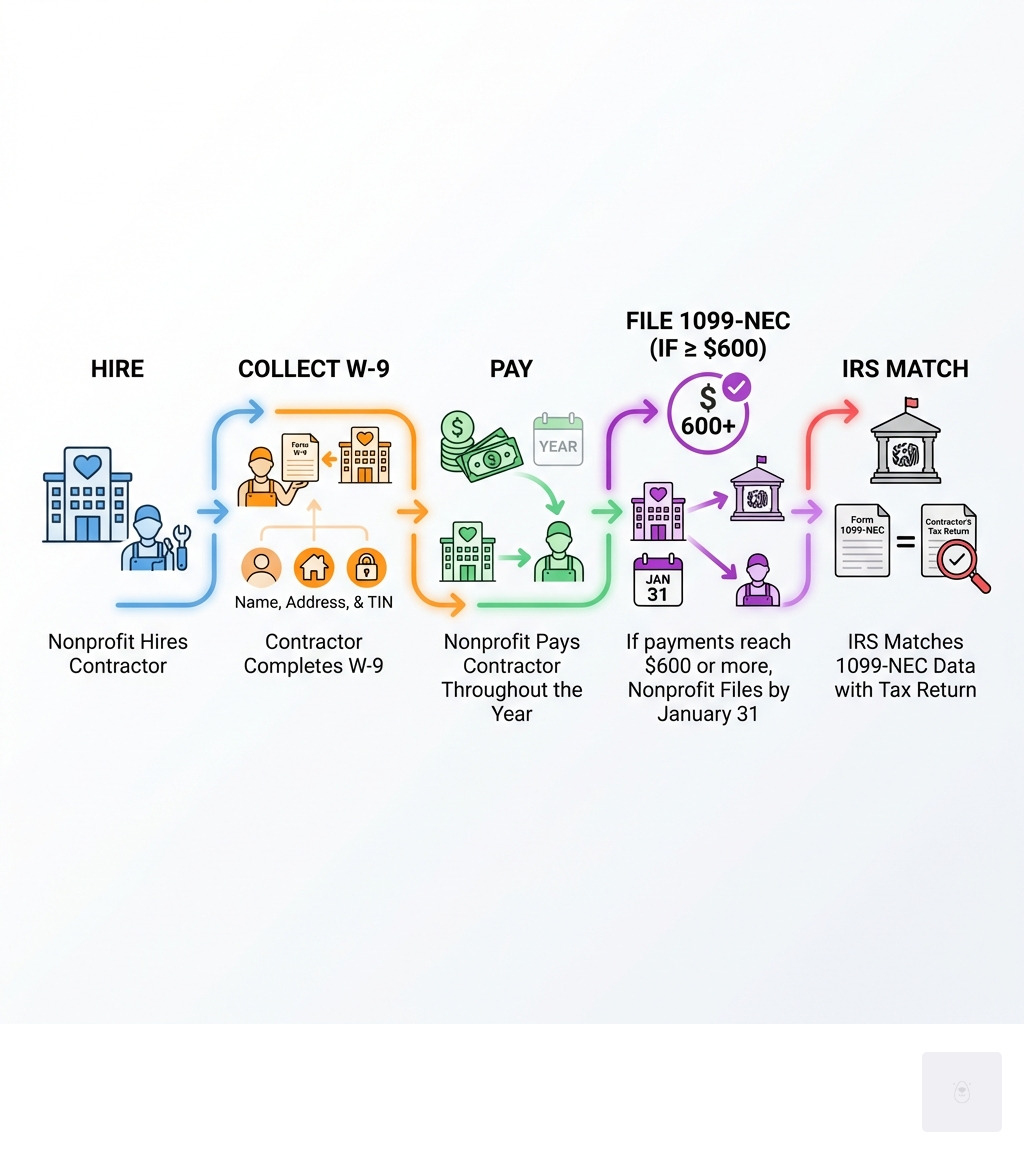
The relationship between Form W-9 and Form 1099-NEC is like two sides of the same coin when it comes to reporting payments to independent contractors. Form W-9 is the information collection tool, and Form 1099-NEC is the information reporting tool.

Here’s how it works:
- Requesting the W-9: When your nonprofit brings on an independent contractor, the very first step (ideally before any payments are made) is to request a completed Form W-9 from them. This form provides us with their legal name, address, and Taxpayer Identification Number (TIN). The TIN is usually an SSN for individuals or an EIN for businesses. You can learn more about the W-9’s purpose directly from the IRS at https://www.irs.gov/forms-pubs/about-form-w-9.
- Tracking Payments: Throughout the year, we track all payments made to that contractor.
- Issuing the 1099-NEC: If the total payments for services to that contractor reach $600 or more in a calendar year, we must then generate a Form 1099-NEC. This form details the nonemployee compensation paid.
- Filing with the IRS: We file Form 1099-NEC with the IRS by January 31st of the following year. The IRS uses this information to verify that the contractor is properly reporting their income. You can find official instructions for Form 1099-NEC here: https://www.irs.gov/instructions/i1099mec.
- Providing to Contractor: We also provide a copy of the 1099-NEC to the contractor by January 31st so they can use it to prepare their own tax return.
This process ensures that the IRS has a clear record of payments made for services, helping to prevent tax evasion. For organizations that file 10 or more information returns (including Form 1099-NEC), the IRS requires electronic filing, which underscores the importance of having accurate W-9 data from the start.
What Information Must a Nonprofit Collect on a W-9?
When we request a W-9 from a contractor, we’re asking for specific pieces of information that are essential for accurate tax reporting. Let’s break down what we need to collect:
- Contractor’s Legal Name: This is the name as it appears on their income tax return. For individuals or sole proprietors, it’s their personal name. For businesses, it’s the legal name under which they are incorporated or registered.
- Business Name (DBA): If the contractor operates under a different business name, trade name, or “Doing Business As” (DBA) name, we’ll need that as well. This helps us identify them correctly in our records.
- Federal Tax Classification: The W-9 asks the contractor to select their federal tax classification. This could be an Individual/Sole Proprietor, C Corporation, S Corporation, Partnership, Trust/Estate, or a Limited Liability Company (LLC). The selection determines how they are taxed and how we should report their payments.
- Address: We need their full mailing address, including street, city, state, and ZIP code. This is where we’ll mail their 1099-NEC at the end of the year.
- Taxpayer Identification Number (TIN): This is arguably the most critical piece of information. The TIN is a unique nine-digit number used by the IRS to identify taxpayers.
- Social Security Number (SSN): For individuals and sole proprietors, their TIN is typically their SSN.
- Employer Identification Number (EIN): For businesses, corporations, partnerships, and many LLCs, their TIN is an EIN. Nonprofits themselves operate with an EIN.
- Certification Signature: The contractor must sign and date the W-9, certifying that the information provided is correct and that they are not subject to backup withholding (unless otherwise noted). This signature confirms the accuracy of the data we’re collecting.
Collecting this information accurately and completely is non-negotiable. Without it, our year-end tax reporting becomes a headache, and we risk penalties.
How Your Nonprofit Should Fill Out a W-9
While our primary interaction with W-9s is usually requesting them from contractors, there are times when our nonprofit acts as the contractor for another organization. This might happen if we provide consulting services to a newly formed nonprofit, offer specialized training, or engage in other paid activities for another entity. For example, a well-established healthcare nonprofit might provide paid consulting services to a new healthcare nonprofit. In such cases, the requesting organization will ask us to complete a W-9.
Filling out a W-9 as a nonprofit requires specific attention to detail, particularly regarding our tax classification and identification number. It’s different from how an individual or a for-profit business would complete it.

Step-by-Step Guide to Completing a W-9 as a Nonprofit
When your nonprofit is asked to fill out a W-9, here’s how to ensure it’s done correctly:
- Line 1: Legal Name: This is where we enter our nonprofit’s full legal name, exactly as it appears on our IRS determination letter, articles of incorporation, and annual tax returns (like Form 990). For instance, if our legal name is “The Benevolent Foundation, Inc.,” that’s what goes here.
- Line 2: Business Name (if different from above): If our nonprofit also operates under a different “doing business as” (DBA) name or trade name, we would include it here. For example, if “The Benevolent Foundation, Inc.” is commonly known as “Community Helpers,” we’d put “Community Helpers” on this line.
- Line 3: Federal Tax Classification: This is a crucial section for nonprofits. We generally won’t check “Individual/sole proprietor,” “C Corporation,” “S Corporation,” “Partnership,” or “Trust/Estate.” Instead, we’ll typically check the “Other” box and clearly write “nonprofit corporation” or “tax-exempt organization” and our applicable IRS code section (e.g., “501(c)(3) organization”) in the space provided. This clarifies our status.
- Line 4: Exemptions: Most nonprofits will leave this box blank, as it generally relates to exemption from backup withholding. However, if we receive specific types of income that are subject to backup withholding (which is uncommon for typical nonprofit activities), we would need to indicate an exempt payee code. The IRS documentation suggests that many nonprofits can use “5” as the Exempt Payee Code if they are a tax-exempt organization. It’s always best to double-check the specific requirements or consult with a tax professional if unsure about this box.
- Lines 5 & 6: Address: Provide our nonprofit’s complete mailing address. This is where the requesting organization will send any relevant tax forms, such as a 1099-NEC, if they’re reporting payments to us.
- Part I: Taxpayer Identification Number (TIN): For a nonprofit, our TIN is always our Employer Identification Number (EIN). We will enter our nine-digit EIN in the designated box for “Employer identification number.” We should leave the “Social security number” box blank. If we’re a brand-new nonprofit and have applied for an EIN but haven’t received it yet, we can write “Applied For” in the TIN box. However, we’ll then have 60 days to provide our official EIN to the requesting organization once it’s issued, so we should file Form SS-4 as soon as possible to get one.
- Part II: Certification: An authorized officer of our nonprofit organization (e.g., President, Treasurer, Executive Director) must sign and date this section. By signing, we are certifying that our EIN is correct, that we are a U.S. person, and that we are not subject to backup withholding, among other things.
Completing the W-9 accurately when we are the contractor helps the payer correctly report their payments to us, avoiding issues for both parties.
Don’t waste time with paper forms — complete your secure W9 online at https://fillablew9.com/apply.
Can a Nonprofit Use Its Tax-Exempt Status to Be Exempt from Providing a W-9?
This is a common question, and understand the nuance. The short answer is: no, our nonprofit’s tax-exempt status does not exempt us from providing a W-9 when requested, nor does it exempt us from collecting W-9s from contractors we pay.
Our tax-exempt status, typically under IRS Section 501(c)(3), means that our organization does not generally pay federal income tax on revenue related to our exempt purpose. However, this tax exemption applies to our income tax liability, not to our information reporting obligations.
When another organization pays our nonprofit for services (e.g., consulting, training), they need our W-9 to fulfill their IRS reporting requirements. They need our legal name, address, and EIN to potentially issue us a Form 1099-NEC. Even though we won’t pay income tax on that revenue (assuming it’s related to our exempt purpose), the IRS still wants to track where money is going. Our W-9 helps the requesting organization correctly identify us for their own compliance.
Similarly, when we pay a contractor, we need their W-9 for our own reporting. Our tax-exempt status doesn’t mean we can skip our duty to report payments made to others.
While some types of organizations are considered “exempt payees” for certain types of payments (like interest or dividends), this generally doesn’t apply to payments for services. We must provide our W-9 when requested, just as any other entity would, to enable accurate information reporting. Failing to do so could lead to the requesting organization being required to “backup withhold” 24% of our payments and send it to the IRS – a situation we definitely want to avoid!
Best Practices for Managing Contractor W-9s
Managing W-9 forms effectively is crucial for our nonprofit’s financial health and compliance. It’s not just about collecting the form once; it’s about establishing a system that ensures accuracy, security, and timely reporting. Think of it as a small investment that prevents big headaches down the road.
One of the best practices we can adopt is making W-9 completion an integral part of our contractor onboarding process. This means requiring the form before any work begins or payments are made. This proactive approach ensures we have all the necessary information when we need it, preventing last-minute scrambles at tax time.
Another key practice is to review every W-9 form we receive for completeness and accuracy. A missing signature, an incorrect TIN, or an unclear tax classification can all lead to problems. If we spot any discrepancies, we should immediately request clarification or additional information from the contractor. The IRS even offers a free TIN Matching service (accessible via their ‘e-services’ portal) that we can use to proactively verify TIN and name combinations against IRS records, adding an extra layer of confidence.
Once collected, the secure storage of W-9 forms is paramount. These documents contain sensitive information (like SSNs and EINs), so they must be kept confidential and protected from unauthorized access. Storing them securely within our accounting platform or a designated, protected digital filing system is ideal.
Finally, we need a clear record retention policy for W-9s. The IRS generally requires us to retain W-9 forms for at least three years after the last tax year for which we filed a Form 1099-NEC for that contractor. However, many organizations find it a best practice to keep them for at least four years, and as long as our relationship with a contractor is active. We should also consider sending annual notices to our independent contractors, reminding them to update their forms if any information (like their address or business structure) has changed.
Checklist: Best Practices for W-9 Collection
To keep our nonprofit compliant and our records tidy, here’s a handy checklist for managing W-9 forms:
- Request W-9 before first payment: Make it a prerequisite for engagement. No W-9, no payment.
- Review for completeness and accuracy: Double-check every field, especially the TIN and signature.
- Use a secure submission method: Encourage contractors to use a secure online platform like Fillable W9 for submission, rather than unsecured email.
- Digitize and store securely: Convert paper forms to digital and store them in an encrypted, password-protected location or an accounting system with robust security features.
- Set reminders for annual updates: Periodically check with long-term contractors to ensure their W-9 information is still current.
- Integrate with accounting software: Link W-9 records to our accounting system for easy reference when preparing 1099-NECs.
What Are the Consequences if a Nonprofit Fails to Obtain a W-9?
Ignoring the need for a W-9 can lead to a surprisingly harsh reality for our nonprofit. The IRS doesn’t take kindly to missing or incorrect taxpayer information, and the penalties can quickly add up.
The most immediate consequence if a contractor doesn’t provide a correct TIN or fails to sign the certification in Part III of Form W-9 is backup withholding. This means we’re generally required to withhold 24% of all future reportable payments to that contractor and send it directly to the IRS. Imagine having to explain to a contractor why a quarter of their payment is missing! Furthermore, if we fail to backup withhold when required, our organization could be held liable for the uncollected amount.
Beyond backup withholding, there are direct penalties for failing to provide correct information returns (like the 1099-NEC, which relies on the W-9). Failure to file a correct information return by the due date can result in a penalty of $50 per form. While this might seem small, it can quickly escalate. The maximum penalty can reach $100,000 per year for smaller organizations, and even higher for larger ones.
If we can’t file Form 1099-NEC on time because we’re missing a W-9, we might consider requesting an extension using Form 8809. However, extensions are not automatically granted, and it’s always better to be proactive in collecting W-9s to avoid this situation entirely. The best defense is a good offense: get that W-9 upfront!
Frequently Asked Questions about Nonprofits and W-9s
We understand that navigating IRS forms can bring up a lot of questions. Here, we’ll address some of the most common inquiries our nonprofits have about W-9s.
-
How does a W-9 for a nonprofit differ from a for-profit entity?
The core purpose of the W-9 remains the same – to collect Taxpayer Identification Number (TIN) information for reporting purposes. However, how we complete certain sections differs:- Tax Classification: For-profit entities will typically select “C Corporation,” “S Corporation,” “Partnership,” or “Individual/Sole Proprietor.” Our nonprofit, however, will usually check the “Other” box on Line 3 and specify “nonprofit corporation” or our specific IRS code section (e.g., “501(c)(3) organization”).
- Exempt Payee Code: While most entities leave this blank, nonprofits, as tax-exempt organizations, might sometimes indicate an “Exempt Payee Code” (often ‘5’) if they are specifically exempt from backup withholding on certain types of payments. However, this is less common for payments for services, which are typically subject to reporting.
- Use of EIN: Both nonprofits and many for-profit businesses use an EIN as their TIN. Individuals and sole proprietors (whether for-profit or working for a nonprofit) typically use their SSN.
- Underlying Tax Status: The biggest difference isn’t on the W-9 itself, but what happens after the W-9. A for-profit entity receiving a 1099-NEC will likely pay income tax on that income. Our nonprofit, if the income is related to our exempt purpose, will typically not pay income tax on it, even if we receive a 1099-NEC. The W-9 simply facilitates the reporting process for the payer.
-
How long should a nonprofit keep W-9 forms?
The IRS provides clear guidelines for record retention to ensure we can support our tax filings if ever audited. For W-9 forms, we must keep them for at least three years after the last tax year for which we filed a Form 1099-NEC for that contractor. Many financial experts and best practices suggest retaining them for at least four years to align with the general statute of limitations for IRS audits. Furthermore, it’s wise to keep W-9s on file as long as our relationship with a contractor is active, even if we don’t issue a 1099-NEC every single year. This ensures we have current information readily available if future payments trigger a reporting requirement. -
When does a nonprofit need a W9 for contractors versus an employee?
This question gets to the heart of worker classification, a critical area where missteps can lead to significant penalties for our nonprofit. The distinction between an independent contractor and an employee determines which tax forms we use:- Independent Contractor (W-9): We need a W-9 for individuals or businesses that we classify as independent contractors. These are workers who control how, when, and where they perform their work. We typically control only the result of their work, not the means or methods. For example, a freelance graphic designer who works for multiple clients and uses their own equipment is usually an independent contractor. Payments to them are reported on Form 1099-NEC. The IRS provides helpful guidance on who is an independent contractor at https://irs.gov/charities-non-profits/exempt-organizations-who-is-an-independent-contractor.
- Employee (W-4): For individuals we classify as employees, we use Form W-4, “Employee’s Withholding Certificate.” Employees are subject to our control regarding how and when they do their job. We withhold income taxes, Social Security, and Medicare taxes from their paychecks, and we issue them a Form W-2 at year-end. If we incorrectly classify an employee as an independent contractor, our nonprofit can be held liable for employment taxes, plus interest and penalties. The IRS offers specific resources for exempt organizations on this distinction at https://irs.gov/charities-non-profits/exempt-organizations-independent-contractors-vs-employees.
Determining worker status can be complex, involving behavioral control, financial control, and the type of relationship between the parties. When in doubt, it’s always best to consult with a qualified tax professional or refer to IRS Publication 15-A, Employer’s Supplemental Tax Guide.
Conclusion
Understanding does a nonprofit need a w9 for contractors is more than just a compliance checkbox; it’s a fundamental aspect of responsible financial management for our organizations. By proactively collecting W-9 forms from our independent contractors, we ensure accurate year-end reporting, avoid costly IRS penalties, and maintain our nonprofit’s integrity.
We’ve seen that the W-9 is the essential precursor to the Form 1099-NEC, linking our payments to contractors with their tax obligations. We’ve also learned how to correctly fill out a W-9 when our nonprofit acts as a contractor and debunked the myth that our tax-exempt status somehow bypasses these reporting requirements. Implementing best practices for collection, review, and secure storage of W-9s is key to streamlining our administrative processes and protecting sensitive data.
At Fillable W9, we understand that tax forms can be daunting. Our goal is to simplify this process for you, providing a secure and intuitive platform to manage your W-9 needs. Don’t let tax compliance become a burden. Accept proactive form management, and empower your nonprofit to focus on its mission, not on tax headaches.
✅ Ready to complete your W9 in minutes? Apply here now.