
Why Contract Labor Schedule C is Essential for Your Tax Compliance

Contract labor schedule c is the specific line on IRS Schedule C (Form 1040) where you report payments made to independent contractors and freelancers who helped with your business. If you’re self-employed or run a small business, understanding this form is crucial for accurate tax filing and maximizing your deductions.
Quick Answer: How to Report Contract Labor on Schedule C
- Line 11 on Schedule C is where you report contract labor expenses
- Report payments of $600 or more made to non-employees during the year
- Issue Form 1099-NEC to contractors you paid $600+ by January 31st
- Keep detailed records of all contractor payments and services provided
- Do not confuse with Line 26 (Wages) which is only for W-2 employees
Schedule C itself is the tax form used by sole proprietors and independent contractors to report business income and expenses. It’s attached to your personal Form 1040 and shows your profit or loss from business operations. Whether you’re a freelance graphic designer, rideshare driver, consultant, or small business owner paying contractors, Schedule C determines your taxable business income and your self-employment tax liability.
The difference between getting Schedule C right and getting it wrong can mean thousands of dollars in taxes—or potential IRS penalties. Many contractors and small business owners leave money on the table by not claiming all eligible deductions, while others face audits for improper reporting.
I’m Haiko de Poel, and through my work as a fractional Chief Marketing Officer and business consultant, I’ve helped countless small businesses and startups steer the complexities of contractor payments and tax compliance, including proper contract labor schedule c reporting. My experience spans branding, business operations, and financial strategy for growing companies that rely heavily on independent contractor relationships.
Start filling your W9 now at https://fillablew9.com/apply/
Similar topics to contract labor schedule c:
Getting Started: Who Needs to File Schedule C and What You’ll Need
If you’re operating a business or profession as a sole proprietor, Schedule C (Form 1040) is your go-to form for reporting income and expenses. This applies to a wide range of individuals and business structures that aren’t incorporated. We’re talking about freelancers, gig workers, side hustlers, independent contractors, and even sole owners of single-member LLCs.
You are considered self-employed if you carry on a trade or business as a sole proprietor or an independent contractor. This includes those with a part-time business in addition to a regular job. If you received income that wasn’t reported on a W-2, and your business isn’t incorporated, then Schedule C is for you.
When it comes to filing, there’s often confusion about whether there’s a minimum income threshold. While there’s no minimum income to file Schedule C itself, you generally need to file Schedule SE (Self-Employment Tax) and pay self-employment tax if your net earnings from self-employment are $400 or more. Even if your net earnings are below $400, it’s still best practice to report all business income and expenses on Schedule C.
For married couples operating an unincorporated business together, you might qualify for a Qualified Joint Venture (QJV) election. This allows each spouse to file a separate Schedule C, splitting the income and expenses, rather than filing a partnership return (Form 1065). This can simplify your tax situation and ensure accurate reporting for both parties.
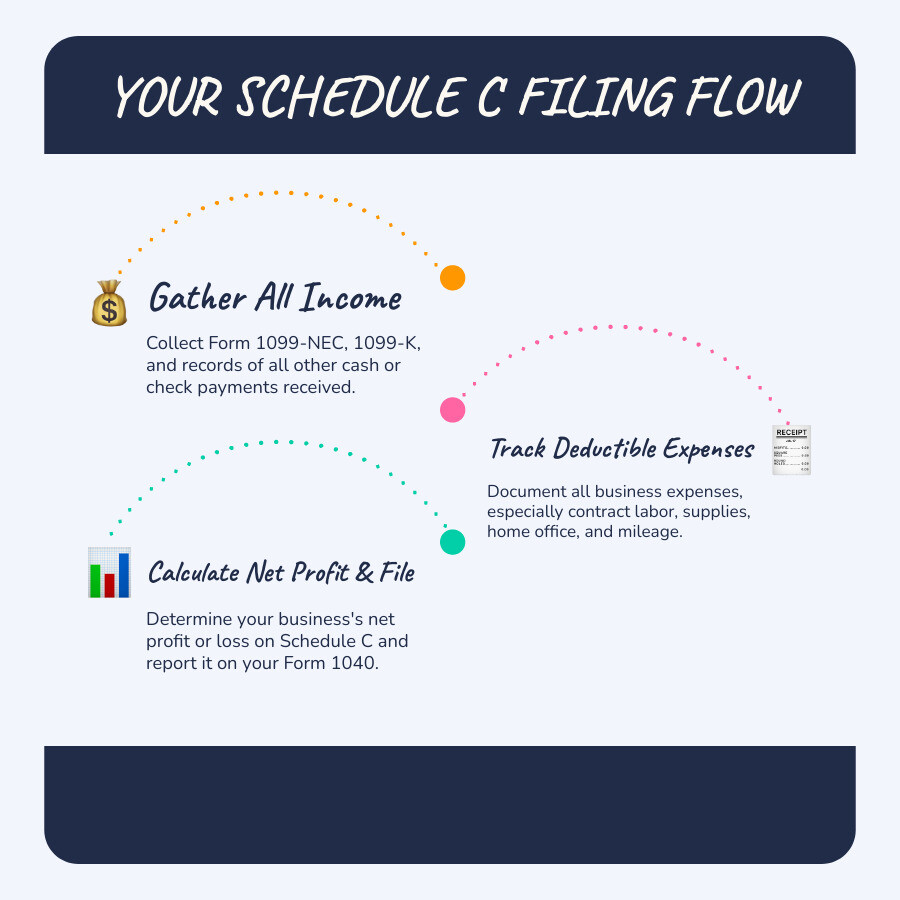
Before you dive into the form, gather all the necessary documents and information. Think of it like preparing for a big adventure – you wouldn’t leave home without your map and supplies, right?

What Information and Documents are Needed?
To accurately complete your Schedule C, we recommend having the following at your fingertips:
- Income Statements and Balance Sheets: These financial summaries, ideally as of December 31st of the tax year, provide a snapshot of your business’s performance.
- Form 1099-NEC and Form 1099-K: These are crucial for reporting nonemployee compensation (1099-NEC) and payment card/third-party network transactions (1099-K). Your clients or payment processors will send these to you.
- Business Records: This includes invoices, receipts for all business purchases, and records of any other income received (cash, checks, bartering, etc.) that wasn’t reported on a 1099 form.
- Expense Receipts and Logs: Keep meticulous records of all your business expenses. This means receipts for supplies, office expenses, travel, and meals.
- Mileage Logs: If you use your vehicle for business, a detailed mileage log is essential for claiming car and truck expenses.
- Bank and Credit Card Statements: These help verify your income and expenses and ensure you haven’t missed anything.
- Prior Year’s Tax Return: This can serve as a helpful reference, especially if your business operations are consistent year-to-year.
The IRS requires that we have on file your own information to support all Schedule C filings, so thorough documentation is key.
Do You Need to File More Than One Schedule C?
This is a common question, especially for those with multiple income streams. The general rule is to use one Schedule C for every distinct business activity you’re involved in.
For example, if you’re like a hypothetical Bruce Banner, DJing on weekends and selling custom T-shirts on Etsy, these are two distinct business activities. You would need to file two separate Schedule C forms – one for your DJ services and another for your Etsy store. This helps avoid audit flags and clearly segregates the income and expenses for each venture.
However, if your activities are similar or related, you can often combine them on a single Schedule C. For instance, if Bruce Banner was driving for both Uber and DoorDash, these could typically be combined on one Schedule C as they fall under similar transportation services. The key is whether the activities are fundamentally different in nature and operation.
Remember the Qualified Joint Venture (QJV) election we mentioned earlier? If you’re married and operating an unincorporated business together, you can each file a separate Schedule C to report your share of the income and expenses, effectively using two Schedule Cs for one business. This is a great way to simplify your tax reporting for co-owned businesses.
A Step-by-Step Guide to Filling Out Your Schedule C
Filling out Schedule C might seem like a daunting task, but we can break it down into manageable steps. It’s designed to capture all the essential information about your business, from your basic details to your income and expenses, ultimately leading to your net profit or loss.
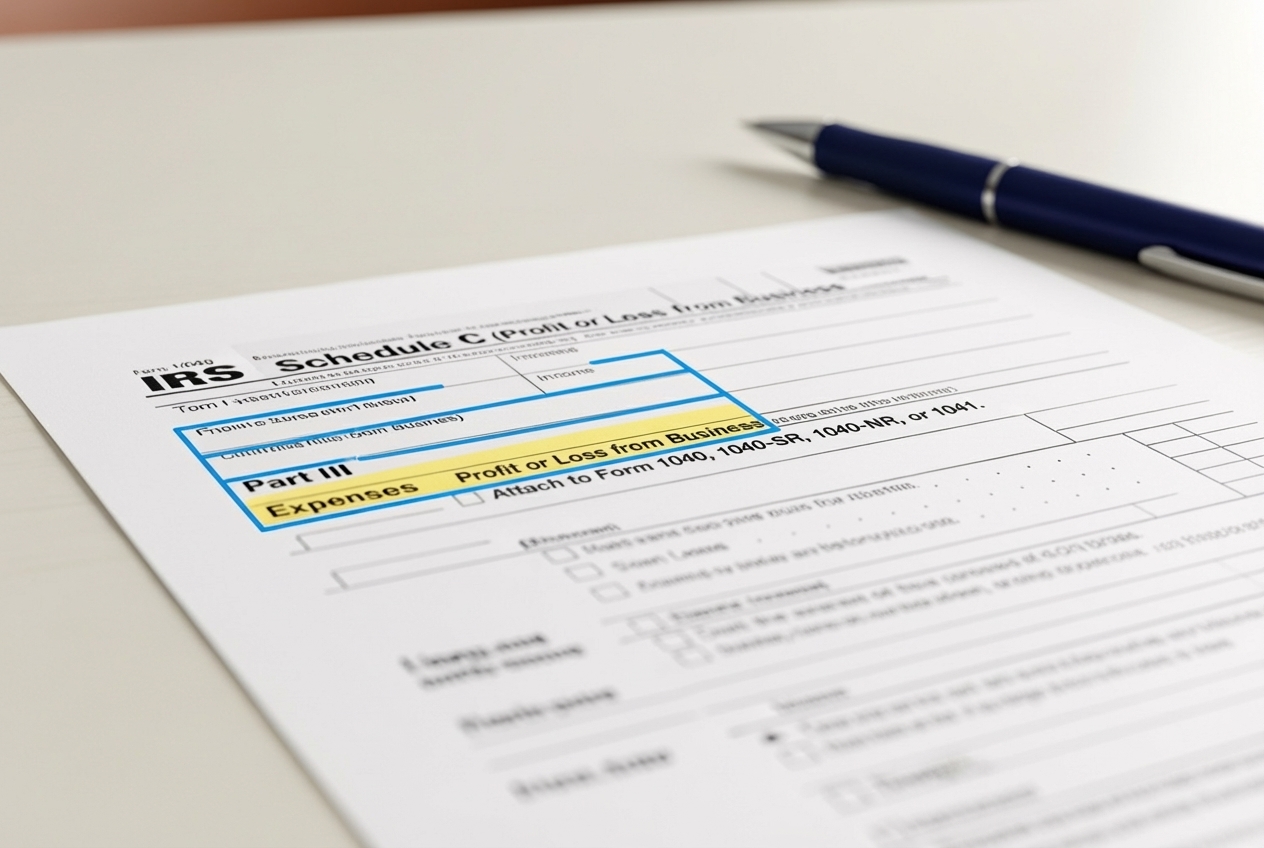
Business Information (Part I)
Part I of Schedule C is all about identifying your business. You’ll need to provide:
- Name of Proprietor and Social Security Number (or EIN): This links the business to you, the taxpayer.
- Principal Business or Profession (Box A): Briefly describe what your business does.
- NAICS Code (Box B): This is a six-digit code that identifies your industry. You can find the correct code using the North American Industry Classification System (NAICS) website. Don’t stress too much about getting the perfect code; there’s no penalty for choosing one that’s close enough.
- Business Name (Box C): If you operate under a “doing business as” (DBA) name, list it here.
- Business Address (Box E): Your physical business address.
- Accounting Method (Box F): Most small businesses and independent contractors use the cash method, meaning you report income when you receive it and expenses when you pay them. The accrual method is less common for Schedule C filers.
- Material Participation (Box G): This confirms you actively participated in the business, which is important for claiming business losses.
Reporting Income (Part I)
This section is where you detail all the money your business brought in.
- Line 1 (Gross Receipts or Sales): This is the total amount of money your business earned from all sources. This includes income reported on any Forms 1099-NEC and 1099-K you received. It also covers any cash, checks, or other forms of payment not reported on these forms.
- Line 2 (Returns and Allowances): If you had to give money back to customers for returned goods or services, report it here.
- Line 6 (Other Income): This line is for any other business income not reported elsewhere, such as income from selling business assets (like old equipment) or recovery of bad debts.
Calculating Cost of Goods Sold (Part III)
If your business sells products (e.g., you’re an Etsy seller or a small retailer), you’ll need to complete Part III to calculate your Cost of Goods Sold (COGS). This is essentially what it cost you to produce or acquire the items you sold. The basic formula is: Starting Inventory + Purchases (including labor and materials) – Ending Inventory = COGS.
Calculating Gross Profit
Once you have your gross receipts and COGS, you can calculate your Gross Profit (Line 7). This is your total sales minus the cost directly associated with making those sales. This figure then moves to Part II of Schedule C, where you’ll start subtracting your operating expenses.
Don’t waste time with paper forms — complete your secure W9 online at https://fillablew9.com/apply/
Mastering the Details of Contract Labor Schedule C and Key Deductions
Now for the fun part: deductions! Schedule C allows you to deduct ordinary and necessary business expenses. An expense is “ordinary” if it’s common and accepted in your industry, and “necessary” if it’s helpful and appropriate for your business. It doesn’t have to be indispensable to be considered necessary.
Here’s a list of common deductible business expenses you might encounter on Schedule C:
- Advertising: Costs for promoting your business, like website ads, social media campaigns, or printed flyers.
- Car and truck expenses: Costs related to using your vehicle for business purposes.
- Commissions and fees: Payments to others for services or sales assistance.
- Contract labor: Payments to independent contractors, freelancers, or other non-employees (this is where our contract labor schedule c comes in!).
- Depreciation: Deducting the cost of business assets over their useful life.
- Employee benefit programs: Costs for employee benefits (though most Schedule C filers don’t have traditional employees).
- Insurance: Premiums for business insurance, like general liability or professional liability.
- Interest: Interest paid on business loans or credit cards.
- Legal and professional services: Fees paid to accountants, attorneys, or consultants.
- Office expense: Costs for general office operations, like postage, printing, and paper.
- Pension and profit-sharing plans: Contributions to retirement plans for yourself or employees.
- Rent or lease: Payments for office space, equipment, or vehicles.
- Repairs and maintenance: Costs to keep business property in working order.
- Supplies: Items consumed in your business, like art supplies for a graphic designer or cleaning products for a cleaning service.
- Taxes and licenses: Business licenses, permits, and certain business taxes.
- Travel and meals: Expenses incurred while traveling for business and a portion of business meals.
- Utilities: Costs for electricity, gas, water, and business phone lines.
- Wages: Payments to actual W-2 employees (different from contract labor).
How to Report Contract Labor on Schedule C
This is where the keyword contract labor schedule c truly shines! Line 11 on Schedule C is specifically dedicated to reporting payments made to independent contractors. This is crucial for businesses that outsource tasks or hire freelancers for specific projects.
What is “contract labor”? It refers to payments for services performed by individuals who are not your employees. Think of freelance writers, web developers, virtual assistants, or specialized consultants you hire. These individuals are typically self-employed and receive a Form 1099-NEC from you if you pay them $600 or more in a calendar year.
It’s vital to differentiate contract labor schedule c (Line 11) from “Wages” (Line 26). Line 26 is exclusively for payments made to employees from whom you withhold taxes and for whom you issue a W-2 form. Confusing the two can lead to misclassification issues with the IRS, which can result in penalties.
Key Rule: If you pay an independent contractor $600 or more during the year for services, you are generally required to issue them a Form 1099-NEC by January 31st of the following year. This form informs both the contractor and the IRS about the payments made.
What are the Rules for Deducting Business Use of a Home?
For many independent contractors and small business owners, their home is also their office. Deducting the business use of your home can be a significant tax saving, but it comes with specific rules. To qualify, you must meet two criteria:
- Exclusive Use: The area must be used exclusively for business. You can’t use your kitchen table for business during the day and for family meals at night. An exception is made for certain storage or daycare facilities.
- Regular Use: You must use the area for business on a regular basis.
There are two main methods to calculate this deduction:
- Simplified Method: This is the easiest option. You can deduct $5 per square foot of your home used for business, up to a maximum of 300 square feet. This means a maximum deduction of $1,500. While simple, it doesn’t allow for depreciation of the home’s business portion.
- Actual Expense Method: This method involves calculating the actual percentage of your home used for business and then deducting a corresponding percentage of your home-related expenses (mortgage interest, property taxes, utilities, insurance, repairs, and depreciation). This method requires completing Form 8829, Expenses for Business Use of Your Home.
We recommend keeping detailed records regardless of the method you choose, as this deduction is often scrutinized by the IRS.
Understanding Car, Travel, and Meal Expenses
These are some of the most common deductions for contractors on Schedule C, but they also have specific rules.
- Car and Truck Expenses (Line 9): If you use your vehicle for business, you can deduct the costs. You have two options:
- Standard Mileage Rate: This is often the simpler choice. For 2024, the standard mileage rate is $0.67 per business mile. You’ll also add any business-related parking fees and tolls.
- Actual Expense Method: This involves deducting the actual costs of operating your vehicle, including gas, oil, repairs, insurance, registration fees, and depreciation. If you choose this method, you must stick with it for the life of the vehicle.
- Regardless of the method, a detailed mileage log is crucial to substantiate your business use.
- Travel Expenses (Line 24a): You can deduct business-related travel expenses when you’re away from your tax home (the general area where you conduct business). This includes accommodation, airfare, train tickets, rental cars, and other transportation costs like Uber or Lyft during your business trip. These deductions are disallowed for “transient workers” who don’t have a designated “tax home.”
- Business Meals (Line 24b): While travel expenses cover the cost of meals while away from home, business meals generally have a 50% deduction limit. This applies to meals with clients, colleagues, or meals consumed while traveling for business. For example, if you spend $100 on a business lunch, you can deduct $50.
Always keep receipts and detailed notes for all car, travel, and meal expenses, including the business purpose and who was present for meals.
Schedule C vs. Form 1099-NEC: Clearing Up the Confusion
It’s easy to confuse Schedule C with a Form 1099-NEC, as they both relate to independent contractor income. However, they serve very different purposes in the tax ecosystem. Understanding this distinction is key to proper tax compliance.
Here’s a quick comparison:
| Feature | Form 1099-NEC | Schedule C (Form 1040) |
|---|---|---|
| Purpose | An information return to report nonemployee compensation (payments for services) from a business to an independent contractor and the IRS. | A tax form filed by self-employed individuals (sole proprietors, single-member LLCs) to report their business income and expenses, ultimately calculating their net profit or loss. |
| Who Issues It | The payer (the business or client) that paid the independent contractor $600 or more during the calendar year. | The taxpayer (the independent contractor or sole proprietor) themselves, as part of their personal income tax return (Form 1040). |
| Who Receives It | The independent contractor (Copy B) and the IRS (Copy A). | The IRS (as an attachment to Form 1040). The taxpayer keeps a copy for their records. |
| What is Reported | The total amount paid to the contractor for services, gross income. | All gross business income (from 1099-NECs, 1099-K, cash, etc.), all deductible business expenses, and the resulting net profit or loss. |
| Filing Deadline | Issued to contractors by January 31st. Filed with the IRS by January 31st. | Filed with the taxpayer’s Form 1040 by April 15th (or extended due date). |
| Type of Form | Information Return | Tax-Filing Form |
A Form 1099-NEC tells the IRS how much money a business paid you. Schedule C is your opportunity to tell the IRS how much money you actually earned after accounting for all your business deductions. The income reported on your 1099-NECs will be part of the gross receipts you report on Schedule C, but Schedule C provides the full picture of your business’s financial activity.
For more clarity on related forms, check out our guide: What Is a W9 Form? Complete 2025 Guide for Freelancers & Small Businesses
Frequently Asked Questions About Schedule C
We know tax forms can bring up a lot of questions. Here are some of the most common ones we hear about Schedule C.
What is the minimum income to file Schedule C?
There is no minimum income threshold that requires you to file Schedule C. If you operate a business or profession as a sole proprietor, you should report all your business income and expenses on Schedule C, regardless of the amount.
However, a critical point to remember is that you are generally required to file Schedule SE (Self-Employment Tax) and pay self-employment tax if your net earnings from self-employment are $400 or more. This means even if your business only cleared $400 in profit, you’ll be using Schedule C to figure out that profit, and then Schedule SE to calculate your Social Security and Medicare taxes.
What are the implications of not filing contract labor schedule c correctly?
Failing to properly report your contract labor schedule c or other aspects of Schedule C can lead to serious consequences from the IRS.
- IRS Penalties and Interest: If you underreport income or overstate deductions, you could face penalties for accuracy, underpayment of estimated taxes, and interest on any unpaid tax.
- Increased Audit Risk: Inaccurate or incomplete Schedule C filings, especially those with unusually high deductions compared to income, can raise red flags and increase your chances of an IRS audit.
- Misclassification Penalties: If you incorrectly classify an employee as a contractor and fail to issue a W-2, you could face significant penalties for unpaid employment taxes. Similarly, if you fail to issue Form 1099-NEC to contractors you paid $600 or more, there are penalties ranging from $60 per form for minor delays to $660 per form for intentional disregard of the filing requirement.
The best defense is a good offense: keep meticulous records, understand the rules, and don’t hesitate to seek professional tax advice if you’re unsure.
Do I need an LLC to use Schedule C?
No, you absolutely do not need an LLC to use Schedule C. Schedule C is designed for sole proprietors and single-member LLCs (which are generally “disregarded entities” for federal income tax purposes, meaning the IRS treats them like sole proprietorships).
An LLC (Limited Liability Company) is a legal structure that provides liability protection for your personal assets, separating them from your business debts and obligations. It’s a legal entity, not primarily a tax classification. For tax purposes, a single-member LLC defaults to being taxed as a sole proprietorship, which means you’ll file Schedule C. You can, however, elect for your LLC to be taxed as a corporation (S-corp or C-corp), in which case you would not use Schedule C.
So, if you’re an independent contractor or small business owner operating without an LLC, you’re a sole proprietor by default and will file Schedule C. If you have a single-member LLC and haven’t elected corporate taxation, you’ll also file Schedule C.
Conclusion: Take Control of Your Contractor Taxes
Navigating the intricacies of contract labor schedule c and the broader Schedule C form is a fundamental part of being a successful independent contractor or small business owner. It’s not just about compliance; it’s about smart financial management. By accurately reporting your income and carefully tracking and claiming eligible deductions, you can significantly impact your tax liability and keep more of your hard-earned money.
We’ve covered the essentials: who needs to file, what information to gather, how to report income and expenses (especially that critical Line 11 for contract labor), and how Schedule C differs from a 1099-NEC. Diligent record-keeping is your best friend in this process. It protects you in case of an audit and ensures you don’t miss out on valuable tax savings.
At Fillable W9, we understand that managing tax forms can be complex. We’re here to simplify the process, helping you securely manage your W-9 forms and related compliance topics with ease. Taking control of your contractor taxes starts with accurate information and reliable tools.