
Unlock the Secrets of 1040-NR Online: Everything Nonresident Aliens Need to Know
Your Guide to 1040-NR Online: Navigating Nonresident Alien Taxes

If you are a freelancer, contractor, or small business owner who is a nonresident alien earning U.S. income, you may need to file Form 1040-NR online. Understanding this form is essential so you can stay compliant with the IRS while also handling other tax paperwork like your W9 form.
Here is a quick look at what 1040 nr online means for you:
- What is Form 1040-NR? It is the U.S. Nonresident Alien Income Tax Return.
- Who files it? Nonresident aliens with U.S.-sourced income or engaged in a U.S. trade or business.
- Can you file it online? Yes, the IRS has allowed e-filing for Form 1040-NR since 2016.
- Why file online? E-filing is faster, more accurate, and more convenient than mailing paper forms.
For many international freelancers and contractors, Form 1040-NR goes hand-in-hand with providing a W9 or other tax forms to U.S. clients. While this guide focuses on your 1040-NR online filing, Fillable W9 helps you complete a secure, compliant fillable W9 in minutes so you can share your taxpayer details safely.
Start filling your W9 now at https://fillablew9.com/apply.
What is Form 1040-NR and Who Must File?
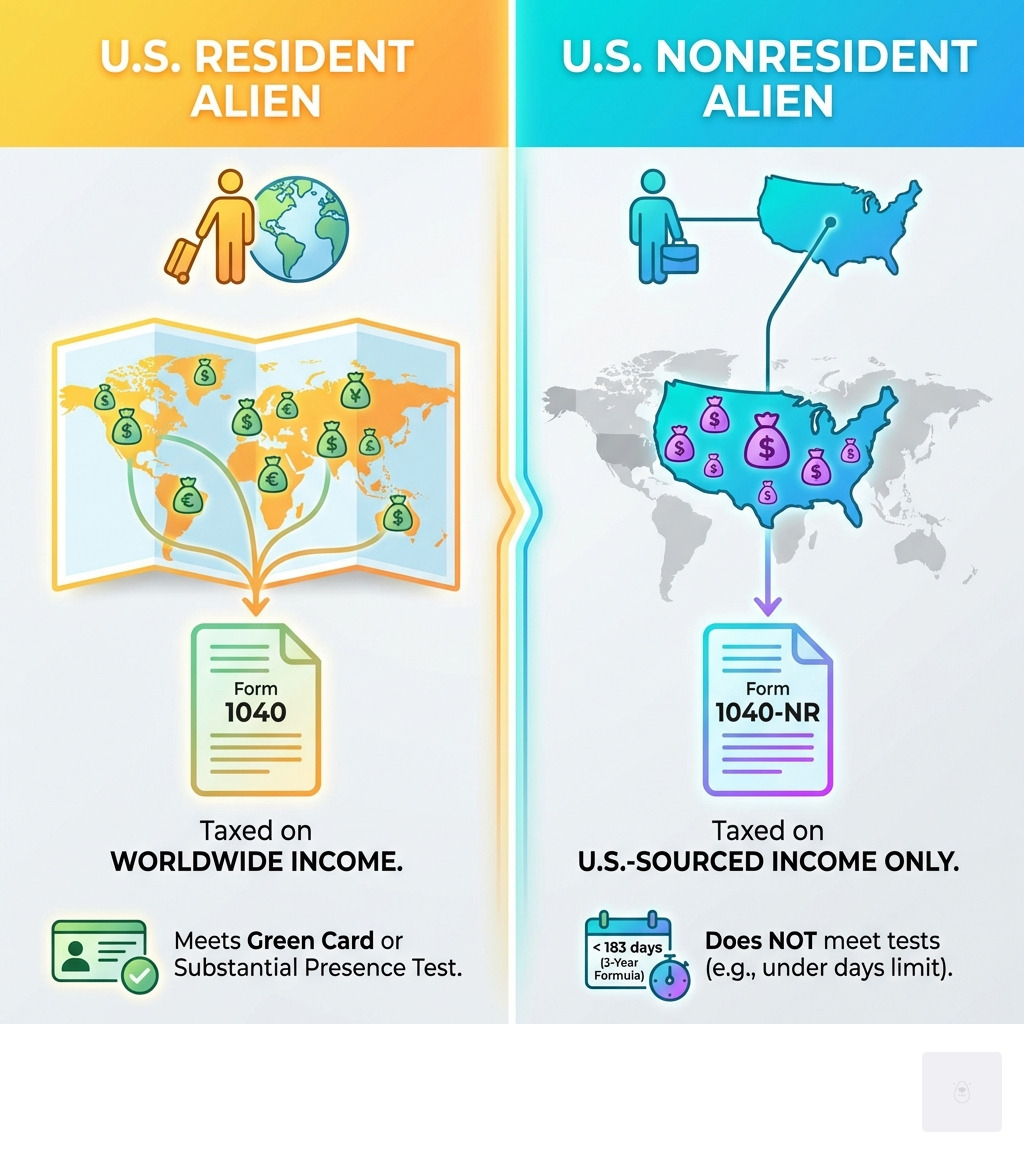
Form 1040-NR, the U.S. Nonresident Alien Income Tax Return, is for individuals who are not U.S. citizens or resident aliens but have U.S.-sourced income. It is the counterpart to the standard Form 1040 that many U.S.-based freelancers and small businesses file.
You must file Form 1040-NR if you are a nonresident alien who received income from U.S. sources or engaged in a U.S. trade or business during the tax year. This also applies to representatives of a deceased person or an estate or trust with these filing requirements.
Common scenarios requiring a 1040-NR filing include:
- Engaged in a U.S. Trade or Business: Performing personal services in the U.S. (for example, consulting work done remotely for a Texas client that is treated as U.S. source) generally requires you to report your earnings.
- U.S. Source Income: If you had U.S. source income (like investments) where tax was withheld, you might file to claim a refund. If no tax was withheld, you must file to report the income and pay any tax due.
“U.S. source income” covers everything from wages and salaries to scholarships, fellowships, and gambling winnings. For more details, the IRS provides an excellent resource: About Form 1040-NR, U.S. Nonresident Alien Income Tax ….
For nonresident freelancers and contractors, your clients may also ask for a W9 form or similar documentation to report payments correctly. You can streamline that side of your compliance using a fillable W9 through Fillable W9 so you are ready whenever a new client requests your tax details.
Key Differences Between Form 1040-NR and Form 1040
Understanding the fundamental differences between Form 1040 and 1040-NR is critical to avoid filing errors.
Here is a quick comparison:
| Feature | Form 1040 (U.S. Citizens/Residents) | Form 1040-NR (Nonresident Aliens) |
|---|---|---|
| Filing Status | Single, Married Filing Jointly/Separately, Head of Household, Qualifying Widow(er) | Single, Married Filing Separately, Qualifying Surviving Spouse (limited) |
| Standard Deduction | Generally available | Not available; must itemize deductions on Schedule A (if eligible) |
| Joint Return | Allowed for married couples | Not allowed |
| Dependents | Can claim various dependents and related credits | Limited to residents of Canada, Mexico, and certain others by treaty |
| Tax Credits | Eligible for a wide range of credits (for example, Child Tax Credit, EITC) | Limited eligibility; Cannot claim Earned Income Credit (EIC) |
| Income Reporting | Reports worldwide income | Reports only U.S.-sourced income |
Key takeaways for 1040 nr online filers are the lack of a standard deduction (you must itemize), the inability to file a joint return, and severely restricted eligibility for tax credits like the Earned Income Credit (EIC). Unlike U.S. residents, you report only your U.S.-sourced income.
If you also need to share your taxpayer information with clients, you can complete your fillable W9 form online at https://fillablew9.com/apply to keep your paperwork organized alongside your 1040-NR obligations.
Determining Your Tax Residency: The Substantial Presence Test
Your first step is to determine your tax residency status. The IRS uses specific rules, not just your immigration status. You are a U.S. resident for tax purposes if you meet the Green Card Test or the Substantial Presence Test.
The Substantial Presence Test determines if you’ve been in the U.S. long enough to be taxed as a resident. You meet this test if you were physically present in the U.S. for:
- At least 31 days during the current year, AND
- A total of 183 days during the last three years, using a weighted formula.
The 183-day calculation works as follows:
- All days present in the current year
- Plus 1/3 of the days present in the first preceding year
- Plus 1/6 of the days present in the second preceding year
If your total is 183 or more (and you meet the 31-day rule for the current year), you are a U.S. resident for tax purposes and file Form 1040. If not, you are a nonresident alien and file Form 1040-NR.

Example: You were in the U.S. for 120 days in each of the last three years (2025, 2024, 2023).
- Calculation: 120 + (1/3 * 120) + (1/6 * 120) = 120 + 40 + 20 = 180 days.
- Since 180 is less than 183, you do not meet the test and are a nonresident alien.
However, days spent in the U.S. as an “exempt individual” do not count toward the test. This often applies to:
- Students (F and M visas)
- Teachers and Trainees (J and Q visas)
- Foreign government-related individuals
If you are an exempt individual (e.g., a student on an F visa) and have no taxable income, you generally don’t file Form 1040-NR. However, you must still file Form 8843, Statement for Exempt Individuals, to document your status. This is a critical step, even with no income. For full details, see the Instructions for Form 1040-NR.
A Step-by-Step Guide to Filing Your 1040 NR Online
Filing your 1040 nr online is possible and offers benefits like speed, accuracy, and convenience. The IRS has allowed e-filing for Form 1040-NR since 2016. The IRS will not calculate the tax for you on this form, so accuracy is key.
For freelancers, independent contractors, and small business owners who are nonresident aliens, this process often happens at the same time you are handling your W9 form or other onboarding paperwork for clients. Keeping everything digital and organized is essential.
Here is a general guide to filing your 1040 nr online:
- Confirm Your Residency Status: First, ensure you are a nonresident alien by using the Substantial Presence Test. If so, proceed with Form 1040-NR.
- Gather Your Documents: Collect all relevant tax documents, including:
- Form W-2 (Wages)
- Form 1042-S (Income for Foreign Persons)
- Forms 1099 (Interest, Dividends, etc.)
- Passport, visa, and U.S. entry/exit dates.
- Get an ITIN (if needed): If you must file but do not have and cannot get a Social Security Number (SSN), you need an Individual Taxpayer Identification Number (ITIN). Apply using Form W-7, but start early as it can take time.
- Choose an E-filing Method: Select an IRS-approved tax software that supports Form 1040-NR. You can find options on the IRS website: IRS e-file options.
- Enter Your Information: Follow the software’s prompts to enter your income and personal details. Pay close attention to distinguishing between income that is “effectively connected” and “not effectively connected” with a U.S. trade or business.
- Review, E-Sign, and Submit: Carefully review your completed return for accuracy. Once you are confident, electronically sign and submit it. You should receive an immediate confirmation from the IRS.
While you are organizing these documents, it is a good moment to also prepare the fillable W9 many U.S. clients request before paying you. Do not waste time with paper forms — complete your secure W9 online at https://fillablew9.com/apply.

Key Schedules for Your 1040 NR Online Filing
Filing Form 1040-NR often requires additional schedules:
- Schedule NEC (Form 1040-NR): Used to report tax on income not effectively connected with a U.S. trade or business, such as certain dividends, interest, or royalties.
- Schedule OI (Form 1040-NR): Collects information about your citizenship, visa, travel history, and any tax treaty benefits you are claiming.
- Schedule A (Form 1040): Since you cannot take the standard deduction, you use this schedule to itemize eligible deductions like state and local taxes or gifts to U.S. charities.
Deadlines, Payments, and Refunds
Meeting deadlines is crucial to avoid penalties.
- Deadlines: The due date is April 15 if you receive wages subject to U.S. withholding. It is June 15 if you do not. You can file Form 4868 for an automatic extension to October 15, but this does not extend your time to pay.
- Payments: If you owe taxes, pay electronically through IRS Direct Pay or other methods offered by your tax software. This is the fastest and most secure way to pay.
- Refunds: The quickest way to receive a refund is via direct deposit into a U.S. bank account. Refunds related to certain forms (like 1042-S) may be delayed while the IRS verifies withholding.
Keeping your 1040-NR, client records, and W9 form information aligned will make life much easier at tax time. You can always start filling your W9 online now at https://fillablew9.com/apply so it is ready before your next client request.
Navigating Deductions, Credits, and Tax Treaties
Your ability to claim deductions and credits on a 1040 nr online return is more limited than for U.S. residents. Understanding these rules is key.
Deductions:
Nonresident aliens do not qualify for the standard deduction. You must itemize eligible deductions on Schedule A (Form 1040). These can include:
- State and Local Taxes (SALT): Deduct state and local income taxes paid, subject to federal limits.
- Gifts to U.S. Charities: Contributions to qualified U.S. charities are generally deductible.
- Casualty and Theft Losses: Losses from a federally declared disaster may be deductible.
- Other Deductions: Certain other items, like gambling losses up to the amount of gambling winnings, may be deductible.
Credits:
Tax credits for nonresident aliens are highly restricted.
- Child Tax Credit (CTC): Generally not available, except for residents of Canada and Mexico. Limited exceptions may apply to residents of South Korea and India under tax treaties.
- Earned Income Credit (EIC): Cannot be claimed on Form 1040-NR.
- Premium Tax Credit: Generally not available, with limited exceptions similar to the CTC.
The Role of Tax Treaties:
The U.S. has tax treaties with many countries that can reduce or eliminate U.S. tax on certain income for residents of those countries. For example, a treaty might offer a lower tax rate on dividends or exempt certain income entirely.
If you claim treaty benefits, you must report this on your return (usually on Schedule OI) and may need to file Form 8833, Treaty-Based Return Position Disclosure. Always consult the specific treaty between the U.S. and your country. IRS Publication 519, U.S. Tax Guide for Aliens, is an excellent resource. For social security agreements, visit SSA.gov/international.
Common Mistakes to Avoid When Filing Form 1040-NR
Filing Form 1040-NR has specific rules, and mistakes can lead to delays, penalties, or immigration issues. Here are common pitfalls to avoid.
1. Choosing the Wrong Residency Status: Filing Form 1040 as a nonresident or Form 1040-NR as a resident is a critical error. Always verify your status with the Substantial Presence Test.
2. Using the Wrong Filing Status: Nonresident aliens cannot file as “Married Filing Jointly” or “Head of Household.” Your options are generally limited to Single or Married Filing Separately.
3. Forgetting Required Forms: Always attach necessary documents like Form W-2, 1042-S, and especially Form 8843 if you are an exempt individual. Forgetting these causes delays.
4. Misreporting Income: Correctly distinguishing between income “effectively connected” (taxed at graduated rates) and “not effectively connected” (often taxed at a flat 30% or treaty rate) is crucial for an accurate tax calculation.
5. Ignoring Form 8843: Exempt individuals (e.g., students on F, J, M, or Q visas) with no U.S. income must still file Form 8843. Failing to do so can impact future residency determinations.
6. Assuming the IRS Will Calculate Your Tax: The IRS will not calculate the tax for you on Form 1040-NR. You are responsible for all calculations.
Common Mistakes When Filing Your 1040 NR Online
Even when filing your 1040 nr online, watch out for these errors:
- Data Entry Errors: Software can’t fix wrong numbers. Double-check all amounts you enter from your W-2, 1042-S, and other documents.
- Missing Treaty Information: If claiming treaty benefits, ensure you complete Schedule OI and Form 8833 (if required) correctly.
- Forgetting to E-Sign: An electronic return is invalid until it is properly e-signed. Follow the final prompts in your software.
- Not Keeping a Copy: Always save a digital and/or physical copy of your submitted return and all supporting documents for your records.
Frequently Asked Questions about Form 1040-NR
Here are answers to common questions about 1040 nr online filing, especially for freelancers, contractors, and small business owners working with U.S. clients.
Can I claim dependents on Form 1040-NR?
Generally, no. Nonresident aliens typically cannot claim dependents. The main exceptions are for residents of Canada and Mexico. Limited exceptions may also apply to residents of South Korea and India under specific tax treaty provisions. Any dependent claimed must have a valid SSN or ITIN.
What if I was in the U.S. but had no income?
If you were a nonresident alien in the U.S. with no U.S.-sourced income, you generally do not need to file Form 1040-NR. However, if you are an “exempt individual” (for example, a student or teacher on an F, J, M, or Q visa), you must file Form 8843, Statement for Exempt Individuals. This form documents your status and is a crucial compliance step even without income.
Where can I get help with filing my 1040-NR?
Navigating Form 1040-NR can be challenging, but help is available:
- Tax Professionals: A qualified tax preparer specializing in nonresident alien returns can provide expert assistance.
- Tax Preparation Software: Many online tax software programs are designed to handle 1040 nr online filings and can guide you through the process.
- IRS Resources: The IRS website (IRS.gov) offers forms, instructions, and publications like Publication 519, U.S. Tax Guide for Aliens. Their “About Form 1040-NR” page is a great starting point.
- Taxpayer Advocate Service (TAS): If you have a tax problem you cannot resolve with the IRS, TAS is an independent organization that can help. Visit their site for assistance: Taxpayer Advocate Service.
- MilitaryOneSource MilTax: Members of the U.S. Armed Forces and qualified veterans can access free tax services through MilTax: MilitaryOneSource MilTax.
How does a W9 form fit into all of this?
If you are a nonresident freelancer or contractor working with U.S. businesses, your clients may request a W9 form so they can properly report payments. While Form 1040-NR handles your annual nonresident income tax filing, the W9 is the form clients use to collect your taxpayer identification information.
Using a fillable W9 online helps you respond quickly and securely when a new client asks for your details. You can complete your secure W9 online at https://fillablew9.com/apply and reuse it for future clients.
Conclusion: File with Confidence
Understanding and filing your 1040 nr online does not have to be a daunting task. By carefully determining your tax residency, gathering all necessary documents, utilizing online filing tools, and being aware of the specific rules regarding deductions, credits, and tax treaties, you can handle your U.S. tax obligations with confidence.
For freelancers, contractors, and small business owners, this annual filing often sits alongside other key paperwork like the W9 form. Getting both right helps you stay compliant, avoid delays in payment from clients, and keep your records organized.
While this guide covers the intricacies of Form 1040-NR, Fillable W9 specializes in streamlining other essential tax forms. We know that accurate and secure form completion is paramount for everyone, from independent contractors to small businesses. Whether it is a fillable W9 or other critical compliance documents, our goal is to make your financial paperwork stress-free.
Do not waste time with paper forms — complete your secure W9 online at https://fillablew9.com/apply.
✅ Ready to complete your W9 in minutes? Apply here now: https://fillablew9.com/apply