
Why Knowing How to Mail Taxes Correctly Matters

How to mail taxes might seem straightforward, but a single mistake-a wrong address, missing signature, or late postmark-can delay your refund by months or trigger penalties. The IRS processes millions of paper returns annually, and the system only works when you follow their specific rules.
Quick Answer: How to Mail Your Federal Tax Return
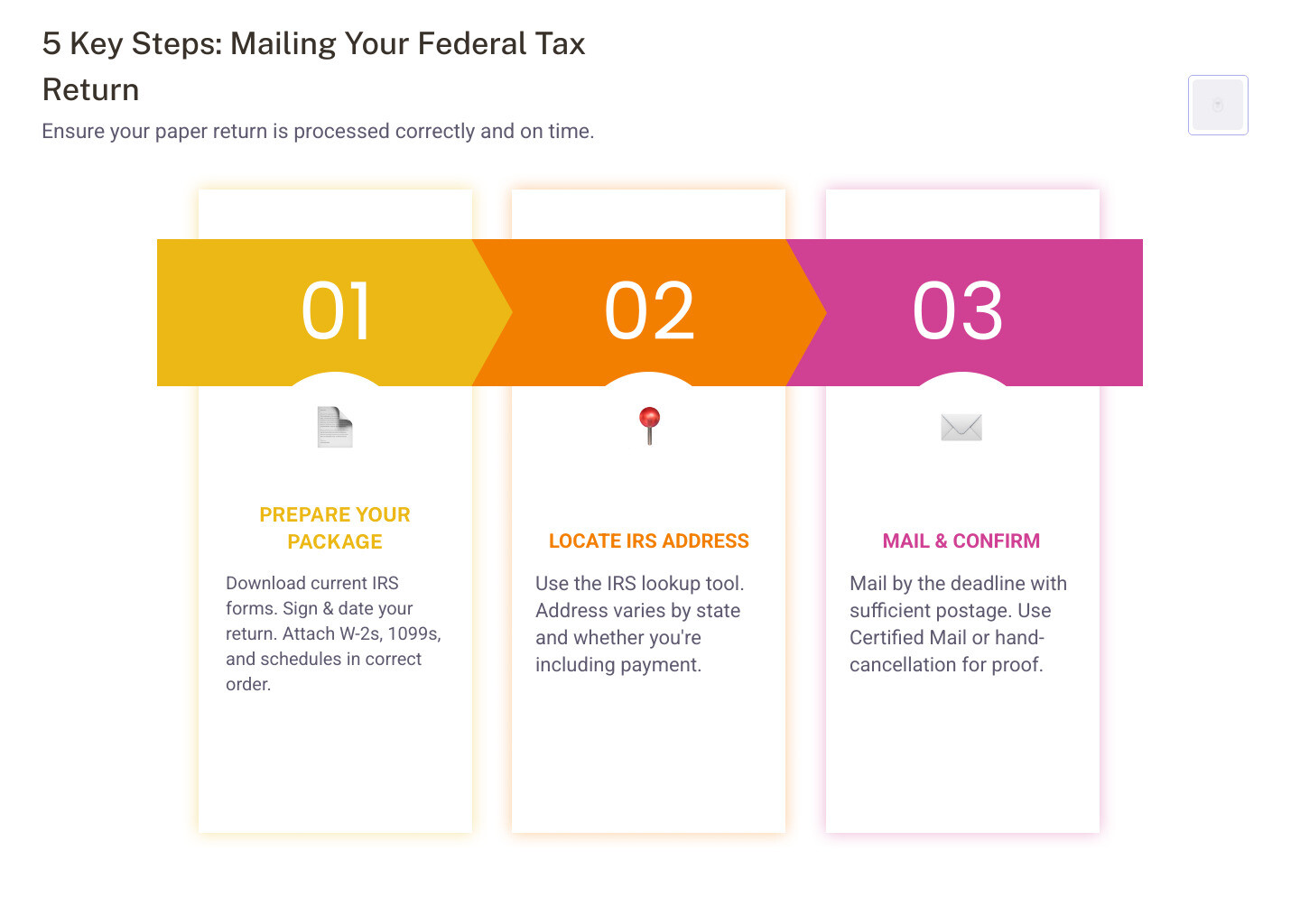
- Get the right forms – Download current year forms from IRS.gov or print from tax software
- Assemble your package – Sign and date your return, attach W-2s/1099s to the front, add schedules behind
- Find your IRS address – Use the IRS state lookup tool; the address varies by your location and whether you’re including payment
- Mail on time – Ensure your envelope is postmarked by April 15 (or the next business day)
- Get proof – Use USPS Certified Mail or ask for hand-cancellation at the post office counter
The IRS considers your return filed on time if your envelope is properly addressed, has enough postage, and is postmarked by the filing deadline-even if it arrives weeks later. That postmark date is your proof, so requesting hand-cancellation or using tracked mail can save you from future headaches.
Despite the rise of e-filing, many taxpayers still mail paper returns. You might need to if your e-file was rejected, you’re filing after the October e-filing deadline, or you simply prefer paper. Understanding the mailing process ensures your return reaches the correct IRS processing center without delays.
I’m Haiko de Poel, and I specialize in digital marketing and brand strategy. I’ve helped countless small business owners and freelancers manage administrative tasks like mailing taxes correctly through streamlined processes at companies like Mass Impact. Clear systems save time and reduce errors-principles that apply to both filing taxes and building a brand.
Simple guide to how to mail taxes:
Preparing Your Paper Tax Return for Mailing
Even in a digital age, you might need to mail a paper tax return. You may prefer it over e-filing, or your e-file could be rejected due to an Adjusted Gross Income (AGI) mismatch. You also must mail your return if filing after the October e-filing deadline. Whatever the reason, correctly preparing your paper return is crucial. This means gathering the right forms, assembling your package carefully, and ensuring all signatures and dates are in place.

Finding and Printing the Correct Tax Forms
First, ensure you have the correct, up-to-date forms.
- Current Year Forms: You can download the current year’s federal tax forms, like Form 1040, directly from the IRS website for free. You can also order them online for mail delivery or by phone at 1-800-TAX-FORM (1-800-829-3676). For direct access, you can Download them from IRS.gov.
- Prior Year Forms: For prior tax years, the IRS website is still your best resource. You can look them up by form number or year.
- State Tax Forms: For state tax obligations in Texas, you’ll need specific state tax forms. The Federation of Tax Administrators website is a convenient hub to download your state’s tax forms and instructions.
- Special Forms for Seniors: The IRS offers Form 1040-SR, an easier-to-read version of the 1040 for people 65 and older. It features bigger print and a standard deduction chart but uses the same schedules as the regular 1040. You can find this tax filing form for people 65 and older [PDF, 171KB].
- Accessible Forms: The IRS also provides accessible tax forms compatible with assistive technologies, including Section 508 accessible PDFs, Braille, and text formats.
- Printing from Tax Software: If you use tax preparation software like TaxAct, printing your return is simple. Steer to the ‘File’ or ‘Filing’ menu and select ‘Print Return.’ The software will guide you and often include mailing instructions.
Assembling Your Tax Return Package
Once you have your printed forms, assemble them carefully to ensure the IRS can process your return smoothly.
- Filing Instructions: Tax software generates filing instructions when you print your return. These are vital, containing details on where to file, what to attach, and refund or balance due information. Read them thoroughly!
- What to Attach:
- Attach copies of all Forms W-2, W-2G, 1099-R, and any other income documents that show federal income tax withheld to the front of your Form 1040.
- If paying by check or money order, include Form 1040-V, Payment Voucher.
- Place related schedules and forms behind your Form 1040 in sequence number order.
- Standard Size Paper: All documents must be on standard-size paper. Do not cut the paper, as this can cause processing problems.
- Do Not Staple: Do not staple your documents. The IRS prefers paper clips or binder clips to keep pages together.
- Signing and Dating: This is a critical step. Both federal and state returns must be signed and dated. For joint returns, both spouses must sign. If one spouse cannot sign due to a medical condition, the other may sign for them with an explanatory statement. A parent or guardian can sign for a minor child. Missing signatures will cause delays.
Where to Mail Your Federal Tax Forms
One of the most common questions about how to mail taxes is, “Where exactly do I send this thing?” The answer isn’t simple. The IRS mailing address depends on your state, the forms you’re using, and whether you’re including a payment. Sending your return to the wrong address will significantly delay processing.
You need to be precise, as different IRS service centers handle mail for different states and forms. The IRS provides clear guidance on its website. Use this IRS page to find the correct address for your state and forms..
Finding the Right IRS Address for Your Form 1040
For Form 1040 (or 1040-SR), the mailing address is determined by where you live. A Texas resident will mail their return to a different IRS center than a New York resident.
The address also changes depending on whether you include a payment, as those returns are routed to a different department.
For example, a Texas resident mailing a Form 1040 will use different addresses based on payment. The principle is the same for all states:
- If you are a resident of Texas and are NOT enclosing a payment, you will mail your Form 1040 to a specific IRS address for non-payment returns from your region.
- If you are a resident of Texas and ARE enclosing a payment, you will send your Form 1040 and payment (with Form 1040-V) to a different IRS address, usually a payment processing center.
We strongly encourage you to use the official IRS tool linked above to confirm the exact address for your situation in Texas. This ensures your return goes to the correct processing center.
Mailing Addresses for Other Common Forms and Filers
Other returns and taxpayers also have specific mailing instructions.
- Amended Returns (Form 1040-X): If you need to correct a previously filed tax return, you’ll use Form 1040-X. The mailing address for amended returns can vary, so always check the form’s instructions or the IRS website.
- Extensions (Form 4868): When you need more time to file, you’ll submit Form 4868, Application for Automatic Extension of Time To File U.S. Individual Income Tax Return. The address for this form also depends on your state.
- Estimated Taxes (Form 1040-ES): If you pay estimated taxes, you might mail quarterly payments with Form 1040-ES, Estimated Tax for Individuals. The mailing location is state-dependent.
- International Taxpayers: If you are an international taxpayer, your mailing address will be different from those residing in the U.S. The IRS provides specific addresses for these situations.
- Tax-Exempt and Government Entities: Organizations like tax-exempt entities or government bodies also have designated mailing addresses for their specific forms (e.g., Form 990 series).
For all these scenarios, the most reliable source for up-to-date mailing addresses is the IRS itself. You can find detailed instructions and specific addresses on the IRS website dedicated to paper tax returns: Where to file paper tax returns with or without a payment – IRS. Always double-check before sealing that envelope!
A Guide on How to Mail Taxes to Meet the Deadline
Meeting the tax deadline is paramount. The federal tax deadline is typically April 15, shifting to the next business day if it falls on a weekend or holiday. When mailing, the “postmark rule” is critical. The IRS considers your tax return filed on time if it’s properly addressed, has enough postage, and is postmarked by the due date. Even if it arrives after the deadline, a timely postmark means you’re in the clear. Proper postage and addressing are non-negotiable.
Understanding the “Timely Mailing as Timely Filing” Rule
This rule is your best friend for meeting mail-in deadlines. The postmark date is key, as it’s the official timestamp proving you sent your return on time. For the rule to apply, your envelope must meet three conditions:
- Proper Addressing: The IRS address must be correct, as discussed in the previous section.
- Sufficient Postage: Under-stamping is a common mistake that causes delays or returns. When in doubt, have the post office weigh your envelope.
- Deposited in the Mail: The envelope must be deposited in the U.S. mail on or before the due date.
The USPS is the primary service for mailing tax returns. You can use it to mail your return, get proof of mailing with Certified or Registered Mail, and track its arrival. You can learn more about their services for tax returns here: Mail Your Tax Return with USPS.
To avoid doubt about the postmark date, especially near the deadline, ask a Post Office retail associate to hand-cancel your envelope for free. This provides undeniable proof it was mailed on that day. You can ask a retail associate at a Post Office retail counter to hand-cancel it for free.Learn More..
Your Best Options for How to Mail Taxes Securely
For sensitive documents like tax returns, security and proof of mailing are paramount. You want to ensure your return reaches the IRS safely and that you have a record of sending it.
Here are your best options for mailing taxes securely:
- USPS Certified Mail: This service provides a mailing receipt and electronic verification of delivery or a delivery attempt. It’s an excellent option for peace of mind, offering proof of mailing and delivery.
- USPS Registered Mail: For higher security, Registered Mail offers maximum protection. It’s processed manually and kept separate from other mail, ideal for critical documents, and includes proof of mailing and tracking.
- Proof of Mailing: Both services provide a receipt at the time of mailing, which is your official proof of sending your return by the deadline.
- Tracking Your Return: These services also let you track your mail’s progress to the IRS.
- Private Delivery Services (PDS): The IRS also recognizes certain Private Delivery Services (PDS) like FedEx or UPS for the ‘timely mailing as timely filing’ rule. Returns sent by the due date via an approved PDS are considered on time. Always check the IRS website for the current list of approved providers and use a service that records receipt and delivery dates.
Special Situations and Filing Issues
Sometimes, tax filing takes an unexpected turn. Whether it’s an e-file rejection, needing more time, or dealing with past-due returns, knowing how to mail taxes in these situations is vital to avoid penalties and ensure compliance. Understanding these challenges helps you meet your obligations.
What to Do If Your E-File Is Rejected
An e-file rejection can be frustrating, but don’t panic. It doesn’t mean you’ve missed the deadline.
- Paper-filing after rejection: If your e-file is rejected by the due date, you have a window to correct it and paper-file. Include an explanation and a copy of the IRS rejection notice with your paper return.
- 10-day mailing window: Mail the return within 10 days of the rejection (no later than April 25 for an April 15 deadline) to be considered as filing on time.
- Correcting AGI issues: A common rejection reason is an incorrect prior-year Adjusted Gross Income (AGI). If re-entering your AGI fails, try entering ‘0’, especially if your prior return was processed late. If that fails, paper-filing with the rejection notice is your solution.
Filing an Extension or a Past-Due Return: A Quick Guide on How to Mail Taxes Late
Sometimes you just need more time, and the IRS understands.
- Filing Form 4868: To get more time to file, request an extension by the April deadline by filing Form 4868, Application for Automatic Extension of Time To File U.S. Individual Income Tax Return. This grants an automatic 6-month extension to file, usually until October 15. For more information on when, how, and where to file, consult Topic no. 301, When, how and where to file.
- Extension to file is not an extension to pay: This is a critical distinction: an extension gives you more time to file, not to pay. You must still pay taxes owed by the original April deadline to avoid interest and penalties.
- Penalties and Interest: If you fail to pay by the original deadline, you will incur interest on the unpaid tax and may face late-payment penalties.
- How to file a prior year return: You can file past-due tax returns for any prior year. Get the correct forms for that year from the IRS website. Follow the same preparation and mailing steps, using the correct address for that year’s return. File past-due returns as soon as possible to minimize penalties. You can look them up by form number or year on the IRS website.
Frequently Asked Questions about Mailing Taxes
Navigating tax filing brings up many questions. Here are answers to common inquiries about how to mail taxes to help you file with confidence.
What’s the difference between mailing a return with and without a payment?
This is an important distinction. The IRS has different mailing addresses for returns with a payment versus those without. Returns with payments go to a financial processing center, while others go to a general processing center.
- Use the correct address: Always double-check the IRS website or form instructions for the correct address based on whether you’re including a payment. Using the wrong address can delay processing and lead to late-payment penalties.
- Include Form 1040-V for payments: If paying by check or money order, include Form 1040-V, Payment Voucher. This helps the IRS apply your payment correctly.
- Never send cash: For security, never mail cash. Pay by check, money order, or an electronic payment method.
What happens if I file or pay my taxes late?
Filing or paying taxes late leads to penalties and interest.
- Failure-to-file penalty: The failure-to-file penalty is charged if you don’t file by the due date (including extensions). It’s generally 5% of unpaid taxes per month (or part of a month) the return is late, capped at 25%.
- Failure-to-pay penalty: The failure-to-pay penalty is charged if you don’t pay by the due date. It’s generally 0.5% of unpaid taxes per month (or part of a month) they remain unpaid, capped at 25%.
- Interest on unpaid taxes: The IRS also charges interest on underpayments and unpaid taxes, which accrues from the original due date until the tax is fully paid.
- Penalties can be significant: These penalties and interest can add up quickly, increasing your tax burden.
- File on time even if you can’t pay in full: Crucially, the failure-to-file penalty is much higher than the failure-to-pay penalty. If you can’t pay in full, still file on time (or file an extension) to avoid the larger penalty. You can then explore IRS payment options.
Can I track my mailed tax return to the IRS?
Yes, and we highly recommend it. Using a trackable service provides peace of mind and official proof of mailing and delivery, which is invaluable if questions arise.
- USPS Certified Mail or Registered Mail: As discussed, services like USPS Certified Mail and Registered Mail are excellent for tracking. They provide a mailing receipt, online delivery confirmation, and a record of when you mailed your return and when the IRS received it.
- Private Delivery Services (PDS): IRS-approved Private Delivery Services like UPS or FedEx also offer robust tracking. You’ll get a tracking number to monitor your package’s journey to the IRS.
- Keep your tracking receipt as proof of filing: No matter which service you use, keep the mailing receipt or tracking confirmation. This document is your official proof of timely filing and delivery, which can save you from future headaches.
Conclusion
Navigating the process of how to mail taxes doesn’t have to be a daunting task. By understanding the key steps, you can ensure your federal tax return is filed correctly and on time, saving you from potential headaches and penalties.
Here are the key takeaways to remember:
- Find the right forms: Always start by obtaining the correct federal and state tax forms for the current or prior year. The IRS and state tax websites are your best resources.
- Assemble the package correctly: Follow filing instructions carefully. Sign and date your return, attach income documents (like W-2s and 1099s) to the front, and place schedules in order behind your main form.
- Use the correct address: The IRS mailing address varies by your state (e.g., Texas), the forms you’re sending, and whether you’re including a payment. Always use the official IRS lookup tool for the exact address.
- Mail on time with proof: Ensure your envelope is properly addressed, has enough postage, and is postmarked by the deadline. For security and proof, use USPS Certified Mail or request hand-cancellation at the Post Office.
- Understand special situations: Know how to handle e-file rejections, file an extension (which is not an extension to pay), and understand the implications of late filing or payment.
Organizing your tax documents, including W-9 forms, is a critical first step in this entire process. A good system ensures you have all necessary information for e-filing or mailing. Fillable W9 helps simplify creating and managing your W-9 forms, which are foundational for accurate tax reporting.
Ready to complete your W9 in minutes? Apply here now.