
Understanding the 1099 vs. W-2 Distinction

Do 1099 employees get a w2? No, and the reason is simple: the term “1099 employee” is a contradiction. Workers who receive 1099 forms are independent contractors, not employees, and they never receive W-2 forms. Here’s the quick breakdown:
- W-2 forms are for employees.
- 1099 forms (specifically 1099-NEC) are for independent contractors.
- You can’t be both for the same work—the IRS classifies you as one or the other.
- Different tax obligations apply to each classification.
If you’ve been asked to fill out a W-9 form, that’s a clear sign you’re being classified as an independent contractor who will receive a 1099, not a W-2. The confusion around this question reveals a common misunderstanding about worker classification. The IRS is very clear about this distinction, and getting it wrong can lead to significant penalties.
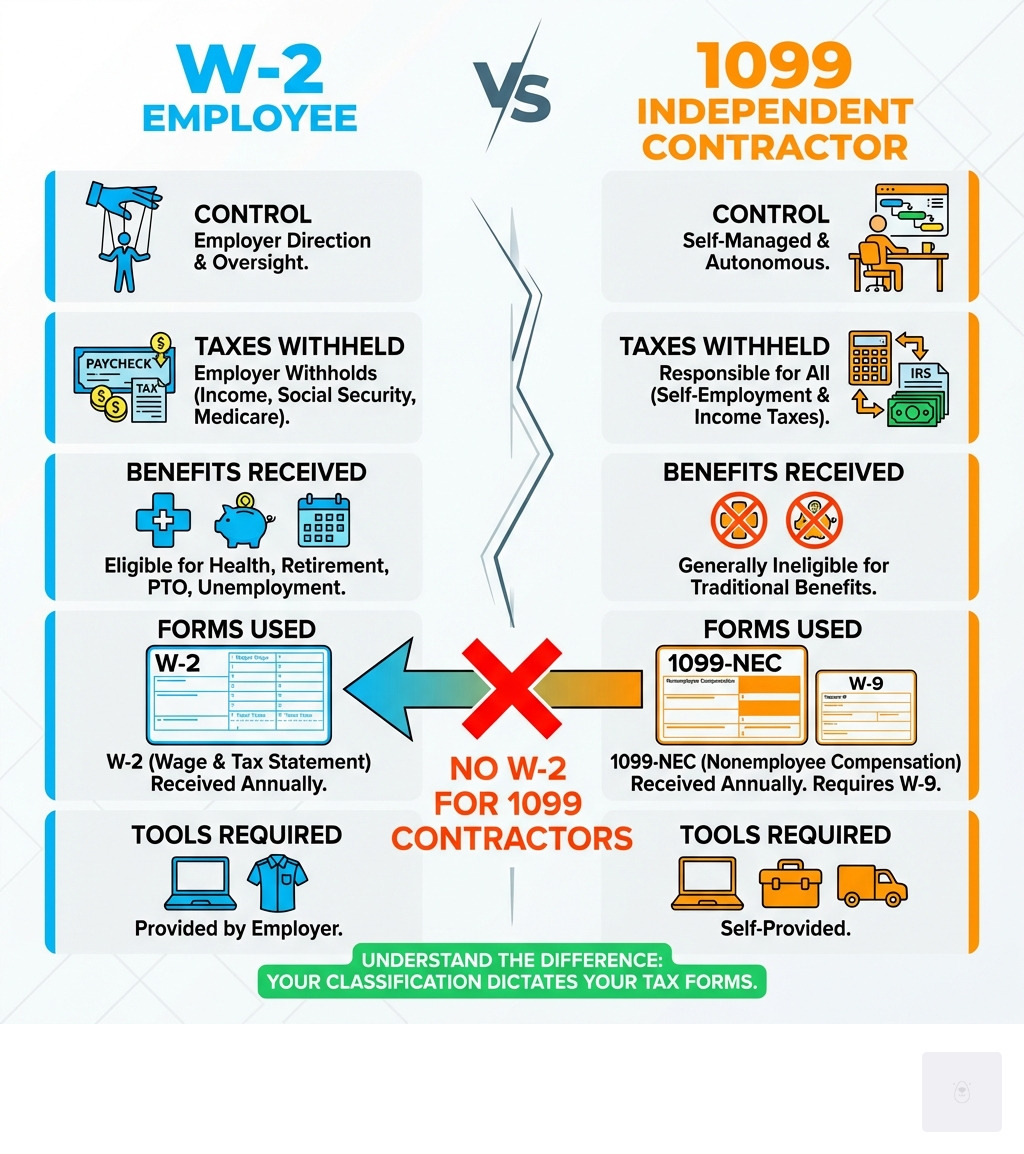
The forms you receive depend entirely on your classification. Employees work under an employer’s control and have taxes withheld, while independent contractors work for themselves, handle their own taxes, and don’t receive employee benefits. This distinction affects everything from your tax bill to your eligibility for unemployment benefits.
Start filling your W9 now at https://fillablew9.com/apply/
Do 1099 employees get a w2 terms at a glance:
W-2 Employee vs. 1099 Contractor: The Core Differences
At the heart of the tax form divide lies the fundamental distinction between a W-2 employee and a 1099 independent contractor. This isn’t just semantics; it dictates how you’re paid, taxed, and what legal protections you receive. For businesses, correct classification is crucial to avoid penalties. For workers, understanding your status is key to managing your finances.
A W-2 employee is a traditional worker on a company’s payroll. The employer controls their work, withholds taxes from each paycheck (income, Social Security, and Medicare), and pays a matching share of payroll taxes. Employees are typically covered by unemployment insurance, workers’ compensation, and labor laws governing minimum wage and overtime. They receive a Form W-2 summarizing their annual earnings and taxes paid.
In contrast, a 1099 independent contractor is a self-employed individual or business hired for a specific service. They control their own work, use their own tools, and invoice clients. Payers do not withhold taxes, placing the full responsibility on the contractor. This includes paying income tax and self-employment tax (covering both employee and employer portions of Social Security and Medicare). Contractors receive 1099-NEC forms from clients who pay them $600 or more. Before receiving a 1099, a contractor must provide the client with a completed Form W-9.

Here’s a quick comparison of the key differences:
| Feature | W-2 Employee | 1099 Independent Contractor |
|---|---|---|
| Control | Employer dictates how, when, where work is done | Worker controls how, when, where work is done |
| Taxes Withheld | Yes, by employer (income, FICA) | No, worker pays all taxes directly |
| Benefits | Yes (health, retirement, paid time off, etc.) | No, responsible for own benefits |
| Tax Forms | W-2 from employer | 1099-NEC (or other 1099s) from clients |
| Payroll Taxes | Employer pays half of FICA, withholds employee’s | Worker pays full self-employment tax (FICA) |
| Legal Protections | Covered by labor laws (minimum wage, anti-discrimination, unemployment) | Not covered by traditional labor laws, fewer protections |
| Tools/Equipment | Typically provided by employer | Typically uses own tools and equipment |
| Business Expenses | Limited deductions | Can deduct significant business expenses |
As a contractor, you are essentially running a business. This means you are responsible for:
- Self-Employment Tax: A 15.3% tax on net earnings to cover Social Security and Medicare, which you’ll calculate on Schedule SE.
- Estimated Quarterly Taxes: Since no taxes are withheld, you must pay estimated taxes to the IRS throughout the year to avoid penalties.
- Deducting Business Expenses: You can lower your taxable income by deducting legitimate business costs on Schedule C (Form 1040).
Understanding this distinction is the first step to proper tax compliance. For more details, you can review the IRS guidelines on employee’s classification and taxes for independent contractors.
Do 1099 Employees Get a W2? The Official IRS Stance
The question “do 1099 employees get a w2?” misunderstands how the IRS classifies workers. The IRS does not recognize “1099 employees.” You are either an employee (W-2) or an independent contractor (1099). The IRS uses the common law test to make this determination, focusing on the degree of control the business has over the worker.

The IRS evaluates three categories to determine worker status:
- Behavioral Control: Does the company control how the worker does their job? Providing detailed instructions, mandatory training, or specific work hours suggests an employee relationship.
- Financial Control: Does the company control the business aspects of the worker’s job? This includes how the worker is paid, whether expenses are reimbursed, and who provides tools. A worker who has a significant investment in their own equipment and can realize a profit or loss is likely a contractor.
- Type of Relationship: Are there written contracts defining the relationship? Is the relationship permanent? Are employee-type benefits (like insurance or paid time off) provided? These factors help clarify the parties’ intent.
No single factor is decisive; the IRS looks at the entire relationship. If a business treats a worker as an employee in practice, they will be classified as such, regardless of their title. For more, consult the IRS Independent Contractor Guidelines and the DOL’s Worker Classification page.
Don’t waste time with paper forms — complete your secure W9 online
The Role of Form W-9 in the 1099 Process
For independent contractors, Form W-9 is the first step in the payment process. Its purpose is to provide your client with your correct name and Taxpayer Identification Number (TIN), which can be your Social Security Number (SSN) or Employer Identification Number (EIN). The client needs this information to accurately report the payments they make to you on a Form 1099-NEC.
By submitting a W-9, you certify your contractor status and help the client avoid backup withholding, where they would be required to withhold 24% of your pay and send it to the IRS. Completing a W-9 promptly and accurately is crucial for smooth financial operations. For a detailed guide, see How to fill out a W-9.
Step-by-Step Guide: How to Fill Out Your W9 Form
Completing your W-9 form correctly is simple when you know the steps. Here’s a quick guide:
- Step 1: Download or access a fillable W9 form online
You can find a free, fillable W9 form on the IRS website or through trusted online platforms like Fillable W9. Ensure it’s the most current version. - Step 2: Enter your name and business name (if applicable)
Line 1 is for your legal name. Line 2 is for your business name or “doing business as” (DBA) name, if you have one. If you’re a sole proprietor or single-member LLC, your legal name goes on Line 1. - Step 3: Select your federal tax classification
Check the appropriate box that describes your tax entity. Common options include Individual/Sole proprietor or single-member LLC, C Corporation, S Corporation, Partnership, or Trust/Estate. - Step 4: Fill in your address and TIN (SSN or EIN)
Provide your mailing address, city, state, and ZIP code. Then, enter your Taxpayer Identification Number (TIN) in Part I. This will be either your Social Security Number (SSN) if you’re an individual or sole proprietor without an EIN, or your Employer Identification Number (EIN) if you have one for your business. -
Step 5: Sign and date the form
In Part II, sign and date the form to certify that the information is correct and that you are not subject to backup withholding. -
Pro Tip: Use Fillable W9 for a secure, fast, and paperless experience. Our platform simplifies the process, ensuring your online W9 form is completed accurately and ready for secure submission to your clients.
The Gray Area: Can You Receive Both a W-2 and a 1099?
Can an individual receive both a W-2 and a 1099 from the same company? Yes, but it’s a rare and highly scrutinized scenario. This dual status is only permissible if the duties performed in each role are completely distinct.

If the work performed as a contractor is just an extension of the employee’s regular duties, it’s a clear sign of misclassification. This situation is an IRS red flag due to the high potential for abuse, where businesses might try to avoid payroll taxes. As noted by experts like Payroll Partners, it takes unusual and well-documented circumstances for this to be legitimate.
Legitimate Scenarios for Receiving Both Forms
Here are some examples where receiving both forms from the same entity could be acceptable:
- Different Roles: A school custodian (W-2 employee) who also owns a snow-plowing business could be paid via 1099 for plowing the school’s parking lots as a separate, contracted service.
- Different Skills: A company’s sales manager (W-2 employee) who also runs a graphic design business could be paid via 1099 for a one-off logo design project.
- Change in Status: An individual starts the year as a 1099 contractor and is later hired as a W-2 employee by the same company. They would receive both forms for the different periods of service.
The key is a clear and defensible separation of duties. The IRS provides guidance on this topic here: When would I provide a Form W-2 and a Form 1099 to the same person?.
How Receiving Both Forms Affects Your Tax Filing
If you receive both a W-2 and a 1099, your tax filing will involve a few extra steps. You must report both types of income correctly.
- Report W-2 Income: This is reported on your Form 1040 as usual. Your employer’s tax withholdings are credited against your total tax liability.
- Report 1099 Income: This income is reported on Schedule C (Form 1040), where you list your gross contractor pay and deduct any business expenses. The net profit flows to your Form 1040.
- Pay Self-Employment Tax: If your net earnings from self-employment are $400 or more, you must file Schedule SE to calculate and pay self-employment tax (Social Security and Medicare).
Using tax software like logging into TurboTax can simplify this process by guiding you through the necessary forms. Keeping meticulous records for both your employment and business activities is essential.
The High Cost of Misclassification
Worker misclassification is a serious issue with significant consequences. The IRS and Department of Labor actively pursue these cases, and the penalties for businesses can be severe.
For employers, the costs can include:
- Back Taxes & Penalties: Liability for un-withheld income taxes, plus both the employer and employee shares of Social Security and Medicare taxes.
- Additional Fines: Penalties for failing to file correct forms, which can be substantial, especially if the misclassification is deemed intentional.
- State Penalties: Fines for unpaid state unemployment insurance and workers’ compensation premiums.
- Legal Action: Lawsuits from workers seeking back pay and benefits.
For workers, being misclassified means losing critical protections and benefits, such as:
- Unemployment insurance
- Workers’ compensation for on-the-job injuries
- Employer-sponsored health insurance and retirement plans
- Protections under minimum wage and overtime laws
The IRS offers relief programs like Section 530 relief and the Voluntary Classification Settlement Program (VCSP) for businesses that voluntarily correct their classification errors.
What to do if you’re misclassified and wondering “do 1099 employees get a W2?”
If you believe you are an employee but are being treated as a contractor, you can ask the IRS to make an official determination.
- File Form SS-8, “Determination of Worker Status.” This form asks for detailed information about your work relationship.
- The IRS will review the facts and circumstances and issue a determination. Be aware that this process can take at least six months.
- While waiting, you should continue to file your taxes as a contractor to remain compliant.
- Consider consulting with a tax professional or employment law attorney for guidance.
State vs. Federal Rules: The ABC Test
Many states have their own, often stricter, rules for worker classification. A prominent example is the ABC Test, which presumes a worker is an employee unless the employer can prove all three of the following conditions:
- (A) The worker is free from the control and direction of the hiring entity.
- (B) The work performed is outside the usual course of the hiring entity’s business.
- (C) The worker is customarily engaged in an independently established trade or business.
Failing even one part of the ABC Test means the worker is considered an employee under state law. This has a major impact on gig economy workers and businesses in states that use this test. Always be aware of both federal and state rules in your jurisdiction.
Frequently Asked Questions about W-2 and 1099 Forms
We understand that tax forms can be confusing. Here are some of the most common questions we hear about W-2 and 1099 forms:
What is the main difference between a W-2 and a 1099-NEC?
The main difference between a W-2 and a 1099-NEC lies in the worker’s classification and the associated tax responsibilities. A W-2 form is issued to employees by their employers. It reports wages earned, federal and state income taxes withheld, and FICA taxes (Social Security and Medicare) withheld. The employer is responsible for withholding these taxes and paying their share of payroll taxes.
A 1099-NEC form (Nonemployee Compensation) is issued to independent contractors by clients who paid them $600 or more for services in a calendar year. It reports the gross amount paid, but no taxes are withheld by the payer. The independent contractor is responsible for paying their own income taxes, including self-employment tax. As The Difference Between a 1099 and a W-2 Tax Form – TurboTax – Intuit highlights, the key distinction is primarily what’s entered on it: the 1099-NEC is solely for payments to independent contractors, with no tax payments reported on the form. The W-2 is a more comprehensive information return, listing not only taxable compensation but also federal and FICA withholding.
What are the deadlines for issuing W-2 and 1099 forms?
The deadlines for issuing W-2 and 1099 forms are crucial for both businesses and recipients.
- Recipient copies: Both Forms W-2 and 1099-NEC must be furnished to the service provider (employee or independent contractor) by January 31 of the year following the year of payment. This gives recipients ample time to prepare their tax returns.
- Government copies: The same January 31 deadline generally applies to submissions of these forms to the government. W-2 forms are submitted to the Social Security Administration (SSA) along with Form W-3, while 1099-NEC forms are submitted to the IRS along with Form 1096.
If a business has 10 or more information returns, they must electronically file them. Electronic filing is done through the Filing Information Returns Electronically (FIRE) system for 1099s. If a business cannot meet the deadline, it can request a 30-day extension through Form 8809, though it’s not automatically granted and requires acceptable reasons.
If I’m a contractor, why do I need to fill out a Form W-9?
As an independent contractor, you need to fill out a Form W-9 for every client who pays you $600 or more for your services in a calendar year. The primary purpose of W-9 is to provide your client with your correct Taxpayer Identification Number (TIN)—either your Social Security Number (SSN) or Employer Identification Number (EIN).
This TIN is essential for the client to accurately report the payments they make to you to the IRS on a Form 1099-NEC at the end of the year. By providing an accurate W-9, you help your client fulfill their IRS reporting obligations and, crucially, you help yourself in avoiding backup withholding. If you don’t provide a correct TIN, your client may be required to withhold 24% of your payments and send it directly to the IRS. This is a hassle you definitely want to avoid!
Completing a W-9 establishes a clear contractor relationship and ensures smooth financial transactions between you and your clients. Our Features at Fillable W9 make it easy to manage and securely send your W-9 forms.
Conclusion: Navigating Your Tax Obligations Correctly
The distinction between a W-2 employee and a 1099 independent contractor is fundamental to the U.S. tax system. As we’ve explored, the answer to “do 1099 employees get a w2?” is a resounding no, because the terms themselves represent entirely different working relationships and tax obligations. Understanding this correct classification is not just about avoiding penalties; it’s about ensuring tax compliance and managing your finances effectively, whether you’re a business owner or a worker.
For businesses in Texas and across the country, correctly classifying workers is paramount to avoid hefty IRS penalties, back taxes, and legal challenges. For independent contractors, embracing your self-employed status means taking responsibility for your own taxes, including self-employment tax and estimated quarterly payments, but also enjoying the benefits of business expense deductions and greater autonomy.
While rare, legitimate scenarios exist where an individual might receive both a W-2 and a 1099 from the same entity, provided the work performed for each classification is distinctly different. However, these situations are IRS red flags and warrant careful documentation and, often, professional guidance.
Navigating the intricacies of the tax code can feel overwhelming, but tools and resources are available to simplify the process. That’s where the Fillable W9 service comes in. We understand the importance of accurate documentation and secure submission of your W-9 forms to establish clear independent contractor relationships. Our platform is designed to make filling out and sending your W-9 forms fast, easy, and secure, helping you stay compliant and focus on what you do best.
Don’t let the complexities of tax forms hold you back. Understand the W-2 and 1099 divide, classify your workers correctly, and manage your tax responsibilities with confidence.
✅ Ready to complete your W9 in minutes? Apply here now