
Why Understanding Contract Labor IRS Forms Matters

Navigating contract labor IRS forms like the W9 form can feel like a maze. Whether you are a freelancer receiving your first client payment or a small business owner hiring your first contractor, knowing which IRS forms to use, and when to use them, is critical to staying compliant and avoiding penalties.
Here are the essential IRS forms for contract labor:
- Form W-9 – Contractor provides their taxpayer identification number (TIN) to the business
- Form 1099-NEC – Business reports payments of $600+ to contractors (due January 31)
- Form 1099-MISC – Used for other payments like rents, royalties, or prizes
- Form SS-8 – Request an official IRS determination of worker status if unclear
- Form 1096 – Transmittal form for paper filing 1099s with the IRS
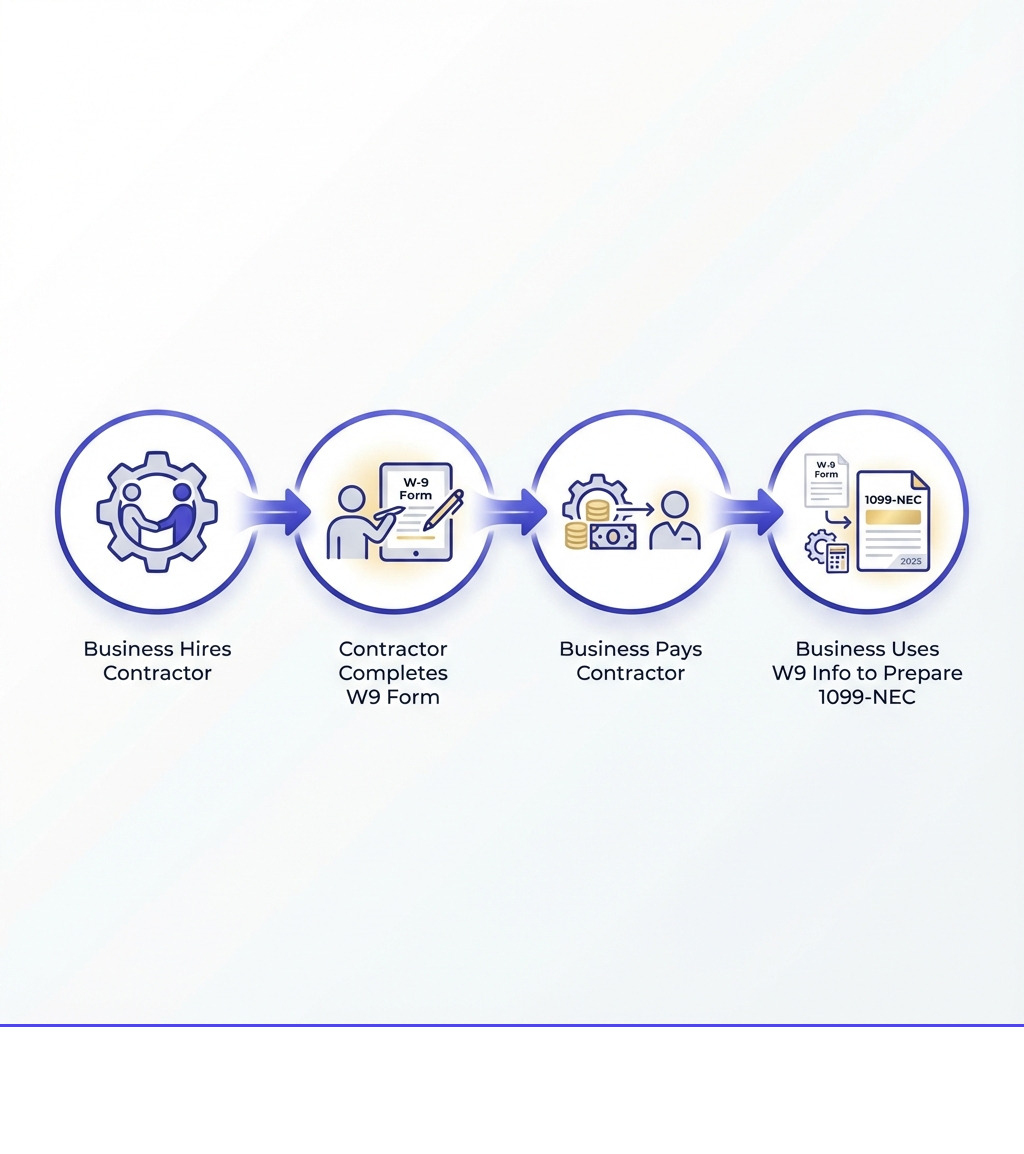
The IRS requires businesses to collect a W-9 from contractors before making payments, then issue a 1099-NEC by January 31 if total payments exceed $600 for the year. Failing to file correctly can result in backup withholding at 24%, penalties, and even liability for unpaid employment taxes if a worker is misclassified.
As Haiko de Poel, a fractional CMO and business consultant who has helped companies steer complex operational and compliance challenges, I have seen how confusion around contract labor IRS forms can cost businesses time and money. This guide breaks down everything you need to know to get it right the first time.
Start filling your W9 now at https://fillablew9.com/apply.
Simple guide to contract labor irs form terms:
Employee vs. Independent Contractor: Getting the Classification Right
Navigating contract labor IRS forms begins with a fundamental question: Is your worker an independent contractor or an employee? This distinction is not just a matter of semantics; it carries significant weight for tax purposes, payroll obligations, and legal compliance. The IRS has strict rules for determining this classification, and misclassification can lead to substantial penalties for a business.
For federal employment tax purposes, the IRS applies common law rules to determine worker status. This means we examine the relationship between the worker and the business, looking for evidence of control and independence. It is not about what the contract says, but what the actual working relationship is.
The 3 Key Factors for IRS Worker Classification
The IRS groups its classification criteria into three main categories. These factors help determine the degree of control a business has over a worker, which is the cornerstone of the independent contractor vs. employee distinction.
-
Behavioral Control: This factor looks at whether the business has the right to direct or control how the worker performs their services.
- Instructions: Does the business provide detailed instructions on how to do the work? Independent contractors typically decide their own methods.
- Training: Does the business provide training to the worker? Employees often receive training from their employer, while independent contractors use their own skills.
- Evaluation: How is the worker’s performance evaluated? An employee’s work might be evaluated for how it is done, while a contractor’s work is typically evaluated on the end result.
-
Financial Control: This category examines whether the business controls the business aspects of the worker’s job.
- Significant Investment: Does the worker have a significant investment in equipment, tools, or facilities used for the work? Independent contractors often have their own significant investment.
- Unreimbursed Expenses: Does the worker incur unreimbursed expenses? Independent contractors are more likely to have uncompensated business expenses.
- Opportunity for Profit or Loss: Can the worker realize a profit or suffer a loss from their services? Independent contractors typically have this risk and reward.
- Services Available to the General Public: Is the worker free to seek out business opportunities elsewhere? Independent contractors often market their services to multiple clients.
- Method of Payment: Are they paid by the hour, week, or month (like an employee), or by the job (like a contractor)? Payment by the job or project often indicates independent contractor status.
-
Relationship of the Parties: This factor considers how the worker and the business perceive their relationship.
- Written Contracts: While a contract might label someone an independent contractor, the IRS looks beyond the label to the substance of the relationship.
- Employee Benefits: Does the worker receive employee benefits like health insurance, pension plans, paid vacation, or sick leave? These are typically reserved for employees.
- Permanency of the Relationship: Is the relationship ongoing, or is it for a specific project or period? A long-term, continuous relationship often points to employment.
- Key Aspect of the Business: Are the services performed a key aspect of the business? If the worker provides services that are essential to the business’s operation, it might indicate an employee relationship.

The determination can be complex, and no single factor is decisive. The IRS looks at all the facts and circumstances. We recommend referring to IRS Topic no. 762, Independent contractor vs. employee for more detailed guidance.
What if You’re Still Unsure? Requesting an IRS Ruling with Form SS-8
Even after carefully considering the three factors, you might still be uncertain. Worker classification can be ambiguous, especially in new or evolving industries. Fortunately, the IRS offers a path to clarity.
If you are still uncertain about a worker’s status, both the business and the worker can file Form SS-8, Determination of Worker Status for Purposes of Federal Employment Taxes and Income Tax Withholding. When you submit this form, the IRS will review the facts and circumstances of the work relationship and provide an official determination of the worker’s status. This process can take at least six months, but it provides a definitive answer, which can be valuable for long-term compliance.
Step 1: Collecting Contractor Information with the W9 Form
Once you have determined that a worker is indeed an independent contractor, your next crucial step in managing contract labor IRS forms is to collect their tax information. This is where the W9 form, or Form W-9, Request for Taxpayer Identification Number and Certification, comes into play.
A W9 form is sent by a business (the payer) to an independent contractor (the payee) to collect their correct name and Taxpayer Identification Number (TIN). This information is essential for the business to accurately report payments made to the contractor to the IRS. Without a properly completed W-9, a business cannot fulfill its reporting obligations, which can lead to complications like backup withholding.
We typically request a W9 form from a contractor before making any payments. This ensures we have the necessary information on file from the start and can avoid any last-minute scrambling or potential issues. Both the W9 form and the subsequent 1099 forms are mandatory for compliant reporting.
Do not waste time with paper forms – complete your secure W9 online at https://fillablew9.com/apply.
How to Fill Out and Handle a W9 Securely
For contractors, filling out a W9 form is straightforward. For businesses, collecting and storing it securely is important. Here is a breakdown of the key sections and best practices:
- Name and Business Name: On Line 1, enter your name exactly as it appears on your income tax return. If you have a business name that is different from your personal name (for example, a “doing business as” name or a disregarded entity), enter it on Line 2.
- Tax Classification (Individual, LLC, etc.): On Line 3, you select your federal tax classification. Options include Individual/sole proprietor/single-member LLC, C Corporation, S Corporation, Partnership, or Trust/estate. If you are an LLC, you also indicate how it is taxed (C = C corporation, S = S corporation, or P = Partnership).
- TIN (SSN or EIN): This is one of the most important pieces of information. For individuals or sole proprietors, this will typically be your Social Security Number (SSN). For businesses, it will be your Employer Identification Number (EIN). Make sure this number is accurate to avoid backup withholding.
- Certification and Signature: Part II of the form requires your certification. By signing, you confirm that your TIN is correct, that you are not subject to backup withholding, and that you are a U.S. person.

Checklist for Handling W9 Forms:
- Double-check spelling and numbers. Even a small typo in a name or TIN can cause issues for the payer and the IRS.
- Only share W9 through secure, encrypted channels. Your W-9 contains sensitive personal information. If sending electronically, use encrypted file attachments or a secure online portal like Fillable W9 to protect your data. Avoid sending unencrypted PDFs via email.
- Store completed W9s safely for at least four years. Businesses must keep these forms on file for a minimum of four years after the last payment to the contractor.
Tip: For freelancers searching for “how to fill out W9 for freelancers,” remember that for most independent contractors, you check “Individual/sole proprietor/single-member LLC” on Line 3 and provide your SSN or EIN.
Step 2: Reporting Payments with Form 1099-NEC
After collecting a W9 form and making payments to your independent contractors, the next essential contract labor IRS form is the Form 1099-NEC, Nonemployee Compensation. This form is designed for businesses to report payments made to non-employees for services performed.
Prior to 2020, nonemployee compensation was reported on Form 1099-MISC. However, the IRS reintroduced Form 1099-NEC to specifically handle nonemployee compensation, streamlining the reporting process and separating it from other miscellaneous income. Now, if you paid an independent contractor for services performed for your trade or business, and the payments meet the reporting threshold, you use a Form 1099-NEC.
You generally must file Form 1099-NEC if all four of these conditions are met:
- You made the payment to someone who is not your employee.
- You made the payment for services in the course of your trade or business.
- You made the payment to an individual, partnership, estate, or in some cases, a corporation.
- You made reportable payments to a payee that total $600 or more during the year.
For more detailed information, you can refer to IRS 1099-NEC Info.
Key Deadlines and Reporting Thresholds for the 1099-NEC
Meeting deadlines is important to avoid penalties. Here is what you need to know for Form 1099-NEC:
- $600 Threshold: You must issue a Form 1099-NEC if you paid a contractor $600 or more for services in a calendar year. This threshold applies to each individual contractor. If you pay multiple contractors, you track payments to each one.
- January 31 Deadline: For the 2023 tax year, clients were required to send contractors Form 1099-NEC by January 31, 2024. For the 2024 tax year, the deadline is January 31, 2025. This deadline applies to both sending the form to the contractor and filing it with the IRS.
- E-filing: If you are a filer of 10 or more information returns (including Forms W-2), you are generally required to file them electronically with the IRS. This 10-return threshold applies to the aggregate of all information returns you file.
For comprehensive information on due dates, consult the IRS Filing Dates.
1099-NEC vs. 1099-MISC: What’s the Difference?
The reintroduction of Form 1099-NEC caused some confusion, especially since Form 1099-MISC still exists. It is important to understand their distinct purposes in contract labor IRS forms.
Before 2020, Form 1099-MISC was a catch-all for various types of payments, including nonemployee compensation. Now, its role is more specialized. While Form 1099-NEC covers nonemployee compensation, Form 1099-MISC reports other miscellaneous types of income.
Here is a quick table to clarify the difference:
| Form | Use For | Example Payments |
|---|---|---|
| 1099-NEC | Nonemployee Compensation | Freelance work, services, commissions |
| 1099-MISC | Rents, Royalties, etc. | Rent payments, prizes and awards, attorney gross proceeds (not for services), medical and healthcare payments |
For example, if you pay a freelance graphic designer $700 for their services, you issue a 1099-NEC. If you pay $700 in rent for your office space, you issue a 1099-MISC.
To learn more about other types of miscellaneous payments, you can refer to the official IRS guide, About Form 1099-MISC, Miscellaneous Information | IRS.
Tax Responsibilities, Risks, and Resolutions
Understanding contract labor IRS forms goes beyond just filling them out; it involves understanding the broader tax responsibilities for both businesses and contractors, as well as the risks associated with misclassification or incorrect reporting. Both parties have specific tax obligations, and knowing them is important to avoiding common pitfalls and potential issues with the IRS.
For Contractors: Understanding Your Tax Obligations
As an independent contractor, you are essentially running your own business. This means you have specific tax responsibilities that differ from those of an employee:
- Self-Employment Tax: Most self-employed individuals need to pay self-employment tax if their net earnings from self-employment are $400 or more. This tax covers your Social Security and Medicare contributions, which would normally be withheld from an employee’s paycheck. You calculate this using Schedule SE (Form 1040), Self-Employment Tax.
- Schedule C: You report your income and expenses from your business on Schedule C (Form 1040), Profit or Loss From Business (Sole Proprietorship). This form helps you determine your net profit or loss from your contracting work.
- Estimated Taxes: Since no employer is withholding taxes from your payments, you are responsible for paying your income tax and self-employment tax directly to the IRS. This is typically done through quarterly estimated tax payments. Failing to make timely payments can result in penalties for underpayment of estimated tax.
It is important to keep detailed records of all income and expenses. Even if a client does not issue you a 1099-NEC for payments under $600, you are still required to report all your taxable income to the IRS.
For Businesses: The High Cost of Misclassification
For businesses, the stakes are high when it comes to correctly classifying workers. Mistakenly classifying an employee as an independent contractor can result in financial and legal consequences:
- Employment Tax Liability: If the IRS determines you misclassified a worker, you could be held liable for the employment taxes you should have withheld and paid, including federal income tax withholding, Social Security and Medicare taxes (both the employee and employer portions), and federal unemployment tax (FUTA).
- Penalties: Beyond the back taxes, the IRS can assess penalties for failure to withhold, failure to pay, and failure to file information returns. These penalties can add up, turning an oversight into a financial burden.
- Voluntary Classification Settlement Program (VCSP): The IRS offers programs like the VCSP, which allows eligible taxpayers to voluntarily reclassify workers as employees for future tax periods with partial relief from federal employment taxes. This can be an option if you find a misclassification and want to correct it.
- Form 8919: If a worker believes they have been improperly classified as an independent contractor, they can use Form 8919, Uncollected Social Security and Medicare Tax on Wages, to figure and report their share of uncollected Social Security and Medicare taxes.
The determination can be complex and depends on the facts and circumstances of each case, as noted by the IRS. Therefore, it is a good practice to review your worker classifications regularly.
Frequently Asked Questions about Contract Labor IRS Forms
We know that navigating contract labor IRS forms can bring up many questions. Here are some common ones we hear, along with answers to help you stay compliant and confident.
What should I do if a client doesn’t send me a 1099-NEC?
It is a common scenario: you performed work for a client, earned over $600, but January 31 passes and no Form 1099-NEC arrives in your mailbox or inbox. What next?
First, you are legally required to report all income you earn, whether you receive a 1099-NEC or not.
- Report All Income: Even without the form, you must report the income on your Schedule C (Form 1040). Use your own records, such as invoices, bank statements, and payment receipts, to calculate your total earnings.
- Contact the Payer: Your first step should be to contact the client and request the missing 1099-NEC. There might have been an oversight, a wrong address, or a delay. Give them a reasonable timeframe to send it.
- IRS Guidance: If you have made a good-faith effort to get the form and the client still has not provided it, you can contact the IRS for assistance. However, do not delay filing your tax return past the April deadline just because you are waiting for a 1099-NEC. Estimate the income and file your return on time.
Do I need to issue a 1099 for payments to a corporation?
Generally, you do not need to issue a 1099-NEC for payments made to C Corporations or S Corporations. This is because corporations typically handle their own tax reporting internally.
However, there are important exceptions to this general rule:
- Attorney Payments: A major exception is for payments for legal services. You must report payments of $600 or more made to attorneys or law firms, even if they are incorporated. These payments for services are reported on Form 1099-NEC. Other types of payments to attorneys (such as settlement funds) might be reported on Form 1099-MISC.
- Other Payments: While services to corporations are usually exempt from 1099-NEC reporting, other types of payments might require a Form 1099-MISC (such as rents paid to an incorporated landlord).
Always verify the recipient’s tax classification on their W9 form. If they check the “C Corporation” or “S Corporation” box, you generally do not need to issue a 1099-NEC, unless the payment is for legal services.
How do I file my 1099 forms with the IRS?
Filing your 1099 forms correctly and on time is the final step in your contract labor IRS form process. The method you use depends on the number of forms you are filing:
- Paper Filing with Form 1096: If you are filing fewer than 10 information returns in total (this includes all types of 1099s and W-2s), you can file them on paper. When filing by mail, you submit your 1099-NEC forms (Copy A) along with Form 1096, Annual Summary and Transmittal of U.S. Information Returns. Form 1096 acts as a cover sheet, summarizing the information on the accompanying 1099s. You need a separate Form 1096 for each type of 1099 form you send. You can find instructions for filing by mail.
- Electronic Filing (IRIS/FIRE): If you file 10 or more information returns in a calendar year, you are required to file them electronically with the IRS. This threshold applies to the aggregate number of all information returns you file. The IRS offers two main electronic filing systems:
- IRIS Taxpayer Portal: This is a free, secure, and accurate online method provided by the IRS for filing Form 1099 series. It is user-friendly and does not require special software.
- Filing Information Returns Electronically (FIRE) System: This system is designed for financial institutions and other entities that file a large volume of information returns. It typically requires specific software to produce files in the correct format.
Electronic filing offers benefits, including faster processing, improved accuracy, and increased security for your sensitive tax data.
Conclusion
Mastering the rules for contract labor IRS forms like the W9 form and 1099-NEC is not just about compliance; it is about smart business practice. By understanding the distinction between independent contractors and employees, collecting accurate information with the W9 form, meeting deadlines for 1099-NEC reporting, and fulfilling your tax obligations, you can handle tax regulations with more confidence.
This cheat sheet should provide a foundation to avoid IRS issues and help your business operations run smoothly.
Ready to complete your W9 in minutes? Apply here now.